Childcare business growth cost for enrollment
If you are not tracking your inquiry-to-tour rate, tour show-up rate, and tour-to-enrollment yield every month, you are guessing at your growth costs. And guessing is exactly how childcare owners overextend, burn out their staff, or drain cash chasing leads that never become enrolled families.
Here is what the numbers actually reveal about childcare enrollment growth:
Your cost per enrollment drops fastest when you respond to inquiries within five minutes, not when you buy more leads.
Tour show-up rate is the single most controllable variable in your enrollment funnel, and most centers never measure it.
Multi-location centers lose revenue when inquiry routing is inconsistent across sites, creating a parent experience that varies by location.
A monthly scorecard tied to three conversion rates tells you exactly where families are dropping off before you spend another dollar.
Buying more leads or opening a second location fails when your current funnel leaks at follow-up.
At BRIT Childcare, we work exclusively with U.S. childcare centers and have built our Enrollment Engine System around one principle: you do not need more families to call. You need more of the families already calling to show up, tour, and enroll.
Our Done-For-You Marketing Service handles the full inquiry-to-enrollment system for you, including automated responses, tour booking, reminder sequences, and conversion tracking across every location, so you stay focused on your team and the children in your care.
Before you adjust your marketing budget or consider expanding, there is a faster and safer place to start. Understanding exactly what you are paying for when you invest in growth, and where that money is actually being lost, changes every decision that follows.
What you are really paying for when you pay for growth
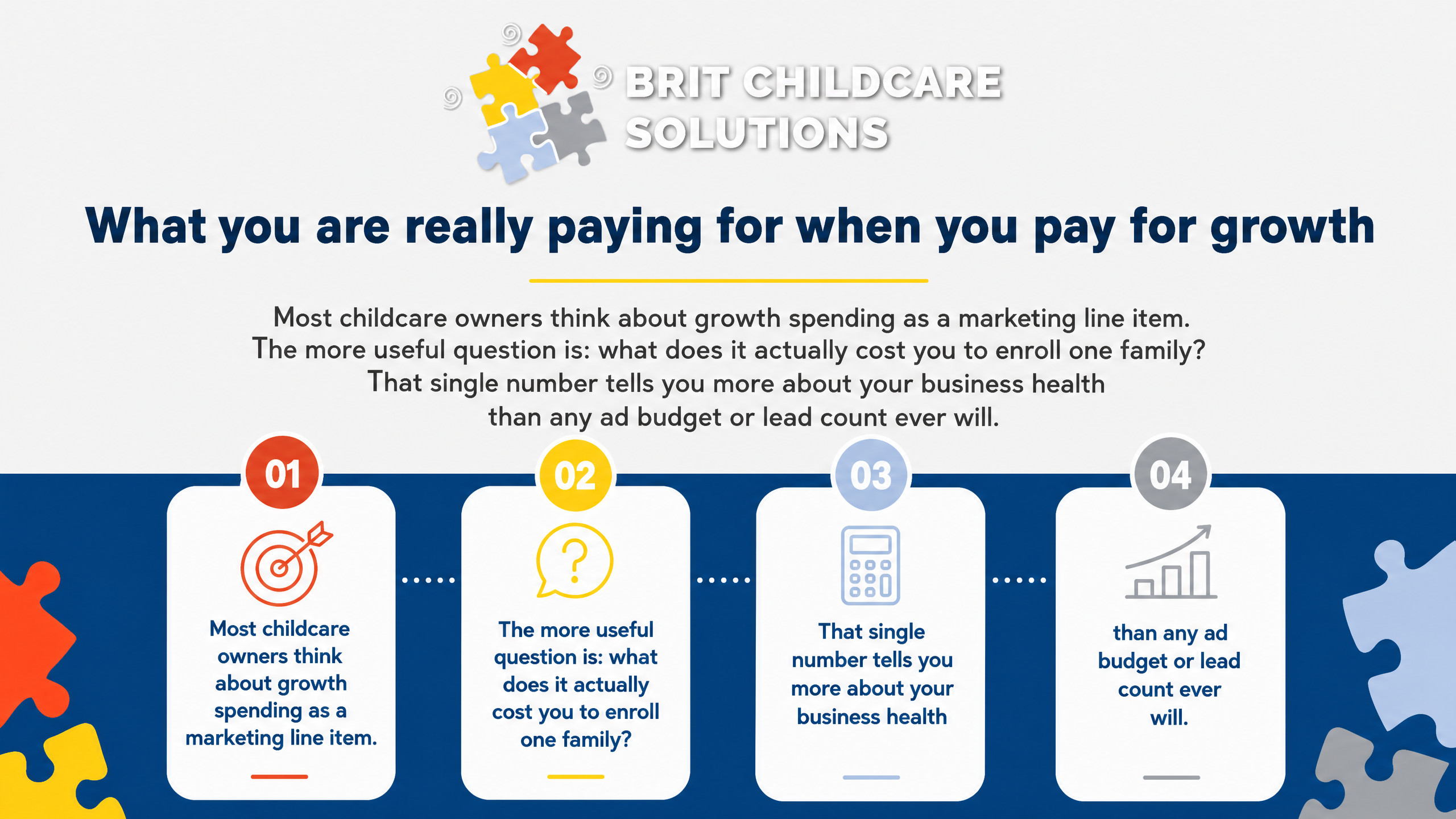
Most childcare owners think about growth spending as a marketing line item. The more useful question is: what does it actually cost you to enroll one family? That single number tells you more about your business health than any ad budget or lead count ever will.
Cost per enrollment formula
Total growth spend includes every dollar tied to bringing families through your door: ads, any outsourced marketing support, staff time spent on follow-up calls, and tour preparation. Divide that total by the number of new enrollments completed in the same period, and you have your cost per enrollment.
Count only enrollments that started within the measurement window, typically 30 or 60 days. Separate new family enrollments from returning families or sibling add-ons. Returning families cost far less to convert, so blending the two numbers hides how much new growth actually costs you.
Total growth spend: ads + outsourced support + staff follow-up time
Divide by new enrollments only, within a defined timeframe
Track new vs. returning separately to see your true acquisition cost
If your cost per new enrollment is climbing but your lead volume is steady, the problem is almost never the ads. It is what happens after the inquiry arrives.
The three rates that decide cost
Three conversion rates control your cost per enrollment more than any ad spend decision. Your inquiry-to-tour rate measures how many families who contact you actually schedule a visit. Your tour show-up rate measures how many of those scheduled tours happen.
Your tour-to-enrollment yield measures how many tours result in a signed agreement.
Small improvements at each stage compound quickly. If you move your inquiry-to-tour rate from 40% to 55%, your show-up rate from 60% to 75%, and your yield from 50% to 60%, you can enroll significantly more families from the same lead volume without spending an additional dollar on advertising.
Most centers we work with discover their biggest leak is in the first rate. Families inquire and then go quiet because follow-up was slow or inconsistent. Fixing that one gap often produces more enrollments than doubling an ad budget.
The hidden costs owners miss
No-shows are not just frustrating. A missed tour represents 30 to 60 minutes of director or staff time that cannot be recovered, plus the opportunity cost of a seat that stayed empty another week.
Staff interruptions compound that cost. When follow-up falls on front desk staff or teachers covering administrative gaps, you pay in burnout and inconsistency. Families who do not hear back within minutes often choose a competitor.
Lead response research confirms that responding within five minutes increases conversion rates dramatically compared to a 30-minute delay.
The largest hidden cost is the empty seat itself. At average childcare tuition rates, one unfilled spot for a single month represents hundreds to thousands of dollars in lost revenue. Multiply that across several open spots and a slow quarter, and the cost of a leaking enrollment funnel far exceeds what most owners spend on marketing.
Run the five-minute enrollment leak check on Google Maps
Before you change a single ad or adjust your budget, document your current baseline. Screenshot your Google Maps position, note your listing completeness score, and record how many calls or tour requests came in last month. Run this same check monthly for each location so you can measure movement, not just activity.
Search like a parent searches
Open Google on your phone and search the way a parent actually would. Start with your center name to confirm your listing appears and controls the map pack. Then search nonbranded terms like 'daycare near me' or 'preschool in [your city]' to see where you rank without name recognition carrying you.
Check your primary category and listed services. If you operate a Montessori program but your category reads 'Child Care Agency,' you are misaligned with how parents filter results. Google uses category data to match listings to search intent, so a mismatch buries you under competitors who got it right.
While you are in the map pack, pull up two or three competitors and compare features side by side: number of reviews, photo count, services listed, and whether they have a booking link. This is not about discouragement. It is about knowing exactly where your listing falls short before assuming you need more ad spend.
Listing completeness that affects calls
Incomplete listings cost you calls directly. Google Business Profile data shows that a complete profile generates more revenue than one with missing information, and over 15% of listings with full profiles receive more than 100 calls per month. Gaps in your listing hand those calls to competitors.
Check these four areas specifically:
Hours and holiday accuracy: Incorrect hours are one of the most common reasons parents call a competitor instead. Verify every location, including holiday closures.
Primary phone and tracking: Confirm the number listed routes to a live person or a tracked line, not a disconnected extension or general voicemail.
Photos that signal trust: Aim for at least ten photos showing classrooms, outdoor play areas, and staff interactions. Listings with strong photo sets consistently outperform sparse ones in click-through.
Review velocity and recency: A center with 40 reviews from three years ago looks stagnant next to a competitor with 20 reviews from the last 90 days.
Recency signals active, trusted operations.
Each of these items is fixable in under an hour, and each one directly affects whether a parent calls you or the center down the street.
One clear tour request path
After a parent finds your listing and clicks through, they need one obvious next step. If your website has three different contact options, a general inquiry form, and a phone number buried in the footer, you are creating friction at the moment a family is ready to act.
Test the mobile click path yourself. Pull up your website on a phone and count the taps it takes to reach a tour request form. More than two taps is too many.
Most parents searching for childcare are doing it from a phone during a lunch break or a commute, and a slow or confusing path ends the inquiry before it starts.
Check your form for unnecessary fields. Name, phone, child's age, and preferred tour date are sufficient. Every additional required field reduces completion rates.
Finally, confirm that any parent who calls rather than fills out a form is offered a tour time before the call ends. A warm call that ends without a scheduled tour is a missed conversion, not a lead.
Speed-to-lead is the fastest cost reducer
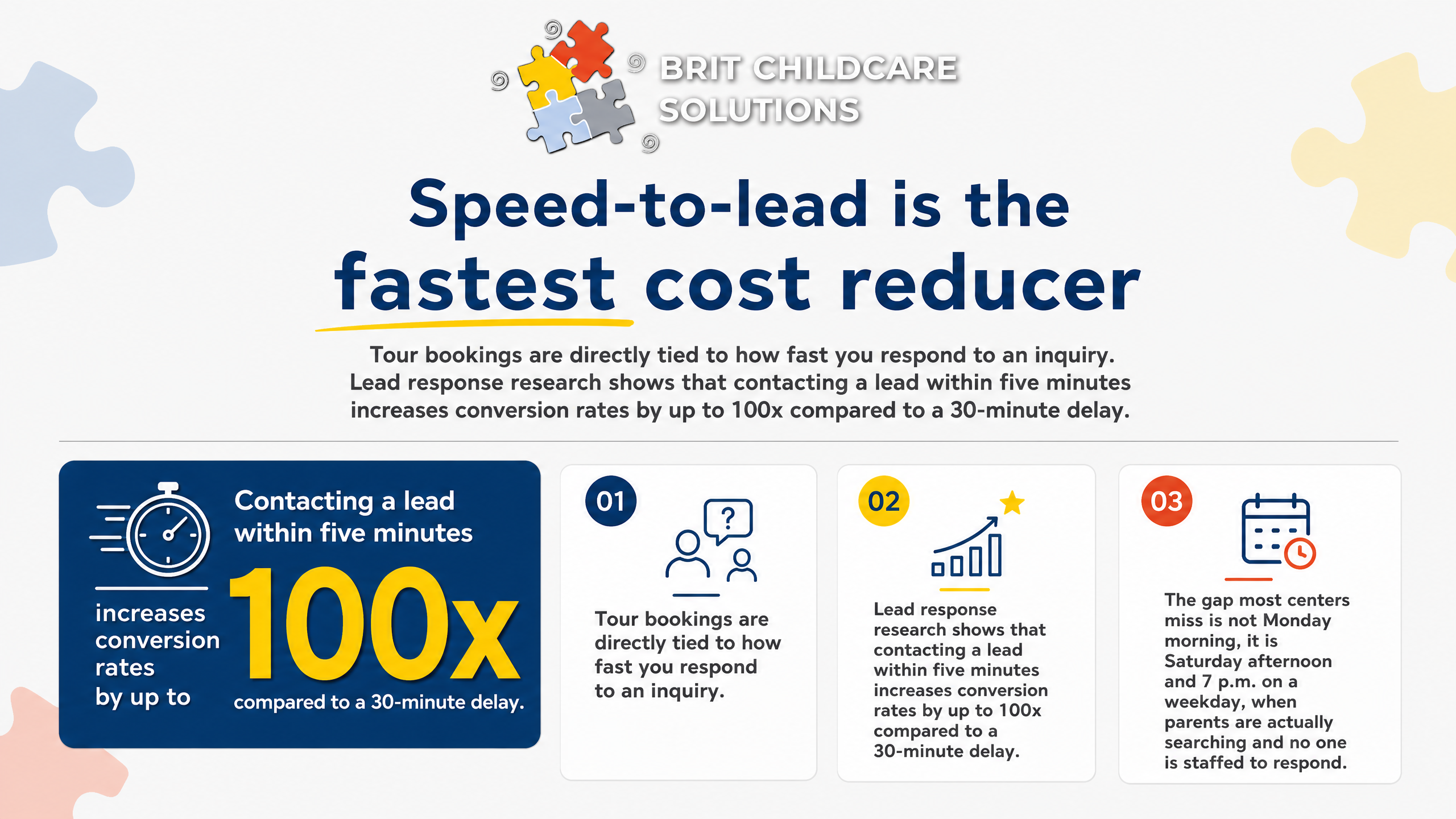
Tour bookings are directly tied to how fast you respond to an inquiry. Lead response research shows that contacting a lead within five minutes increases conversion rates by up to 100x compared to a 30-minute delay. The gap most centers miss is not Monday morning, it is Saturday afternoon and 7 p.m. on a weekday, when parents are actually searching and no one is staffed to respond.
The five-minute contact rule
A perfectly worded email sent two hours later loses to a simple phone call made in four minutes. Speed signals availability and trust to a parent who is comparing three centers at once.
The standard is straightforward: call and text every new inquiry within five minutes during business hours. Both channels matter because some parents will not answer a call from an unknown number but will reply to a text immediately.
After hours, an automated response should fire within seconds of the inquiry arriving. It does not need to be elaborate. It needs to confirm receipt, set a clear expectation for when someone will follow up, and include a link to schedule a tour.
Centers using our Enrollment Engine System have this running automatically so no inquiry sits cold overnight.
Staff handoff expectations must be written, not assumed. Every team member who touches inquiries should know the five-minute window, who covers it when the primary contact is unavailable, and how to log the attempt.
How to run your speed test
Submit a mystery inquiry to your own center using a personal email or a colleague's phone number. Do not tell your staff. Record the exact timestamp of submission and track every touchpoint that follows.
Log each contact attempt with a timestamp: first call, first text, voicemail left, email sent. If no one responds within 30 minutes, you have found your leak. Also note what happens when the call goes unanswered.
Does a voicemail prompt a callback? Does a missed call trigger any automated follow-up at all?
Run this test for each location separately and report results by location manager. What you will often find is that one location responds in six minutes and another takes six hours. That inconsistency is a direct enrollment cost.
Submit inquiry on a Saturday or after 5 p.m. to expose weekend and evening gaps
Timestamp: inquiry submitted, first call, first text, first email
Note missed call handling: voicemail quality, callback time, automated follow-up
Report response time per location manager, not as a center average
This test takes under an hour and typically reveals the single highest-impact fix available without spending a dollar on additional leads.
Follow-up and tour booking workflow that protects show-up rate
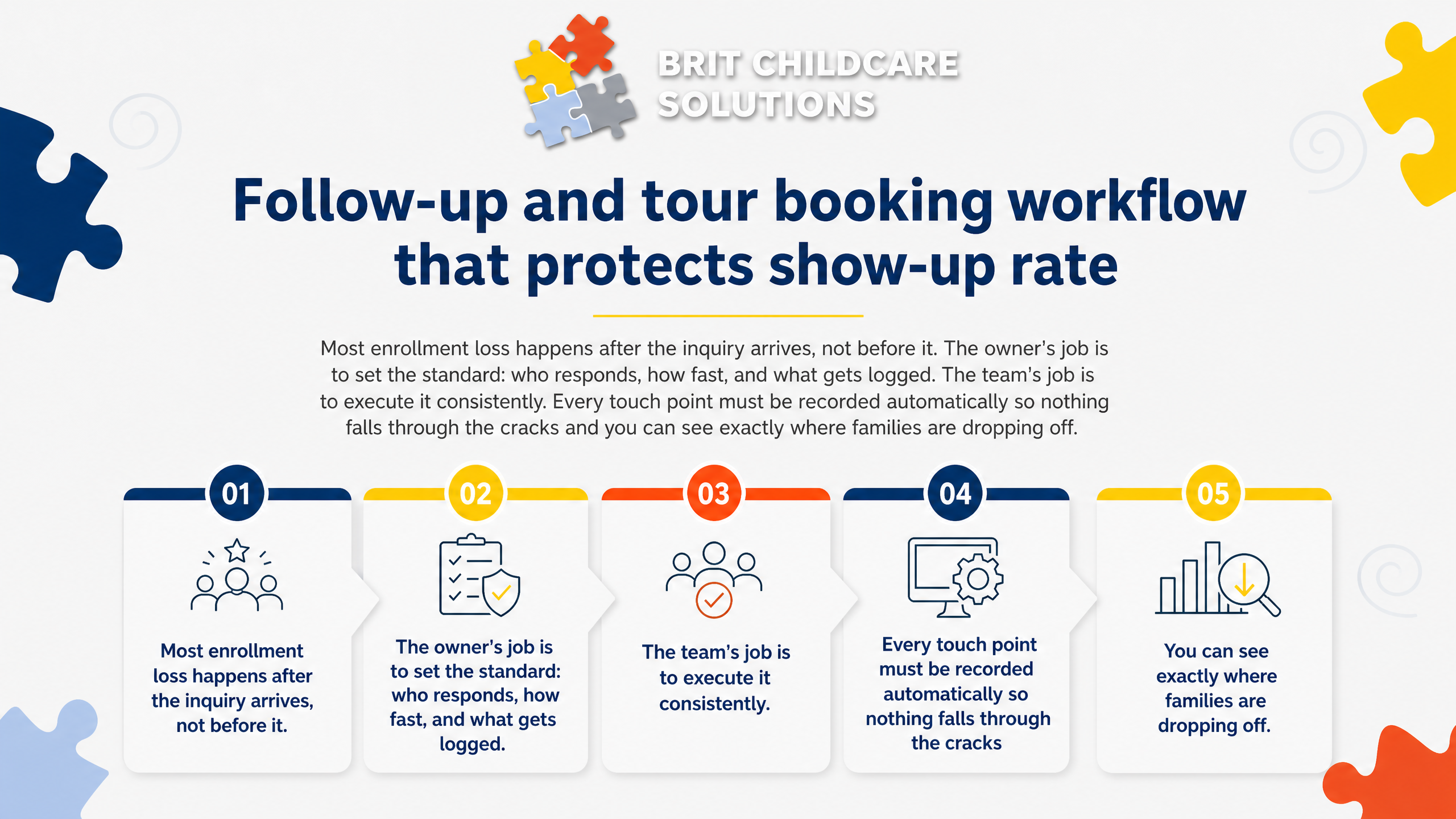
Most enrollment loss happens after the inquiry arrives, not before it. The owner's job is to set the standard: who responds, how fast, and what gets logged. The team's job is to execute it consistently.
Every touch point must be recorded automatically so nothing falls through the cracks and you can see exactly where families are dropping off.
Follow-up cadence that works now
Speed is the single biggest variable in whether an inquiry becomes a tour. Lead response research shows that responding within five minutes increases conversion rates up to 100x compared to a 30-minute delay. That first contact must happen automatically, not when someone at the front desk gets a free moment.
Your first 24 hours should include an immediate automated text or email acknowledging the inquiry, a personal phone call attempt within the hour, and a second text if the call goes unanswered. From there, a seven-day sequence keeps your center top of mind without requiring manual effort each day.
Day 1: Automated text within minutes, phone call within 60 minutes, voicemail plus follow-up text if no answer
Days 2 to 3: Email with tour availability and a short video or photo of your space
Days 4 to 5: Second phone attempt with a value-focused voicemail
Days 6 to 7: Final text with a direct tour booking link
Mix voice and text throughout. Families respond differently, and a sequence that uses both channels consistently outperforms either channel alone. For inquiries that went quiet weeks ago, a reactivation message acknowledging the gap and offering a fresh tour slot recovers families most centers write off as lost.
Tour scheduling that prevents drift
Book the tour the same day the inquiry comes in. Every hour you wait gives the family time to schedule with a competitor. The goal is a confirmed appointment before the conversation ends.
Use a two-slot offer rather than open-ended scheduling. Say: 'We have availability this Thursday at 10 a.m. or Friday at 2 p.m. Which works better for your family?' This removes the back-and-forth that kills momentum and positions the tour as in demand.
Once booked, send an immediate confirmation with the date, time, your address, parking instructions, and who they will meet. No follow-up emails asking for clarification. One message, all the information they need.
No-show prevention essentials
A booked tour is not a guaranteed show. Two reminders close most of the gap between scheduled and actual visits.
Send a 24-hour reminder that confirms the appointment details and builds anticipation. Include a brief note about what to expect during the visit. Two hours before the tour, send a second reminder with directions and a parking tip.
Both should include a one-click reschedule link so families who cannot make it can pick a new time without calling.
When a no-show happens, do not wait. Send a same-day message within the hour acknowledging they missed the visit and offering two new time slots. In our experience, families who no-show are not always disinterested.
Life gets in the way. A prompt, warm outreach recovers a meaningful share of those appointments and keeps your pipeline moving.
Multi-location inquiry routing that stops revenue leakage
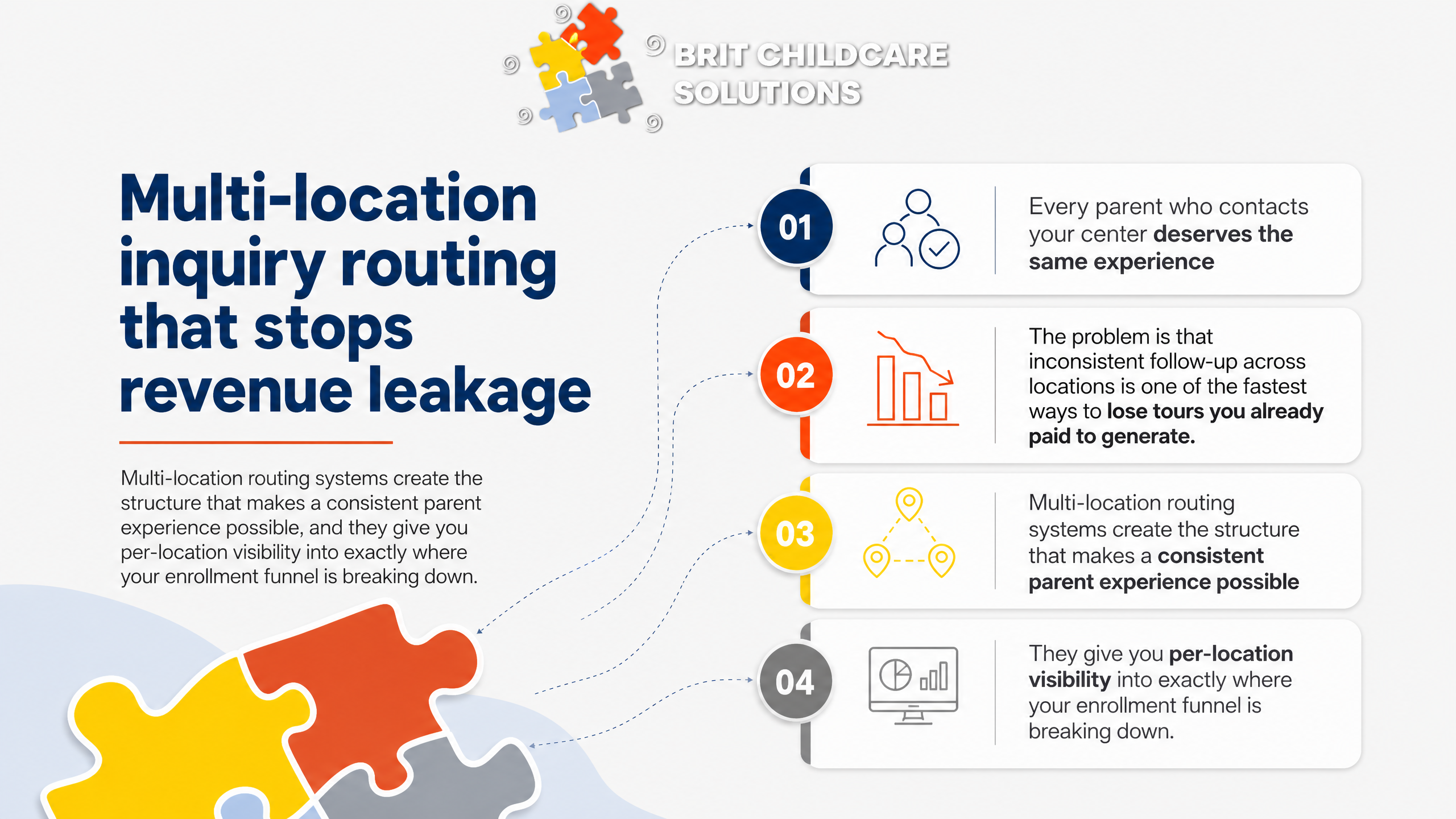
Every parent who contacts your center deserves the same experience, whether they reach your flagship location or your newest one. The problem is that inconsistent follow-up across locations is one of the fastest ways to lose tours you already paid to generate. Multi-location routing systems create the structure that makes a consistent parent experience possible, and they give you per-location visibility into exactly where your enrollment funnel is breaking down.
Routing rules by location
Without deliberate routing logic, inquiries land wherever they happen to land, and that is usually the wrong place. Zip code-based form logic and call tracking by center solve this directly.
When a parent submits a tour request, the zip code field on your form should automatically assign that inquiry to the nearest location. Each center gets its own tracked phone number so you can see call volume, missed calls, and response times by location, not just across the whole organization.
Backup coverage routing matters just as much. If a location manager is unavailable, the inquiry needs a defined next step, whether that is a regional manager, an automated response, or a coverage staff member. Without it, leads sit unanswered.
Single shared inbox: the most common multi-location mistake, creates zero accountability and frequent inquiry mix-ups
Zip code form logic: routes each submission to the correct center automatically
Dedicated call tracking numbers: show call volume and missed calls per location
Backup routing rules: define who handles inquiries when the primary contact is unavailable
Geography is the most reliable routing variable for local businesses, and building it into your intake process removes the manual sorting that causes delays and dropped leads.
Accountability without owner chasing
Accountability at scale requires systems, not reminders. Each location manager should have a clear SLA, specifically, a defined window to respond to new inquiries and a follow-up sequence they are responsible for completing.
Missed-lead alerts notify you or a regional manager when an inquiry goes uncontacted past that window. This removes the need for you to audit manually. A weekly pipeline review across all locations, even a 20-minute check-in using your conversion dashboard, surfaces which centers are converting and which are stalling.
Standardized tour notes complete the loop. When every location records the same post-tour details, including parent concerns, timeline, and next steps, you can identify patterns across centers and coach managers with real data instead of guesswork. Our Done-For-You Marketing Service builds this structure into your enrollment system so location managers stay accountable without the owner becoming the enforcer.
Location manager SLA: defined response window for every new inquiry
Missed-lead alerts: automatic notification when follow-up falls outside the SLA
Weekly pipeline review: per-location conversion data reviewed on a set schedule
Standardized tour notes: consistent post-tour documentation across all centers
Build a monthly scorecard that ties spend to seats filled
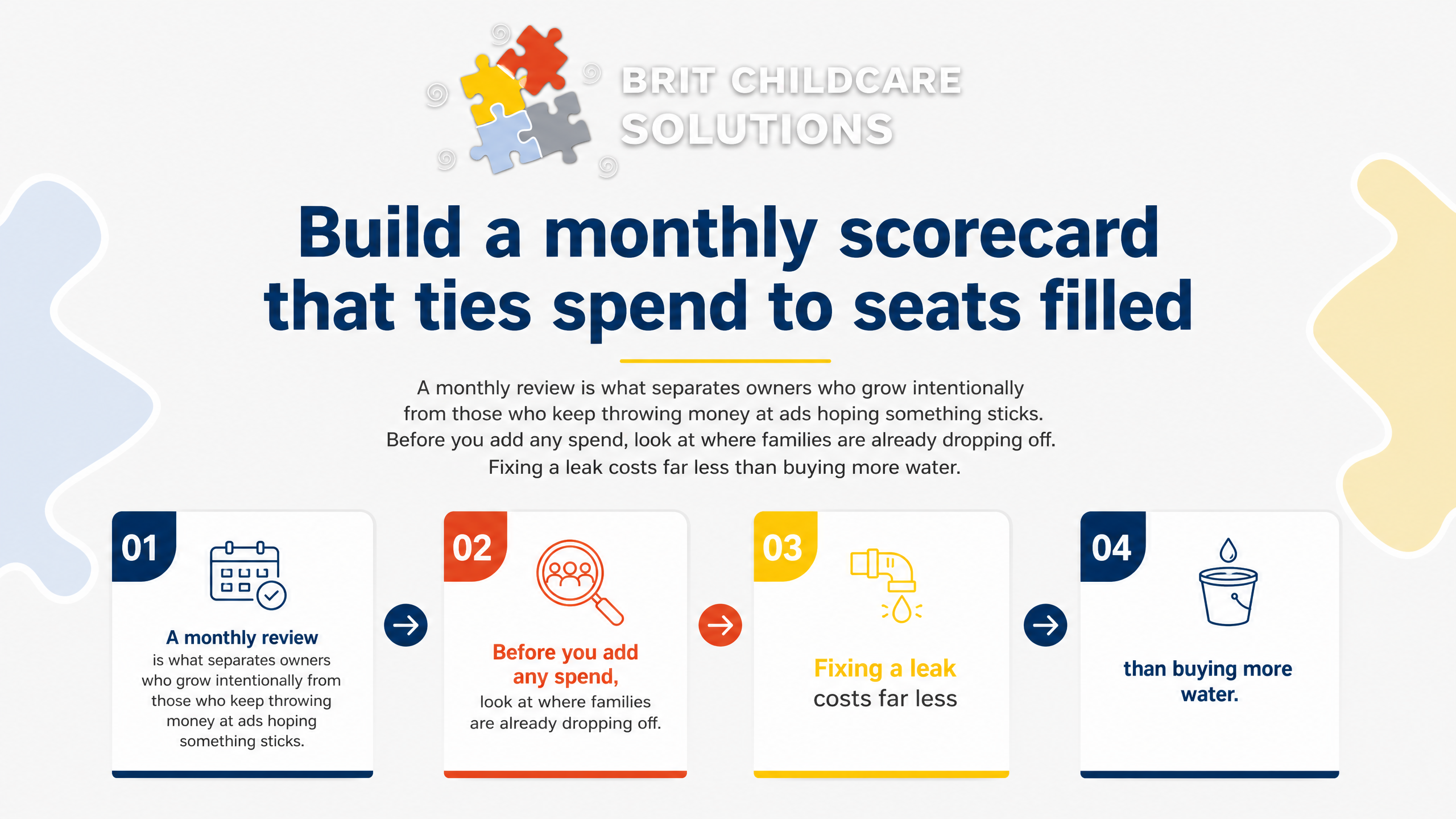
A monthly review is what separates owners who grow intentionally from those who keep throwing money at ads hoping something sticks. Before you add any spend, look at where families are already dropping off. Fixing a leak costs far less than buying more water.
The five metrics to track
Your scorecard does not need to be complicated. Five numbers, reviewed every month, will tell you exactly where your enrollment funnel is healthy and where it is bleeding.
Track these in order, because each one feeds the next:
Inquiries count: total families who reached out, across all channels and locations
Tours scheduled: how many of those inquiries converted to a booked tour
Tour show-ups: how many scheduled tours actually walked through your door
Enrollments: how many show-ups signed an enrollment agreement
Cost per enrollment: total marketing spend divided by enrolled families that month
When you line these five numbers up side by side, the drop-off point becomes obvious. Most centers discover the problem is not inquiries. It is the gap between scheduled tours and families who actually show up.
Benchmarks that prove it works
Knowing your numbers only helps if you know what good looks like. Lead response research confirms that responding to an inquiry within five minutes increases conversion rates dramatically compared to a 30-minute delay. If your front desk is calling back two hours later, you are losing families before the conversation even starts.
On tour conversion, childcare financial benchmarks point to 85 to 95 percent occupancy as the target for profitable programs. Centers that hit that range consistently are not running more ads. They are converting tours at a higher rate.
We have seen this play out directly with clients. One center reached 21 enrollments in a single month after tightening their follow-up and tour reminder sequences. Another achieved a 95 percent tour show-up rate once automated reminders replaced manual front desk calls.
Neither result came from increasing ad spend. Both came from fixing what happened after the inquiry arrived.
Run your scorecard for 30 days. If your tour show-up rate is below 80 percent or your inquiry-to-tour rate is below 50 percent, those are the levers to pull before you consider expanding your budget or opening a second location.
Where spending more fails when the funnel leaks
The fastest path to enrollment growth is a system-first approach: fix conversion before you add volume. BRIT's Enrollment Engine System and Done-For-You Marketing Service are built for exactly this sequence, giving you implementation, not just a plan.
Buying leads without follow-up
Spending more on ads while your follow-up is broken raises your cost per lead without raising your enrollments. The inquiries come in, staff scramble to respond manually, and most families never hear back within the window that matters.
What follows is predictable: missed calls pile up, scheduled tours become no-shows, and the owner concludes the marketing did not work. In most cases, the marketing worked fine. The conversion system did not.
Higher ad spend, same enrollment yield because families drop off in follow-up
Front desk staff overwhelmed by inquiry volume they cannot manage manually
Missed calls and no-shows that could have been prevented with automated reminders
False read on marketing performance when the real gap is response speed and follow-up cadence
Lead response research confirms that responding within five minutes increases conversion rates by up to 100x compared to a 30-minute delay. Most centers are not close to five minutes.
Expanding before conversion is fixed
Opening a second location before your first location converts reliably does not double your revenue. It doubles your problems. Cashflow tightens, hiring accelerates under pressure, and the operational stress that comes with rapid expansion creates real compliance risk.
Licensing requirements do not pause because you are stretched thin. Directors managing two or three locations without a unified system for inquiry routing and follow-up often find empty seats across all of them, not just the new one. Owner bandwidth collapses fast when every location needs attention and no automated process exists to handle the front end.
Centers that partner with us through the Done-For-You Marketing Service stabilize conversion at their existing locations first. That foundation is what makes multi-location growth sustainable rather than stressful.
Stop Guessing at Growth.
Start Tracking What Actually Fills Seats.
If this article gave you one clear takeaway, it's this: your growth cost is not determined by how much you spend on ads. It's determined by what happens after a parent reaches out. Inquiry-to-tour rate, tour show-up rate, and enrollment yield are the three numbers that control your cost per enrolled child, and most centers are not tracking any of them.
That's exactly what we built our Done-For-You Enrollment Engine System and Full Package Marketing Service to fix. We handle the follow-up cadence, the tour booking automation, the no-show reminders, and the unified conversion dashboard so you can see where families drop off and close those gaps fast.
If you're ready to stop guessing, book a BRIT Childcare Done-For-You Enrollment Engine strategy session. Come prepared with your last 30 days of numbers: total inquiries, tours scheduled, actual show-ups, and enrollments closed. On the call, ask us specifically about multi-location inquiry routing and how our unified dashboard tracks conversion across every center you operate.
That's where we do our best work.
