Childcare center advertising that fills tours
Childcare advertising that actually fills tours starts with one shift: stop measuring success by leads and start measuring it by families who show up.
Here is what the most effective childcare advertising strategies have in common:
Google Business Profile is the highest-trust, zero-cost visibility tool most centers underuse.
Geo-targeted ads work when the goal is a booked tour, not a website visit.
Responding to an inquiry within 10 minutes dramatically increases the chance a family schedules a tour.
Automated reminders before a tour date are one of the fastest ways to cut no-show rates.
Boosted social posts and scattered one-off content rarely move enrollment numbers on their own.
At BRIT Childcare, we work exclusively with childcare centers, preschools, and Montessori schools across the U.S. because enrollment funnels in this industry require a childcare-specific approach, not a generalist one. Our Done-For-You Enrollment Marketing Service handles lead capture, automated follow-up, tour booking, and conversion tracking so you can stay focused on your team and the children in your care.
Before diving into channels and tactics, it helps to get clear on the one metric that should drive every advertising decision you make: tour show-ups. That is where we start.
Measure childcare advertising by tour show-ups
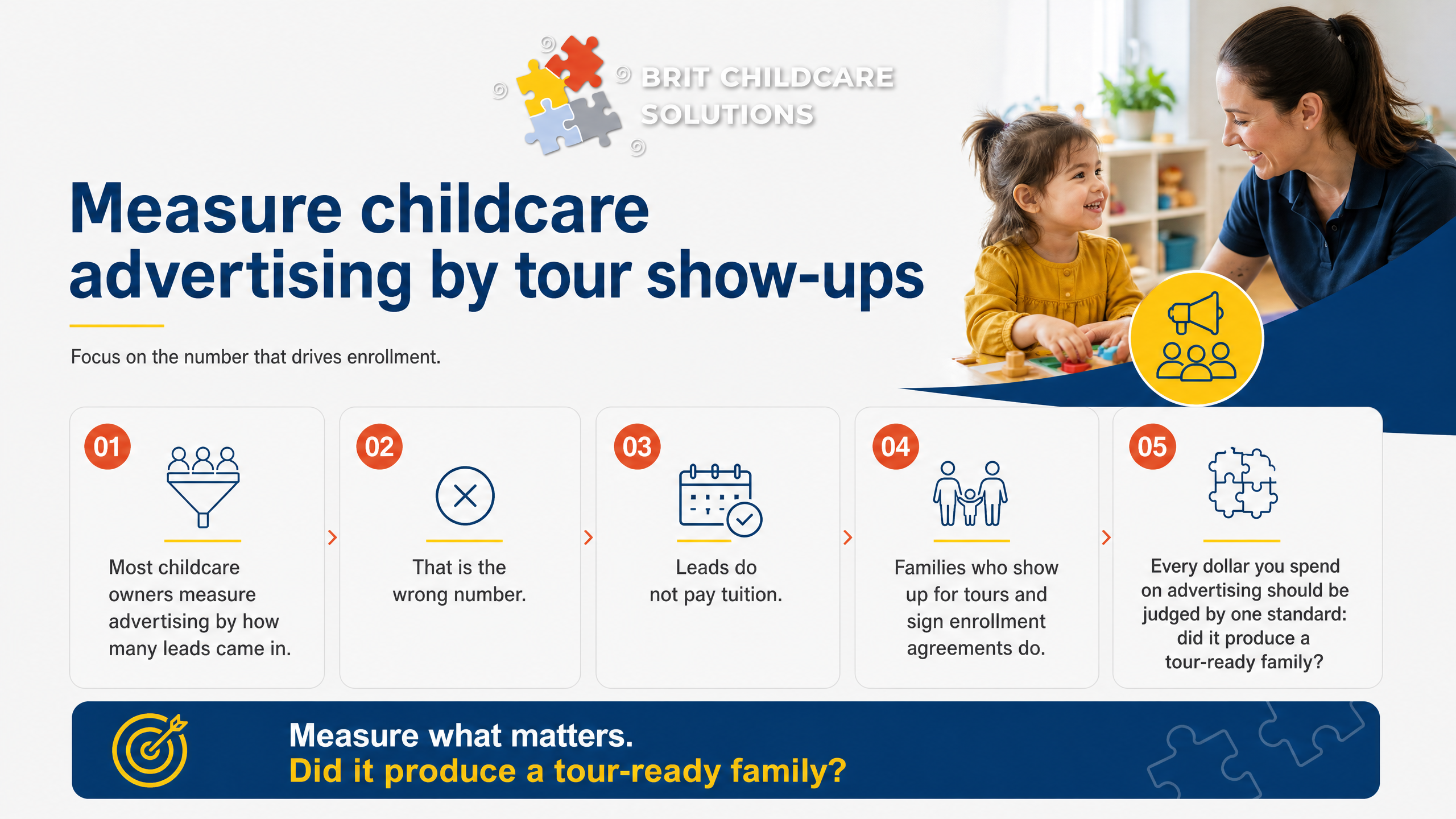
Most childcare owners measure advertising by how many leads came in. That is the wrong number. Leads do not pay tuition.
Families who show up for tours and sign enrollment agreements do. Every dollar you spend on advertising should be judged by one standard: did it produce a tour-ready family?
The only numbers that matter
Your enrollment funnel has four metrics worth tracking. Everything else is noise.
Track these four numbers weekly, not monthly:
Tours booked per week: the raw output of your advertising and follow-up combined
Tour show-up rate: the percentage of booked tours where the family actually arrives
Enrollments per 10 tours: your conversion benchmark once families are in the door
Time-to-enrollment days: how many days pass from first inquiry to signed agreement
In our experience working with centers across the U.S., most owners discover their show-up rate and time-to-enrollment are the real bottlenecks, not lead volume. If you are booking tours but fewer than 70% are showing up, your advertising budget is funding no-shows, not growth.
Where most budgets leak
Childcare advertising budgets do not usually fail at the ad level. They fail in the four steps between inquiry and tour arrival.
Harvard Business Review research on lead response found that waiting just 10 minutes instead of 5 to respond to an inquiry decreases your odds of qualifying that lead by 400%. For childcare centers, a slow response means the family has already called your competitor.
Beyond response speed, three other gaps drain budgets quietly:
No tour confirmation steps: booking a tour without a confirmation sequence leaves families with no reason to follow through
One-touch follow-up: sending a single email or making one call and stopping is the most common reason stale inquiries never convert
Unclear tour scheduling path: if a parent cannot figure out how to book within 60 seconds of contacting you, most will not try again
Fixing these gaps does not require more ad spend. It requires a system that responds fast, confirms consistently, and keeps following up until the family walks through your door.
Win the free visibility parents trust first
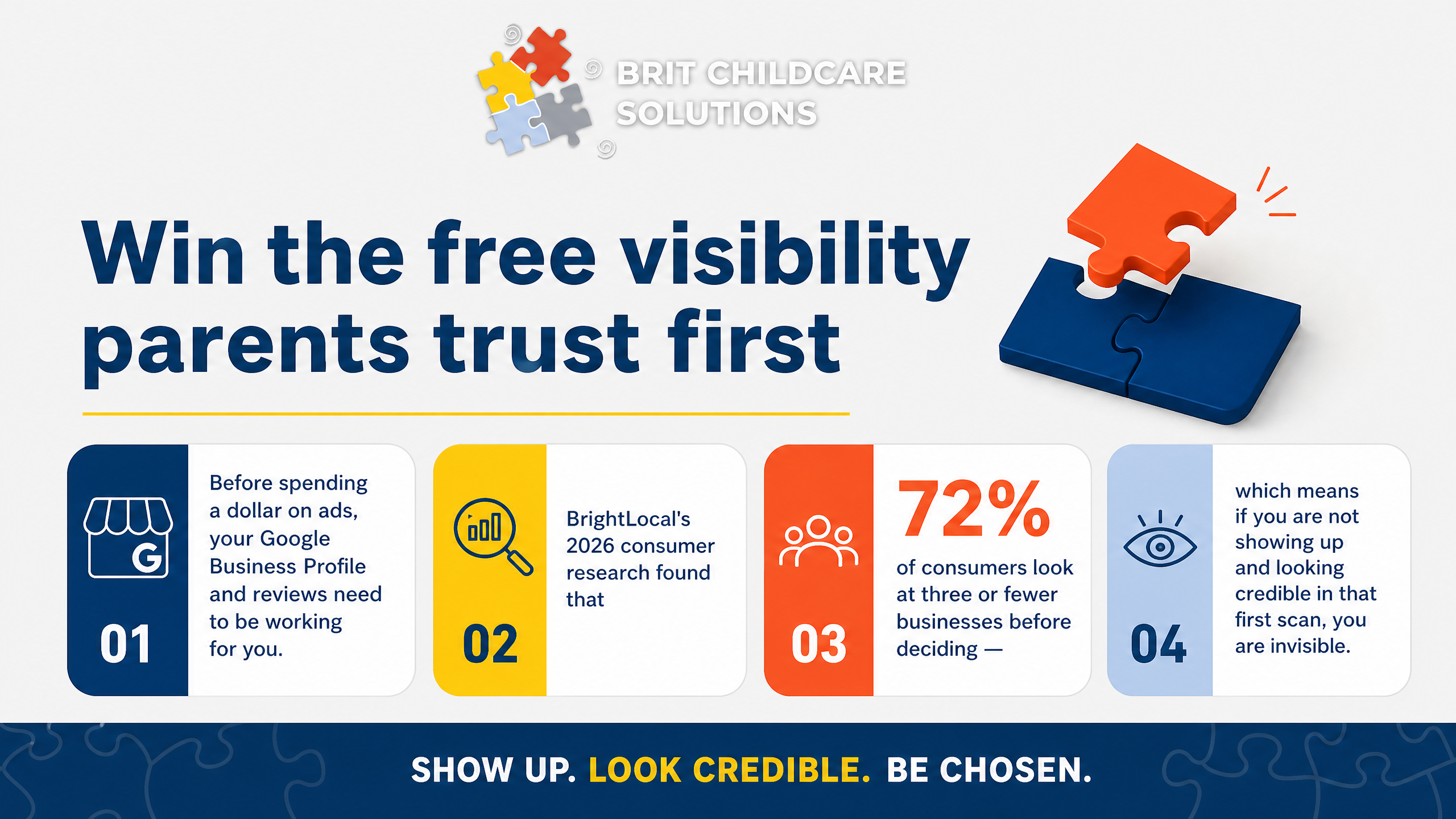
Before spending a dollar on ads, your Google Business Profile and reviews need to be working for you. BrightLocal's 2026 consumer research found that 72% of consumers look at three or fewer businesses before deciding - which means if you are not showing up and looking credible in that first scan, you are invisible.
Google Business Profile setup
Your Google Business Profile is often the first thing a parent sees before they ever visit your website. Getting the category and services right is not optional - select 'Child Care Agency' or 'Day Care Center' as your primary category, then add services like infant care, preschool, and after-school programs so your profile surfaces for the specific searches parents are running.
Your call-to-action should point directly to tour scheduling, not a general contact form. Parents searching for childcare are often deciding within minutes, so removing friction between 'found you' and 'booked a tour' matters.
Photos: lead with bright, welcoming classroom shots and outdoor play areas
parents scan images before reading a single word
Add staff photos to build familiarity and trust before the first visit
Post weekly updates - a new classroom activity, an upcoming event, or a seasonal program - to signal an active, well-run center to both Google and parents
Consistent weekly posts tell Google your profile is current, which improves how often you appear in local map results.
Reviews that drive tour decisions
The best time to ask for a review is within 48 hours of a positive milestone - a successful first week, a parent pickup where they commented on how happy their child seemed, or the moment a family signs their enrollment agreement. Timing the ask when the experience is fresh produces more detailed, specific responses.
Parents writing reviews naturally use phrases like 'safe environment,' 'caring teachers,' 'clean classrooms,' and 'easy to communicate with.' These are the exact words other parents search for and trust. You do not need to coach reviewers - just ask at the right moment and the language follows.
Responding to every review, positive or negative, signals that your center is attentive and accountable. For positive reviews, a brief, warm reply reinforces the relationship. For negative reviews, respond professionally, acknowledge the concern without admitting fault, and invite the family to continue the conversation privately.
Parents reading your responses are evaluating how you handle problems - that is a direct proxy for how you run your center.
Use geo-targeted ads to book tours, not clicks
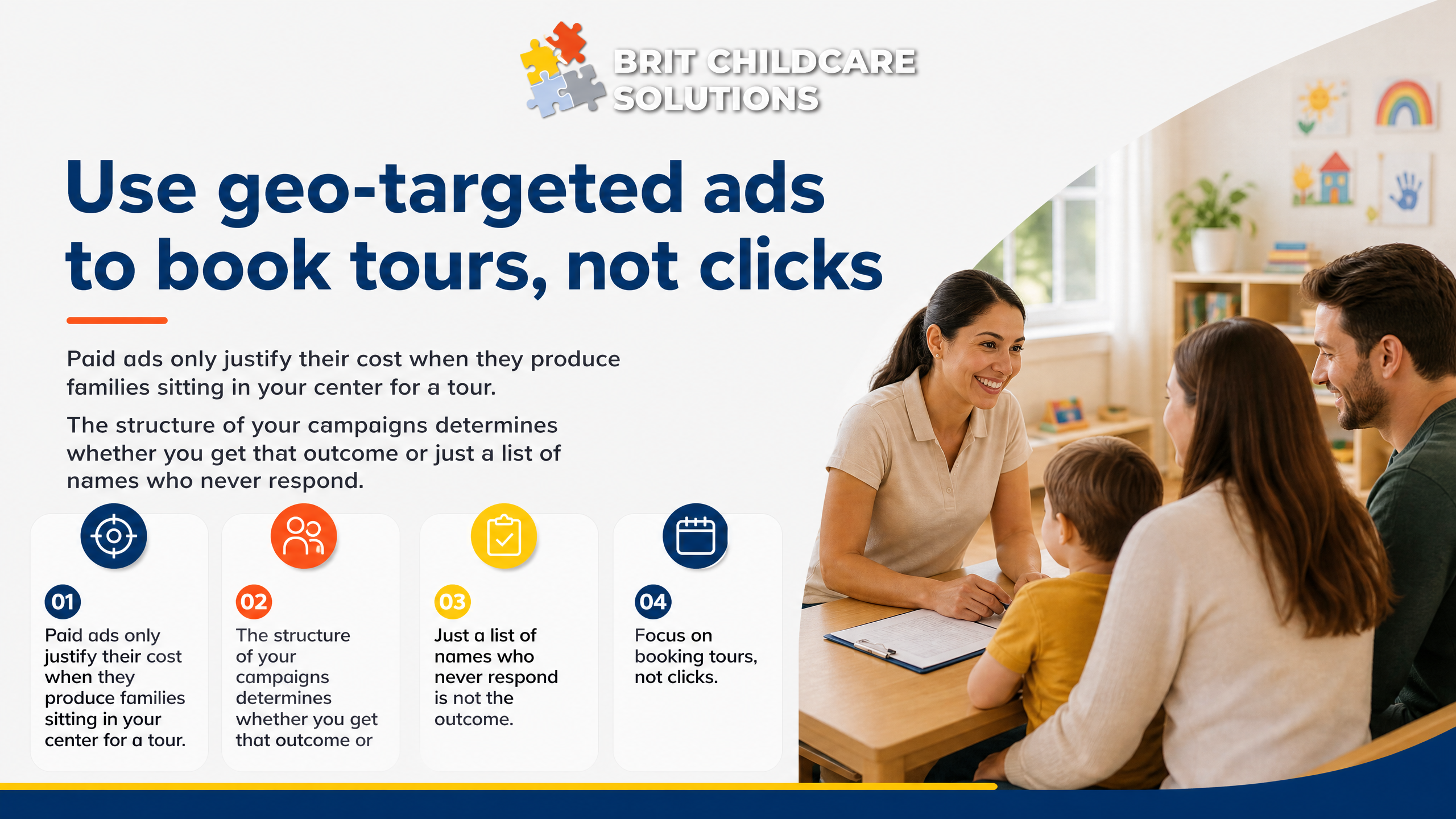
Paid ads only justify their cost when they produce families sitting in your center for a tour. The structure of your campaigns determines whether you get that outcome or just a list of names who never respond.
Google Ads for near-me searches
Parents searching 'daycare near me' or 'preschool in [city]' are ready to act. Capturing them requires tight radius targeting, typically 5 to 10 miles from your center, layered with zip code exclusions that cut out areas where families rarely enroll due to distance or demographics.
Your keyword list should stay narrow and intent-specific. Focus on terms like 'preschool enrollment,' 'daycare open enrollment,' and 'childcare center near me.' Broad match on generic education terms burns budget fast without producing tour requests.
Every ad should send clicks to a single-purpose landing page built around one action: scheduling a tour. No homepage. No program overview.
A clear headline, two or three trust signals such as star rating and years open, and a booking form or calendar link. That is the entire page.
Enable call extensions and location extensions on every campaign. Many parents searching on mobile will call directly from the search result rather than click through. If your number and address are not visible in the ad, you lose those families before they ever reach your site.
Facebook and Instagram tour ads
On social platforms, parents are not searching. Your ad has to stop them mid-scroll. Creative that performs in childcare typically features real children in your space, a specific enrollment message such as 'Spots open for Fall,' and a warm, direct call to action like 'Schedule your tour this week.' Stock photos and generic copy do not produce tour bookings.
Constrain your audience by geography first. Set a radius of 8 to 12 miles around your center, then layer in age targeting for adults 24 to 40. You are not trying to reach everyone.
You are trying to reach parents of young children who live close enough to actually attend.
Lead forms built natively inside Facebook reduce friction and typically outperform website clicks for tour requests, because parents can submit their information without leaving the app. Use them when your goal is volume. Drive to your website when you want parents to see your environment and build intent before they commit to a tour date.
Retargeting is where most centers leave money on the table. Parents who visited your tour page but did not book are warm prospects. A retargeting ad with a specific message, 'Still looking for the right fit?
We have a spot open,' brings them back at a fraction of the cost of a cold audience ad.
Benchmarks to validate spend
Without clear targets, ad spend is guesswork. These benchmarks give you a baseline to evaluate whether your campaigns are working or need adjustment.
Harvard Business Review research on lead response found that waiting more than five minutes to follow up on an inquiry reduces your odds of connecting by 400 percent. That number applies directly to tour bookings. Automated inquiry response within minutes is not a nice-to-have.
It is a conversion requirement.
Tour booked rate: At least 30 to 40 percent of inquiries from paid ads should convert to a scheduled tour. Below 25 percent signals a landing page or follow-up problem, not an ad problem.
Show-up rate: Target 70 percent or higher of scheduled tours actually attended. Centers using automated reminders consistently outperform those relying on manual follow-up.
Lead response time: First contact within 5 minutes of inquiry submission.
Automated response systems make this achievable without adding staff workload.
Cost per tour: Varies by market, but most well-structured childcare campaigns should produce a booked tour for under $75 to $120. If cost per tour climbs above that range, audit your targeting and landing page before increasing budget.
If your cost per tour is in range but your show-up rate is low, the ad is not your problem. The follow-up system is. That distinction matters because it tells you exactly where to fix the funnel instead of cutting spend that is actually working.
Automated follow-up that cuts no-shows and fills rooms
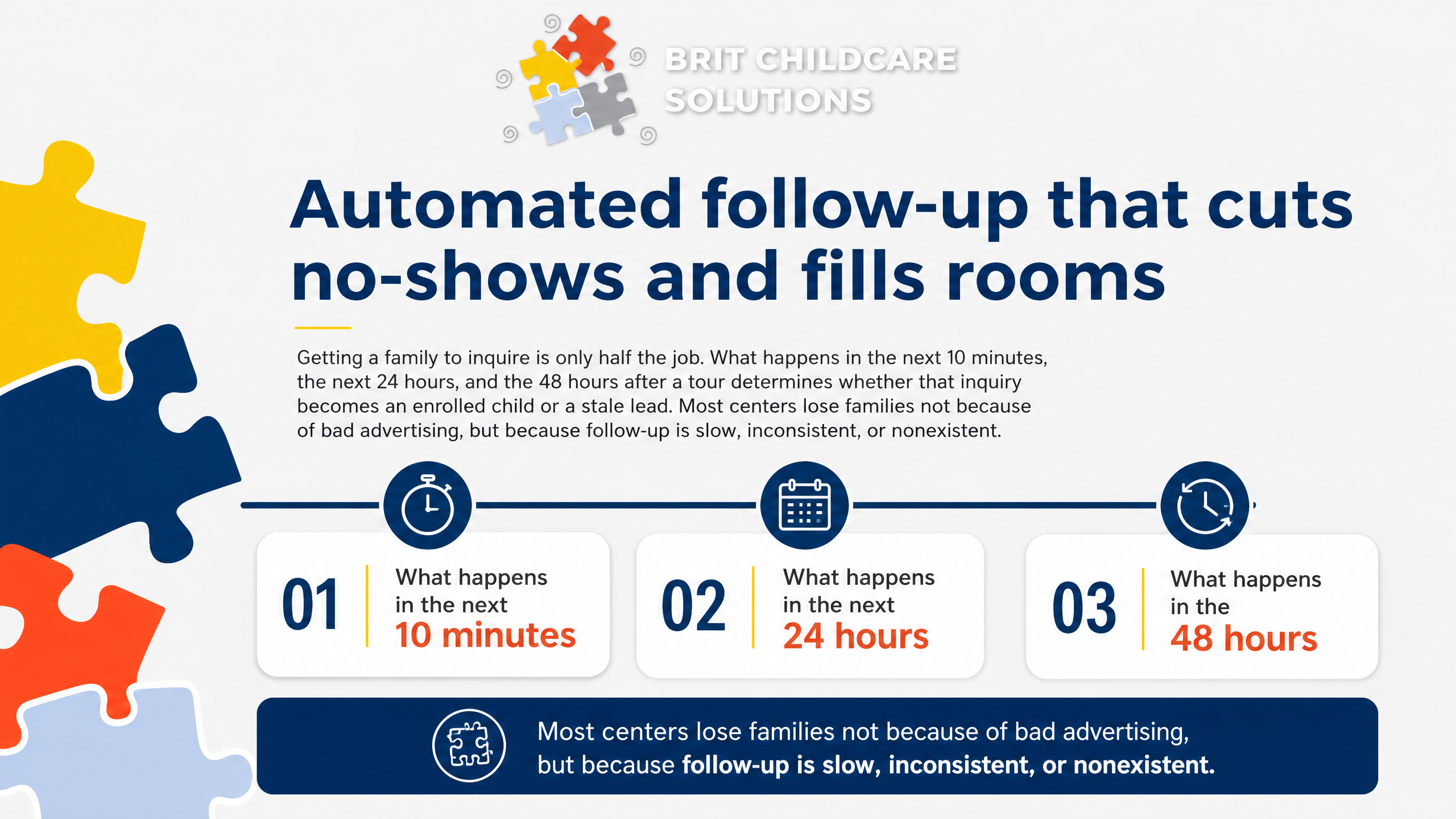
Getting a family to inquire is only half the job. What happens in the next 10 minutes, the next 24 hours, and the 48 hours after a tour determines whether that inquiry becomes an enrolled child or a stale lead. Most centers lose families not because of bad advertising, but because follow-up is slow, inconsistent, or nonexistent.
The first 10 minutes system
Harvard Business Review research on 15,000 leads found that waiting just 5 to 10 minutes to respond decreases your odds of qualifying that lead by 400%. For childcare, where parents are often comparing two or three centers at once, speed is a competitive advantage you cannot afford to ignore.
The moment a family submits an inquiry, an automated text reply should go out immediately. Something direct: 'Hi, this is [Center Name]. We received your inquiry and would love to schedule a tour.
Here is our booking link: [link].' That message does two things at once: it confirms you received their request and gives them a frictionless path to book.
Automation handles the first contact, but a human needs to follow through. Your staff should attempt a call within 10 minutes of the inquiry, then again at the 1-hour mark if there is no response. A simple script works best: introduce the center, reference their inquiry, confirm availability, and offer two specific tour times.
Giving families a choice between two options moves the conversation forward faster than an open-ended 'when works for you?'
Tour confirmation sequence
Booking a tour is not the finish line. A systematic review of appointment reminder studies found that reminders reduced non-attendance by an average of 34% from baseline. For a center running 20 tours a month, that difference is significant.
Once a tour is scheduled, send a confirmation text immediately with the date, time, and address. Follow that with a 24-hour reminder that includes what to expect during the visit. On the day of the tour, send a same-day message that also covers what to bring: ID, any current childcare records, and a list of questions they want answered.
The reschedule path matters just as much as the reminder. Every message should include a one-tap option to reschedule rather than cancel. Families who reschedule are still interested.
Families who cancel with no easy alternative often disappear. Make it easy to stay in your funnel.
Post-tour enrollment nudges
Most families leave a tour without making a decision on the spot. That is normal. What is not normal is letting them go quiet for a week with no follow-up.
The 48 hours after a tour are your highest-conversion window.
Send a follow-up message within 24 hours that addresses the two things families most often stall on: tuition clarity and schedule fit. Lay out your rates, available start dates, and program options clearly. Ambiguity at this stage kills enrollment decisions.
Frame your deposit and enrollment deadline with honest urgency. If spots are limited, say so directly. If a family toured but has not enrolled, a waitlist positioning message works well: 'We have one spot remaining in the age group you toured.
We are holding it for 48 hours before opening it to our waitlist.' This is not pressure. It is accurate information that helps families prioritize.
Send a personal follow-up call 24 to 48 hours post-tour if there is no response to messages
Trigger a second call at the 72-hour mark for families who opened your messages but did not reply
Reactivate stale post-tour leads at the 7-day mark with a brief check-in text
This is where a done-for-you enrollment system like BRIT Childcare's Enrollment Engine earns its keep. Consistent post-tour follow-up across every inquiry, every location, without your front desk managing it manually, is what moves tour attendance into signed enrollment agreements.
What to do this week to get tours moving
You do not need a complete marketing overhaul to start seeing tours booked. These six actions can be completed in a few hours and will immediately improve how families find and respond to your center.
Start with your Google Business Profile. Confirm your primary category is set to 'Child Care Agency' or 'Preschool' and that your call-to-action points to a tour booking page, not just your homepage. Then add a tour booking button directly to your GBP listing using the 'Book' or 'Appointments' feature so families can schedule without calling first.
Next, personally reach out to five families whose children currently attend your center and ask for a Google review. BrightLocal's 2026 consumer research shows 67% of consumers often or always read reviews after a local search, and five new reviews can meaningfully shift how your listing performs against nearby competitors.
Launch one geo-targeted Google campaign set to a 5-mile radius around your center, with the single goal of driving tour bookings. Keep the budget focused and the audience tight rather than broad.
Finally, install a 10-minute auto-response for every new inquiry. Harvard Business Review research found that response time going from 5 to 10 minutes drops lead qualification odds by 400%. Pair that with a 24-hour tour reminder sent automatically to every scheduled family to reduce no-shows before they happen.
What to stop doing if you want enrollments
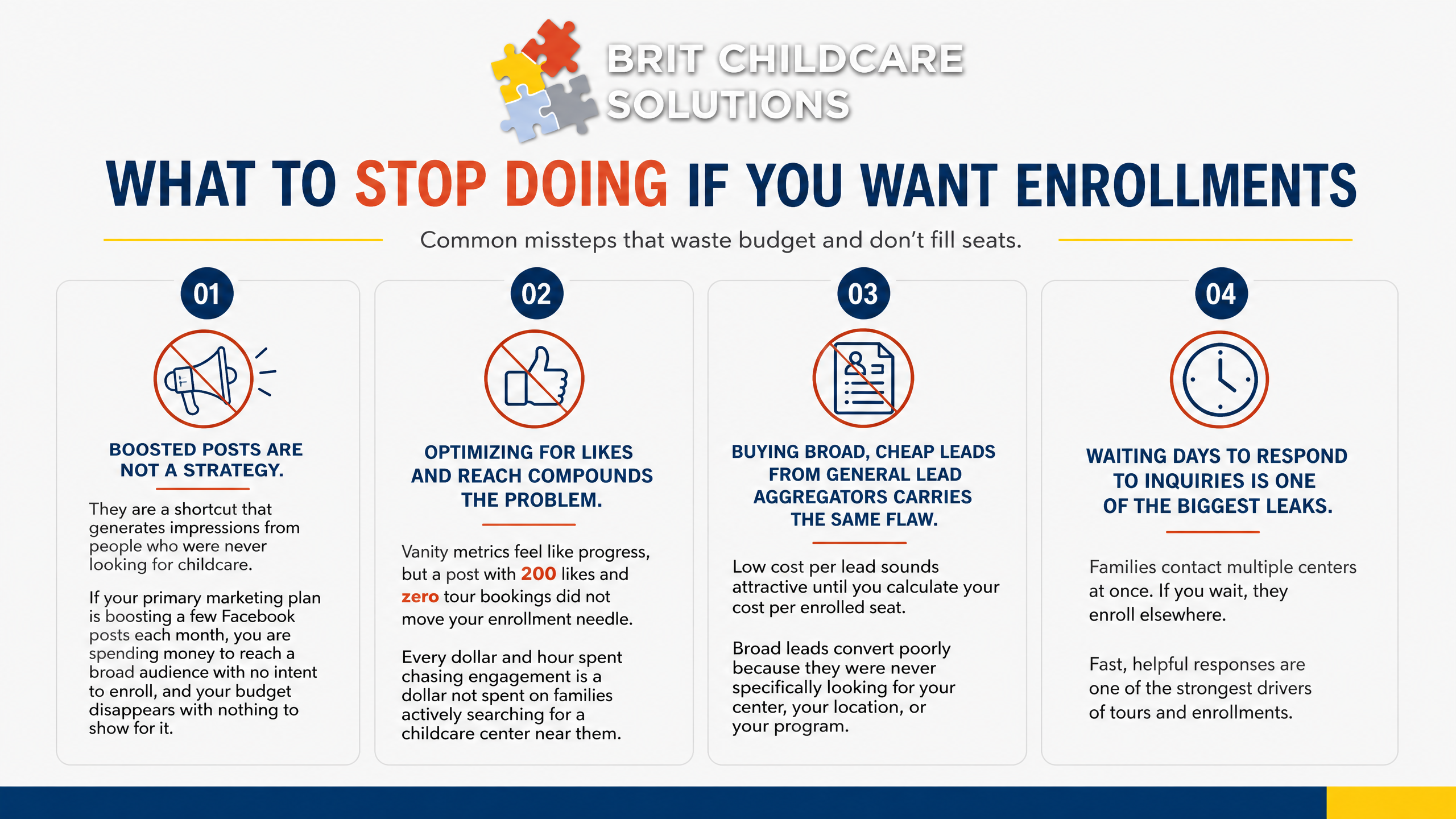
Boosted posts are not a childcare advertising strategy. They are a shortcut that generates impressions from people who were never looking for childcare. If your primary marketing plan is boosting a few Facebook posts each month, you are spending money to reach a broad audience with no intent to enroll, and your budget disappears with nothing to show for it.
Optimizing for likes and reach compounds the problem. Vanity metrics feel like progress, but a post with 200 likes and zero tour bookings did not move your enrollment needle. Every dollar and hour spent chasing engagement is a dollar not spent on families actively searching for a childcare center near them.
Buying broad, cheap leads from general lead aggregators carries the same flaw. Low cost per lead sounds attractive until you calculate your cost per enrolled seat. Broad leads convert poorly because they were never specifically looking for your center, your location, or your program.
Waiting days to respond to inquiries is one of the most costly habits we see. Harvard Business Review research found that response time going from 5 to 10 minutes decreases your odds of qualifying a lead by 400 percent. Families researching childcare contact multiple centers at once.
The first to respond with a tour invitation usually wins.
When you should bring in BRIT Childcare
Not every center is ready for a done-for-you enrollment system, and that is by design. The centers that see the strongest results share a few things in common before we ever run an ad or build an automation.
Fit check for your center
We work best with centers that have real capacity to fill. If your licensed capacity is 50 or more, you have enough open spots to make a full enrollment funnel worth the investment. Below that threshold, a single referral can close the gap, and a done-for-you system is more than you need.
Multi-location operators are a strong fit because consistency is the hardest problem to solve across sites. Routing inquiries by location, maintaining follow-up timing, and tracking tour conversion per center manually is where most operations break down.
Licensed capacity of 50 or more children
Single or multi-location operators with defined enrollment targets
Clear staffing and enrollment goals you can bring to a strategy call
A marketing budget aligned with growth, not just maintenance
If you can walk into a call with your current enrollment number, your licensed capacity, and a staffing goal, we can build a tour-ready family plan around those numbers.
What we install for you
Our done-for-you model means you are not managing campaigns or chasing leads. We build and run the full enrollment funnel so your front desk focuses on welcoming families, not sorting inquiries.
We handle geo-targeted Google and Facebook ads built specifically for childcare searches, paired with childcare SEO and website updates that improve how your center shows up before a family ever clicks an ad. Harvard Business Review research shows that response time alone can reduce your odds of qualifying a lead by 400 percent when it slips past five minutes, which is why our automated follow-up and CRM responds to new inquiries within minutes, not hours.
Every piece of the system ties back to one number: tours booked and families who show up. Our reporting dashboard tracks inquiry volume, tour conversion rate, and show-up rate by location so you always know where families are dropping off and what is working.
Ready to Fill Your Tours?
Let's Build the System That Gets Families Through the Door
If you've read this far, you already know the problem isn't a shortage of parents searching for childcare in your area. The problem is what happens between the first inquiry and the tour. Most centers are losing families in that gap, and no amount of ad spend fixes a broken follow-up system.
That's exactly where we come in. At BRIT Childcare, we install a done-for-you enrollment funnel that handles lead capture, automated follow-up, tour booking, and no-show reduction for you. You stay focused on your team and the children in your care.
We handle the system that fills your rooms.
Book an enrollment growth strategy call with our team. Come prepared with your current enrollment numbers, licensed capacity, and staffing goals. On the call, ask us for a tour-ready family plan that pairs geo-targeted ads with automated follow-up designed to cut no-shows and move families from inquiry to enrolled seat faster.
Visit britchildcare.com/work-with-us to schedule your call.
