Childcare center advertising that wastes budget
Most childcare centers that struggle to fill empty spots are not running out of leads. They are running out of tour show-ups. The advertising approaches that drain your budget fastest are the ones optimized for clicks and impressions instead of families who actually arrive, sit down, and enroll.
Here is what separates childcare advertising that fills seats from advertising that fills spreadsheets:
Tour show-up rate, not lead volume, is the metric that tells you whether your advertising is actually working.
Your Google Business Profile is often the highest-intent free visibility channel available, and most centers have not fully set it up.
Geo-targeted Google Search ads can be structured to book tours directly, not just collect form fills.
Automated follow-up that responds to inquiries within minutes is the step most centers skip, and it is where most families go quiet.
Boosted social posts as a primary strategy consistently produce low-quality leads that rarely convert to enrolled seats.
At BRIT Childcare, we work exclusively with childcare centers, preschools, and Montessori schools across the United States. Our done-for-you enrollment marketing service manages the entire inquiry-to-enrollment pipeline, from lead capture and automated follow-up to tour booking and conversion tracking, so owners can stay focused on their staff and the children in their care.
Before you can fix your advertising, you need to know which number to fix first. That starts with understanding the one metric that actually predicts whether your marketing budget is working or being wasted.
The only childcare advertising metric that matters
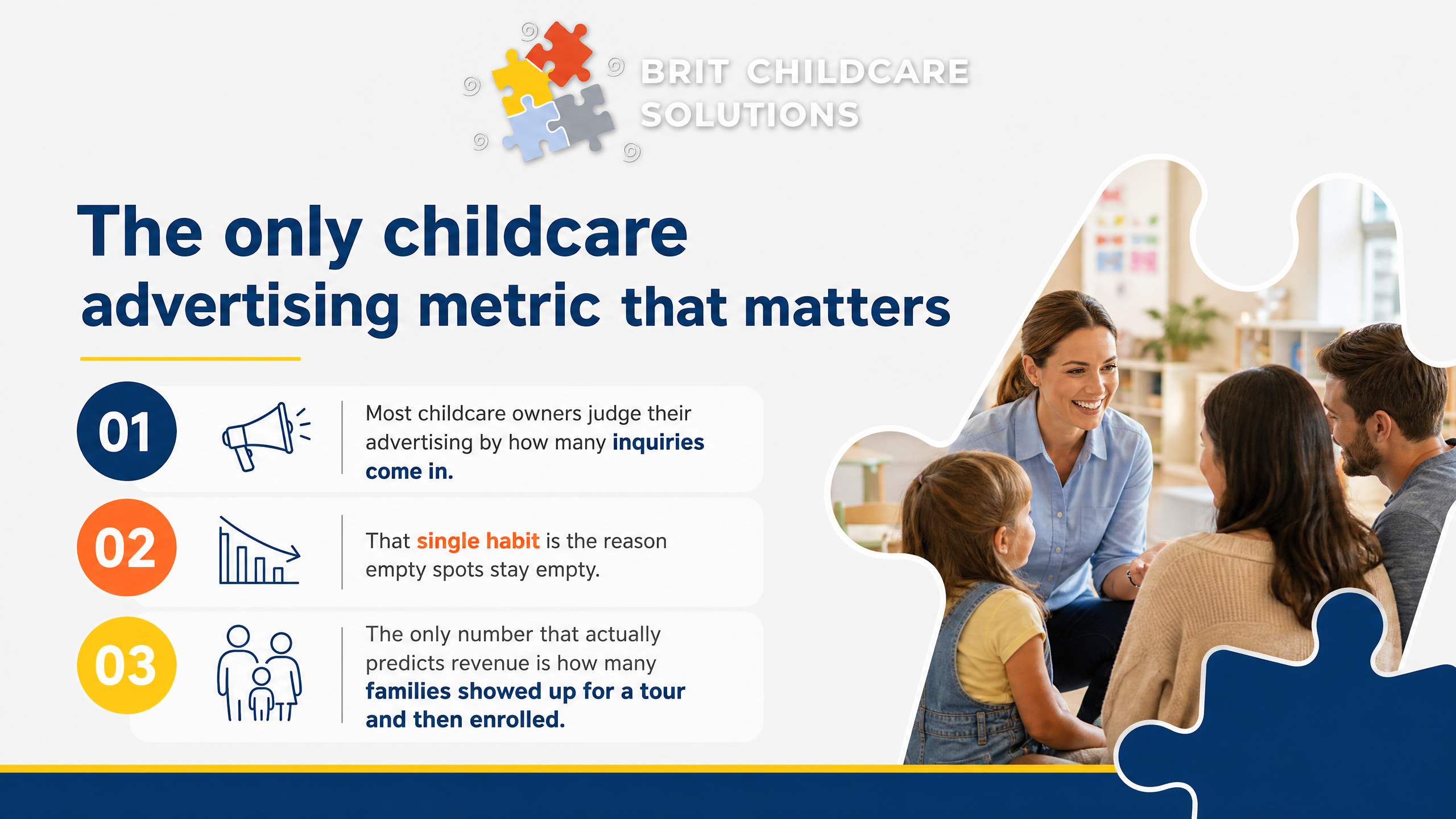
Most childcare owners judge their advertising by how many inquiries come in. That single habit is the reason empty spots stay empty. The only number that actually predicts revenue is how many families showed up for a tour and then enrolled.
Leads versus tour show-ups
Inquiry volume hides weak intent. A parent who fills out a Facebook form at 11pm while scrolling is not the same as a parent who drives to your center on a Tuesday morning. When you measure success by lead count, you are counting both equally, and that distorts every decision you make about your advertising.
The metric that actually matters is your tour show-up rate: the percentage of scheduled tours where the family actually arrives. In our experience working with centers across the country, this number is where most enrollment funnels break down, not at the inquiry stage.
A reasonable benchmark to work toward is enrolling one out of every two families who complete a tour. If your close rate is lower than that, the problem is tour experience or follow-up, not advertising spend. If your show-up rate is below 60%, the problem is follow-up before the tour, which automation can fix.
A simple tour math model
Start with the seats you need to fill this month. That number drives every other decision. If you need 10 enrollments and your close rate is 50%, you need 20 attended tours.
If your show-up rate is 65%, you need to schedule roughly 31 tours to get 20 families through the door.
Now you have a real advertising target: 31 scheduled tours. From there, you can calculate a meaningful ad budget by working backward from your cost per attended tour, not your cost per click or cost per lead. If your ad spend produces scheduled tours at $40 each and your show-up rate is 65%, your cost per attended tour is closer to $62.
That is the number to track and improve.
This model forces clarity. Instead of asking whether your ads are generating enough leads, you ask whether your budget is producing enough attended tours to hit your enrollment goal. Those are very different questions, and only one of them connects to revenue.
Proof you should demand
Any marketing partner worth hiring should be able to tell you exactly what results to expect in concrete terms. For childcare centers with 70 or more licensed spots, a well-run enrollment funnel should produce 10 to 40 scheduled tours per month depending on market size, current enrollment, and ad spend.
Show-up rate improvement is measurable within 30 to 60 days of implementing automated tour reminders and pre-tour follow-up sequences. Automated reminder research shows that clinics using these systems report up to a 38% reduction in no-shows, and childcare centers see comparable results when the same approach is applied to tour confirmation.
Time-to-enrollment is the third proof point to request. A family that inquires today should ideally move from first contact to signed enrollment agreement within two to three weeks when a follow-up system is working correctly. If your current average stretches past 30 days, stale leads are costing you spots that a faster system would have filled.
Scheduled tours per month: 10 to 40 depending on center size and market
Show-up rate target: 60% minimum, with 75%+ achievable through automated reminders
Time-to-enrollment goal: two to three weeks from first inquiry to signed agreement
If a marketing partner cannot show you these numbers from existing clients, they are optimizing for leads, not enrollment.
Free visibility that captures high-intent searches first
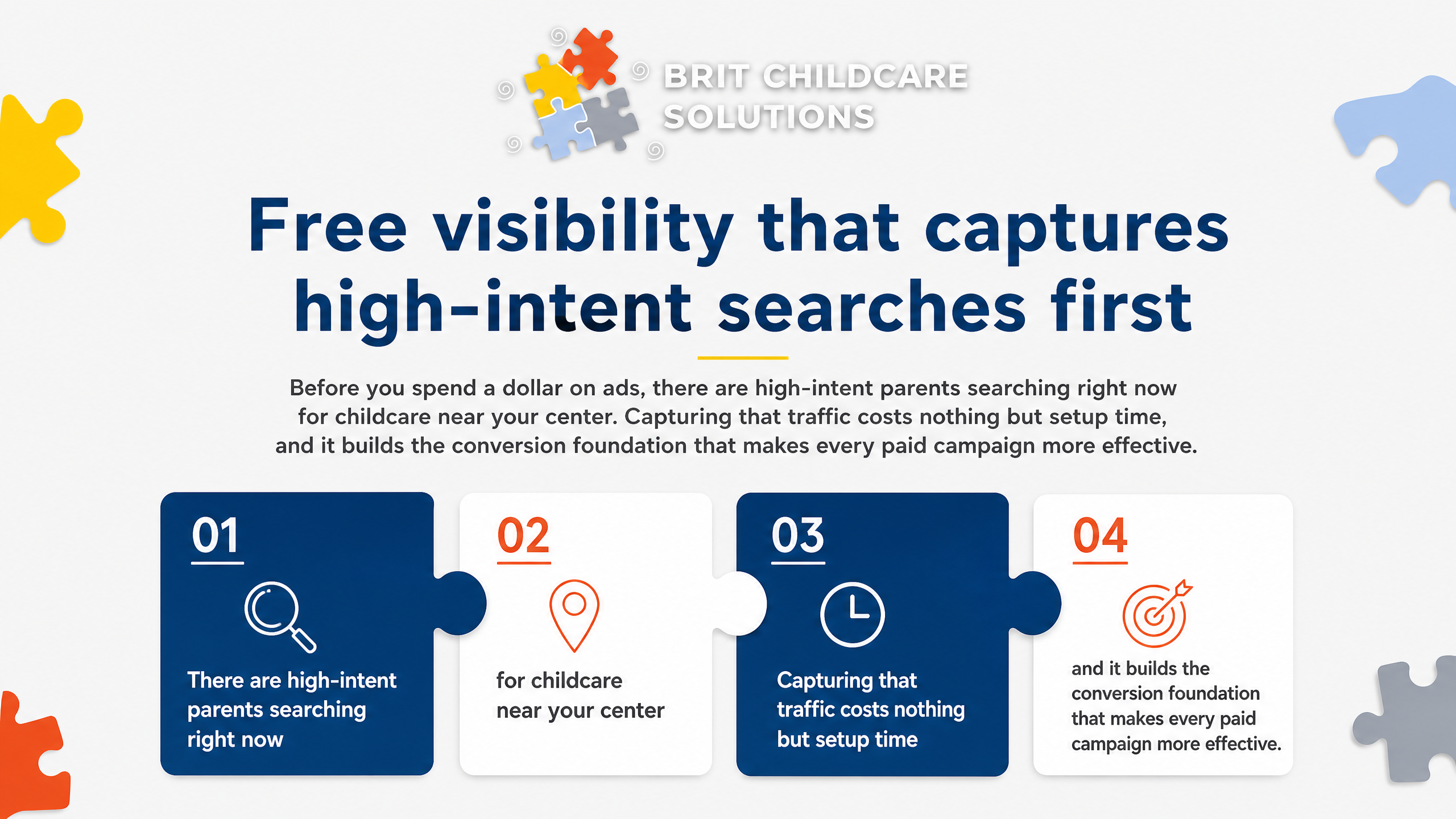
Before you spend a dollar on ads, there are high-intent parents searching right now for childcare near your center. Capturing that traffic costs nothing but setup time, and it builds the conversion foundation that makes every paid campaign more effective.
Google Business Profile setup
Your Google Business Profile is the first thing a parent sees when they search 'daycare near me' or 'preschool in [city].' Getting it right determines whether they call you or your competitor.
Start with your primary category. Choose 'Child Care Agency' or 'Preschool' depending on your program mix. If you serve infants through pre-K, select the category that matches your highest-demand age group, then add secondary categories for the others.
Accuracy here directly affects which searches surface your profile.
Fill in every service and attribute Google offers. List your age ranges, hours, whether you accept subsidies, and any curriculum distinctions like Montessori or STEM. Incomplete profiles rank lower and give parents less reason to click.
Upload 15 to 25 photos covering classrooms, outdoor play areas, meal spaces, and staff interactions
Include at least one photo per age group room so parents can visualize their child's specific environment
Add a virtual tour or short video walkthrough if possible - it pre-sells the tour before a parent ever calls
A fully built profile with strong photos reduces the friction between a search and a scheduled tour.
Review plan that drives calls
According to BrightLocal's local SEO study, businesses in Google's Local Pack earn 126% more traffic than those outside the top three positions, and reviews are a primary ranking signal. Consumer trust research shows 93% of parents read reviews before making a purchase decision, which in childcare means before booking a tour.
The timing of your review request matters more than the ask itself. The strongest triggers are the first week after enrollment, the day after a successful tour, and at the 30-day mark for new families. These are moments of genuine satisfaction, and parents are far more likely to respond.
When you respond to reviews, weave in natural keywords. A response like 'Thank you for trusting us with your toddler's early learning journey at [Center Name] in [City]' reinforces your local relevance without sounding forced.
Aim for 3 to 5 new reviews per month rather than a one-time push
velocity signals active community trust to Google
A center with 40 reviews at 4.8 stars typically outperforms one with 200 reviews at 4.2 stars in local pack rankings
Consistent review velocity builds compounding visibility that no single ad campaign can replicate.
Local pages that match searches
Parents search with specific intent. 'Infant care in [city],' 'Montessori preschool near me,' and 'toddler daycare with openings' are different searches that deserve dedicated pages, not a single generic homepage.
Build separate pages for each age group you serve: infant, toddler, and preschool. Each page should speak directly to that parent's concerns, developmental milestones for that age, and your specific program approach. If you offer a Montessori or play-based curriculum, name it explicitly on those pages using the terms parents actually type.
Tuition and availability are the two questions parents ask before they ever call. Including a tuition range and a clear 'check availability' prompt on each program page removes a barrier that causes parents to move on to the next result.
Use location-specific language on each page: neighborhood names, nearby landmarks, and city references
Add a FAQ section per page addressing common questions like 'Do you have infant openings?' or 'What curriculum do you use?'
Paid ads that book tours instead of collecting clicks
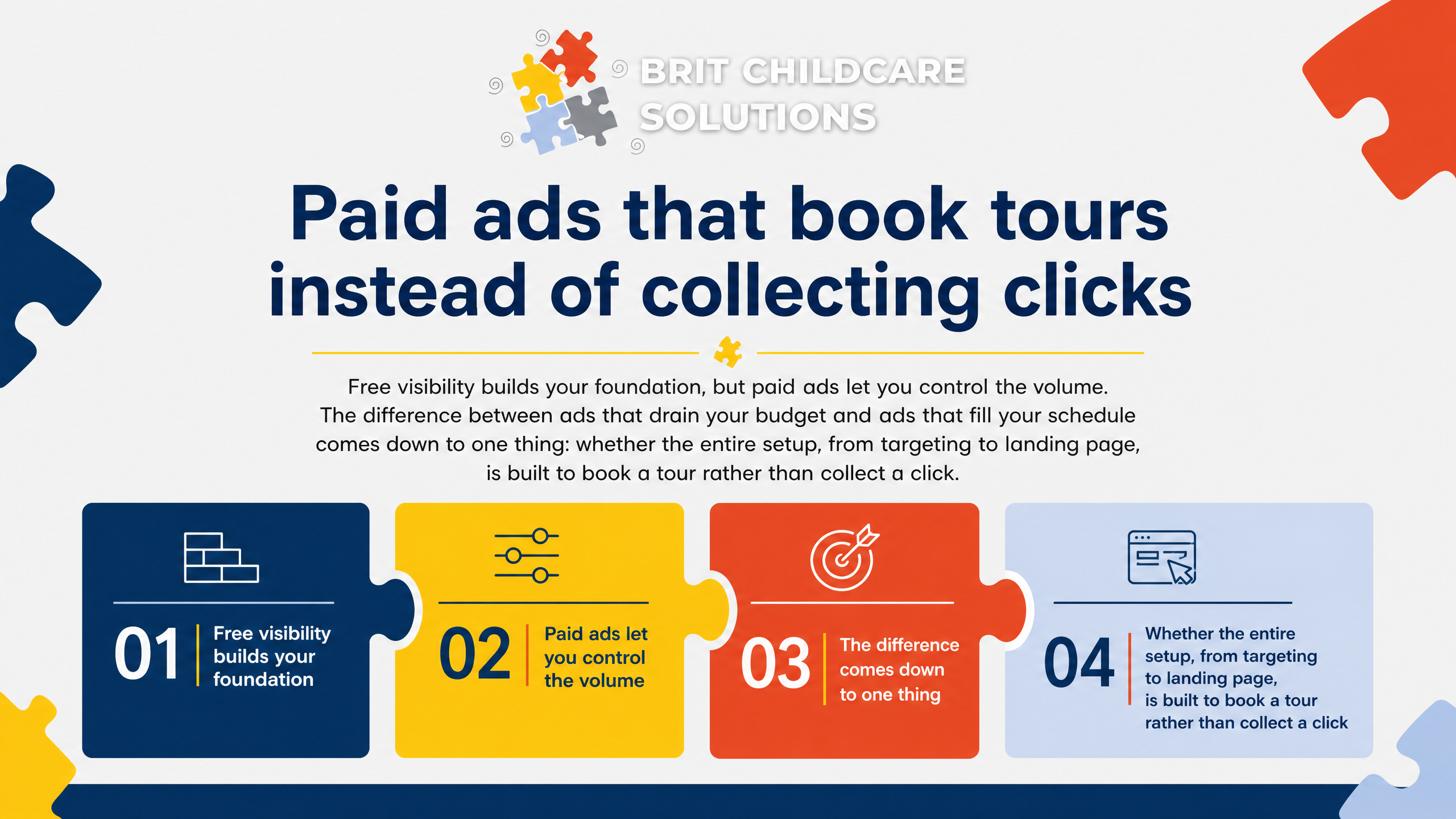
Free visibility builds your foundation, but paid ads let you control the volume. The difference between ads that drain your budget and ads that fill your schedule comes down to one thing: whether the entire setup, from targeting to landing page, is built to book a tour rather than collect a click.
Geo-targeted Google Search ads
Google Search ads work for childcare centers because families search with clear availability intent. Phrases like 'infant care openings near me' or 'preschool with open spots' signal a parent who is ready to act, not just browsing. Targeting those keywords instead of broad terms like 'daycare' keeps your spend focused on families who are close to a decision.
Set your geographic radius based on commute patterns, not just a circle around your center. Most families choose childcare along their morning drive route, so a five to seven mile radius that follows major commuter corridors will outperform a perfectly round radius that ignores how people actually travel.
Always activate call extensions and location extensions. Call extensions let a parent tap to call directly from the search result, which removes a step and captures high-intent families before they click away. Location extensions show your address and distance, which reinforces that you are genuinely local and not a national directory.
Facebook and Instagram tour ads
Social ads give you the ability to pre-qualify parents before they ever contact you. Creative that shows your actual classrooms, staff, and age groups served filters out families who are not a fit and draws in those who are, which improves tour show-up rate because the family already knows what to expect.
The lead form versus landing page decision matters more than most centers realize. Native lead forms on Facebook reduce friction and collect contact information quickly, but they often attract lower-intent inquiries because the parent never visited your site. A dedicated landing page with a clear tour booking form takes more effort to complete, which self-selects for families who are genuinely motivated.
For centers focused on tour quality over tour volume, a landing page typically produces better show-up rates.
Retargeting is where most childcare ad budgets leave money on the table. Families who visited your site or opened your lead form but did not book are your warmest audience. A short retargeting sequence, running three to five days after initial contact, with a direct message like 'Spots are still available, schedule your tour this week' consistently recovers families who were interested but got distracted.
Compliance and ad policy basics
Facebook and Instagram classify childcare advertising under their Special Ad Category for housing, employment, or credit-adjacent services in some cases, but the more relevant concern is their sensitivity around targeting families with children. Detailed demographic targeting based on parental status can be restricted, which means your creative and copy need to do the pre-qualifying work that targeting alone cannot.
Google also limits certain audience targeting for sensitive categories. In practice, this means relying on keyword intent and geographic targeting rather than demographic layering. Both platforms reward advertisers who target by behavior and search intent rather than personal characteristics, which aligns well with a tour-focused strategy anyway.
Your ads must link to a landing page that includes a clear privacy policy and consent language, particularly if you are collecting names, email addresses, or phone numbers. This is not optional. Parents are trusting you with family contact information, and regulators in several states have strengthened data privacy requirements for businesses collecting data from or about minors.
A simple, plainly written privacy statement on your landing page protects your center and builds the trust that gets families to show up.
The missing piece most centers skip: automated follow-up that reduces no-shows
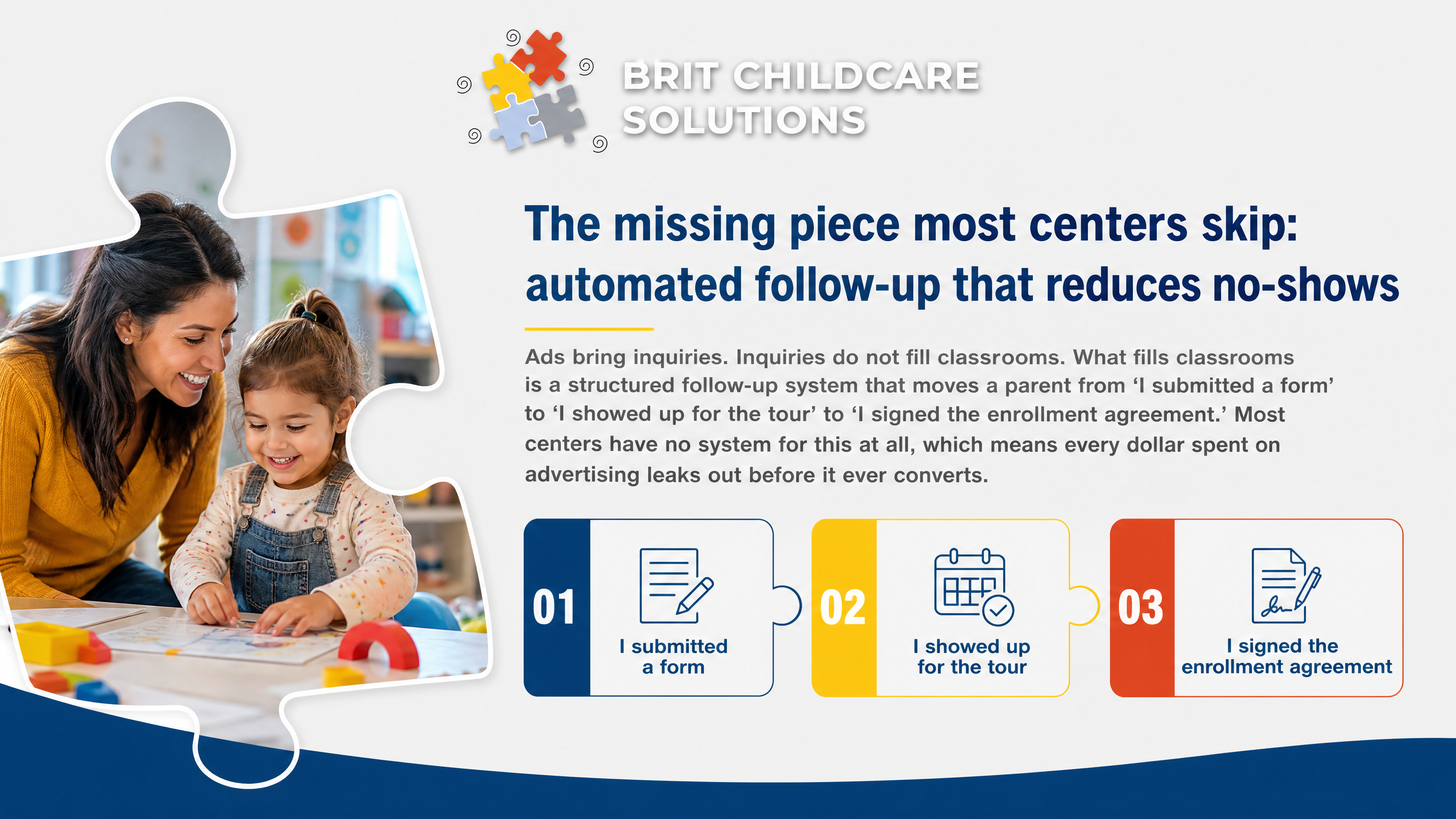
Ads bring inquiries. Inquiries do not fill classrooms. What fills classrooms is a structured follow-up system that moves a parent from 'I submitted a form' to 'I showed up for the tour' to 'I signed the enrollment agreement.' Most centers have no system for this at all, which means every dollar spent on advertising leaks out before it ever converts.
Speed-to-lead standards
The first five minutes after an inquiry arrives are the most valuable window you have. Harvard Business Review research found that responding within five minutes makes teams 21 times more effective at qualifying leads than those who wait just 30 minutes. For childcare, that window matters even more because parents are often comparing two or three centers at once.
Text messaging is the right first move. Most parents submit a form from their phone, and a text reply lands immediately, feels personal, and gets read. An email might sit unopened for hours.
After-hours inquiries are where most centers lose ground. A parent searching at 9 p.m. needs an automated response that acknowledges their inquiry, sets expectations, and offers a tour booking link. Without that, they move on by morning.
Tour confirmation sequence
Booking a tour is not the finish line. The gap between scheduling and showing up is where families quietly disappear. A confirmation sequence closes that gap with minimal staff effort.
Once a tour is booked, the sequence should deliver:
A calendar link with the tour date, time, and your center address sent immediately after booking
A reminder text 48 hours before the tour
A 'what to bring' text the morning of the tour, covering ID, questions to ask, and what to expect during the visit
A one-click reschedule link included in every reminder so families who cannot make it can move the date instead of simply not showing up
Automated reminder research shows clinics using text-based reminders reduce no-shows by as much as 38%. The same principle applies directly to childcare tour attendance, and the reschedule link is what keeps a warm lead in your pipeline instead of losing it entirely.
Post-tour close sequence
Most centers go quiet after the tour ends. That silence costs enrollments. A same-day recap message, sent within two hours of the visit, keeps your center top of mind while the family is still in decision mode.
It should thank them for visiting, recap one or two things specific to their child's age group, and include a clear next step.
If a family is not ready to enroll immediately, the next step is a waitlist or a soft deadline. Something like 'We hold spots for 48 hours after a tour' creates urgency without pressure. Families who toured but have not committed respond well to a follow-up that outlines exactly what enrollment looks like:
Families who toured but have not committed respond well to a follow-up that outlines exactly what enrollment looks like:
How to secure their child's spot with a deposit
What paperwork is needed and how long it takes
The enrollment deadline tied to their preferred start date
Our Tour Booking and Reminder System handles this entire sequence automatically, so your front desk is not chasing families manually while also managing drop-offs, pickups, and everything else that comes with running a center.
What to do this week to stop budget waste
You do not need a new ad campaign this week. You need four operational fixes that reveal exactly where your enrollment funnel is breaking right now, and most of them cost nothing.
Start with your Google Business Profile. Confirm your primary category is set to 'Child Care Agency' or 'Preschool' rather than a generic education label, and verify your hours match your actual availability. BrightLocal's local SEO study found that 75% of Google Business Profile views come from Search rather than Maps, meaning an outdated profile is quietly costing you visibility every day.
Next, add a 'Schedule a Tour' button directly to your GBP and connect it to a tracked landing page so you can see which clicks become actual bookings. Without tracking, you are guessing.
This week, send a simple SMS to the last 20 families who enrolled asking for a Google review. Consumer trust research shows 53% of parents trust online reviews as much as a personal recommendation, and a handful of new reviews can shift your ranking within days.
Finally, set up a five-minute inquiry response automation. Harvard Business Review research confirms that responding within five minutes makes teams 21 times more effective at qualifying leads than waiting 30 minutes. A missed inquiry at 7 PM is a tour that never gets booked.
What to stop doing if you want enrollments
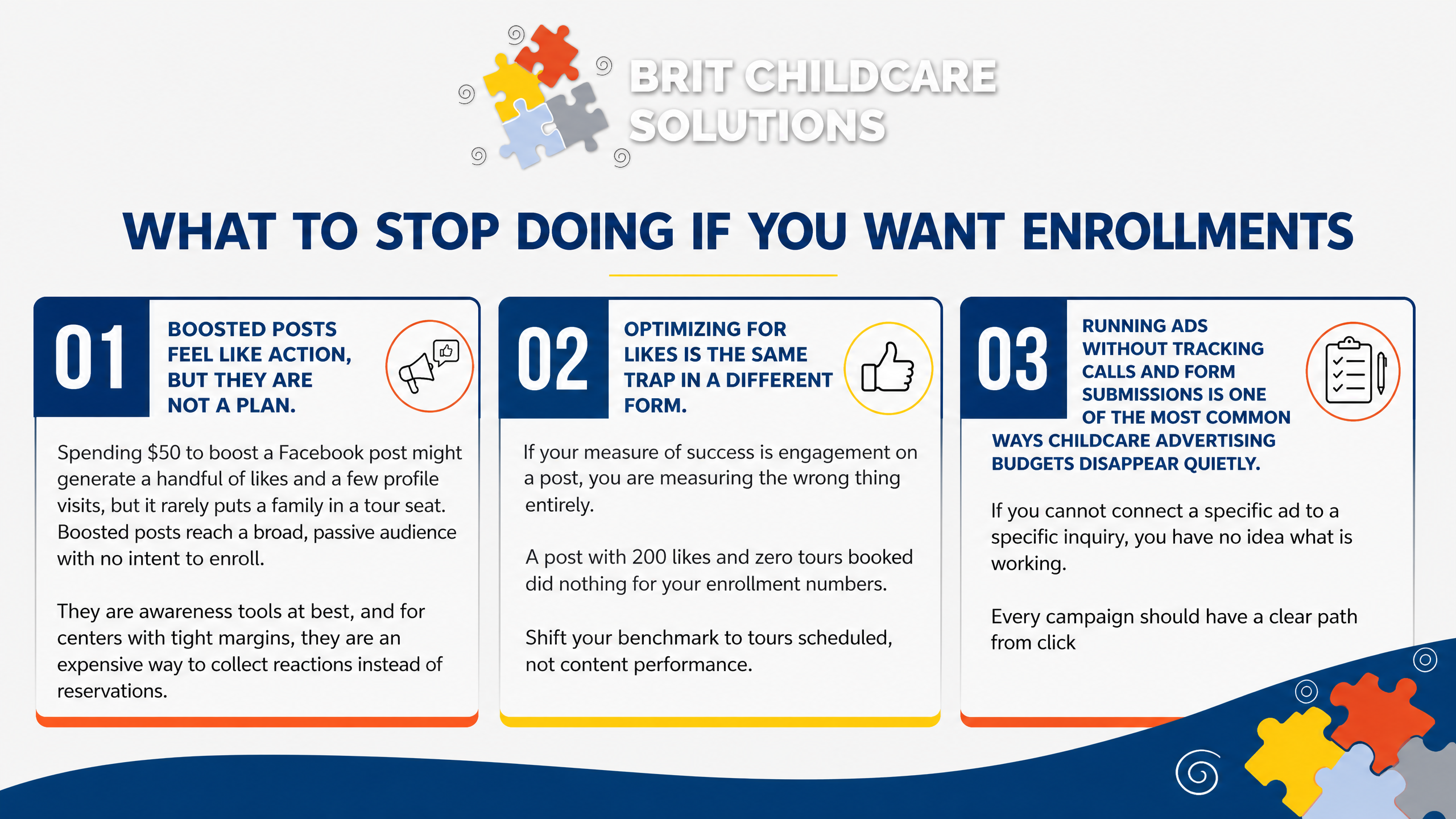
Boosted posts feel like action, but they are not a plan. Spending $50 to boost a Facebook post might generate a handful of likes and a few profile visits, but it rarely puts a family in a tour seat. Boosted posts reach a broad, passive audience with no intent to enroll.
They are awareness tools at best, and for centers with tight margins, they are an expensive way to collect reactions instead of reservations.
Optimizing for likes is the same trap in a different form. If your measure of success is engagement on a post, you are measuring the wrong thing entirely. A post with 200 likes and zero tours booked did nothing for your enrollment numbers.
Shift your benchmark to tours scheduled, not content performance.
Running ads without tracking calls and form submissions is one of the most common ways childcare advertising budgets disappear quietly. If you cannot connect a specific ad to a specific inquiry, you have no idea what is working. Every campaign should have a clear path from click to contact, and every contact should be logged.
One-off follow-up from memory is where most centers lose families who were genuinely interested. A staff member sends one email or makes one call, gets no response, and moves on. In our experience, most families need multiple touchpoints before they commit to a tour.
Manual follow-up from memory is inconsistent by nature. An automated follow-up sequence removes that inconsistency and keeps your center top of mind until the family is ready to visit.
When done-for-you becomes the fastest path
At some point, patching individual tactics stops being a strategy. If you are spending time managing ads, chasing stale inquiries, and still watching tour no-shows pile up, the bottleneck is not effort. It is the absence of a connected system.
Signals you are past DIY
Three situations consistently mark the point where DIY marketing costs more than it saves.
First, capacity. Centers at 70 or more licensed spots, or operators running multiple locations, have too much revenue at stake to rely on inconsistent outreach. A single month of low enrollment at that scale is a significant financial hit.
Second, owner time. If you are already stretched across staffing, licensing, and daily operations, marketing is not getting your best attention. It is getting whatever is left over at the end of the week, and that shows in your tour volume.
Third, tour targets. If you need a predictable number of scheduled tours each month to hit enrollment goals, you need a system that produces them consistently, not a campaign you revisit when things slow down.
What BRIT Childcare runs for you
Our done-for-you enrollment marketing service takes the full funnel off your plate, not just one piece of it.
On the demand side, we manage geo-targeted Google and Facebook ads built specifically to drive tour bookings, not just clicks. We also handle SEO and website conversion improvements so that families searching locally find you and take action when they land on your site.
On the follow-up side, we build and run CRM automations that respond to new inquiries within minutes, send tour reminders to cut no-shows, and reactivate stale leads that went quiet before scheduling. Every location gets its own enrollment tracking dashboard so you can see exactly where families are dropping out of your funnel.
What our clients gain is not just more leads. It is more families who actually show up.
How to prep for the call
The strategy call works best when you come in with real numbers. Spend five minutes pulling these three things together before we connect.
You do not need polished reports. Rough estimates are fine. The goal is to identify where your funnel is leaking so we can show you exactly where to focus first.
Current enrollment and licensed capacity: how many spots are filled versus available right now
Staffing goals and open positions: whether hiring is a constraint on growth or enrollment is the primary gap
Tour show-up rate estimate: how many families who schedule a tour actually arrive
If you do not know your tour show-up rate, that alone tells us something important about where your enrollment funnel needs attention. Book a BRIT Childcare enrollment growth strategy call at britchildcare.com/work-with-us and bring what you have. We will build from there.
Ready to Stop Paying for Leads and Start Filling Tours?
You have read through the channels, the follow-up sequences, and the checklist. Now comes the honest question: do you have the time and systems to execute all of it consistently while running your center?
If your answer is no, that is exactly where we come in. At BRIT Childcare, we run your entire enrollment funnel for you, from geo-targeted ads that capture high-intent local searches to automated follow-up that gets families through your door and into a signed agreement. We are not a generalist agency.
We work exclusively with childcare centers, preschools, and multi-location operators across the United States.
Book an enrollment growth strategy call with our team. Come prepared with your current enrollment numbers, your licensed capacity, and your staffing goals. On the call, ask us for a tour-ready family plan that pairs geo-targeted advertising with an automated follow-up system designed to cut tour no-shows and shorten the time from inquiry to enrollment.
Your open spots have a cost. Let us help you fill them.
