Childcare Lead Generation Types That Book Tours
Not all childcare lead generation types produce the same result, and the ones that book tours are not always the ones generating the most inquiries.
Here is what separates lead generation that fills seats from lead generation that fills spreadsheets:
Intent-based leads convert to tours at a higher rate than interruption-based leads, and the channel determines which you get.
Targeting one or two specific neighborhoods before you run a single ad prevents wasted spend on families outside your enrollment zone.
Disabling Google's partner search network is one of the fastest ways to cut fraudulent clicks and protect your budget.
Required form fields and CAPTCHA filter out bots and low-intent submissions before they ever reach your CRM.
Tour show-up rate, not lead volume, is the metric that tells you whether your lead generation is actually working.
We work exclusively with childcare centers, preschools, and Montessori schools across 40+ states, and our focus has always been on tours booked and enrollments confirmed, not inquiry counts.
At BRIT Childcare, we built our Done-For-You Childcare Marketing and Enrollment System specifically for centers with 70+ capacity and multi-location operators who need predictable tours without managing the marketing themselves. Our Automated Response Engine, Tour Booking Module, and Reminder Sequence work together so families move from inquiry to scheduled tour without your team chasing them manually.
Before you can optimize any of these systems, you need to understand why certain lead generation types look nearly identical on the surface but behave completely differently once a parent is in your funnel. That distinction is where most centers lose families, and it is exactly where we start.
The lead generation types that look similar but behave differently
Not every inquiry is created equal, and the channel that drives the most volume is rarely the one that fills your tours. Before choosing a vendor or adjusting your ad spend, you need a clear mental model for what each lead type actually delivers.
Intent-first vs interruption leads
Google Search captures parents who are actively looking for childcare right now. That intent signal is powerful. A parent typing 'preschool near me with open spots' is already in decision mode, which means they are far closer to booking a tour than someone who stumbles across your center elsewhere.
Facebook works differently. Parents on social media are not searching for childcare. Your ad interrupts their scroll, which means they need more nurturing before they are ready to commit to a tour.
That is not a flaw in Facebook as a channel. It is simply a different buyer stage, and your follow-up system needs to reflect that.
Tour readiness is the metric that separates these two channels in practice. Google Search leads tend to convert to scheduled tours faster. Facebook leads often require multiple touchpoints before a family is ready to visit.
Running both without tracking which source produces actual tour bookings means you are optimizing for inquiry volume instead of enrollment outcomes.
Rented attention vs owned pipeline
Directories like Care.com and Winnie put your center in front of parents who are actively searching, which has real value. But the attention belongs to the platform, not to you. When a family finds you through a marketplace listing, the platform controls the experience, the ranking, and often the next step in the conversation.
Your own website and landing pages work differently. A parent who submits a form on your site enters a pipeline you control. You decide the questions asked, the follow-up speed, and how qualification happens.
That control directly affects tour show-up rates.
The practical difference comes down to qualification. On a directory, any parent can send a generic inquiry to five centers at once. On your own landing page, you can require specific fields, such as start date, child age, and preferred schedule, that filter out families who are not a real fit before your team spends time responding.
DIY tools vs done-for-you partners
DIY lead generation tools hand you the platform and expect you to run it. For a childcare owner already managing staff, licensing, and daily operations, that time tradeoff is significant. Building ad campaigns, writing follow-up sequences, and troubleshooting form submissions pulls you away from the work only you can do.
Ownership of tracking and CRM is where DIY setups most often break down. If your team is manually logging inquiries in a spreadsheet or responding to leads through a personal email, you have no reliable data on inquiry-to-tour conversion rates or where families drop off in the process.
The failure modes are predictable:
Slow response times that lose families to faster-responding competitors
No reminder sequences, which drives up tour no-show rates
Inconsistent follow-up across locations when multiple centers are involved
No reactivation system for families who went quiet after their initial inquiry
A done-for-you partner absorbs these gaps so the system runs without requiring your daily attention.
Pick 1 to 2 neighborhoods and define who you can enroll
Before you spend a dollar on ads or lead capture, narrow your geography and eligibility criteria. Every enrollable lead you attract improves your tour rate. Every out-of-range or ineligible inquiry wastes your follow-up time and budget.
Draw your micro-service area
Start with one or two neighborhoods, not a broad metro radius. Families choose childcare based on commute logic, not city boundaries. A parent driving from the north side of town will not cross downtown traffic to reach your center, even if your program is excellent.
Map your current enrolled families and identify where they live and work. Most centers find that 70 to 80 percent of enrolled families live within a 10 to 15 minute drive. Use that commute pattern to define your real service area, then build your ad targeting around those zip codes.
Run ads in two zip codes at a time and compare inquiry-to-tour conversion rates across them
Drop zip codes with high inquiry volume but low tour attendance after 30 days
Shift budget to the zip code producing families who actually show up
Zip code split testing turns geography from a guess into a data-driven decision you can refine each month.
Set your enrollable family criteria
An enrollable family is one your program can actually serve today. Define this before you run a single ad. Age group, schedule fit, start date, and budget range all determine whether an inquiry becomes a tour or a dead end.
Be specific about what your program accepts. If you have infant spots open but no toddler availability, your ads should reflect that. If you only offer full-time schedules, a parent seeking part-time care is not an enrollable lead regardless of how interested they seem.
Age groups and classroom availability you can fill right now
Start dates within the next 30 to 90 days, or your next open enrollment window
Budget range that aligns with your tuition without subsidy assumptions
Subsidy and program eligibility if you accept vouchers or state assistance
Filtering for these criteria at the lead capture stage reduces the volume of follow-up conversations that go nowhere.
If you are waitlisted
A full center does not mean your marketing should stop. It means your targeting should shift. Move ad spend toward your higher-value programs, such as preschool or pre-K, where tuition is higher and turnover creates openings more predictably.
Prioritize families with flexible or future start dates. A family open to starting in 60 to 90 days is a pipeline asset, not a wasted inquiry. Capture them now, nurture them through your follow-up sequence, and convert them when a spot opens.
The goal is a managed pipeline, not a growing waitlist you cannot service. Set a cap on how many future-start families you actively follow up with per month so your team is not overwhelmed when openings do appear.
Google and Facebook for tours: the non-negotiable settings that stop waste
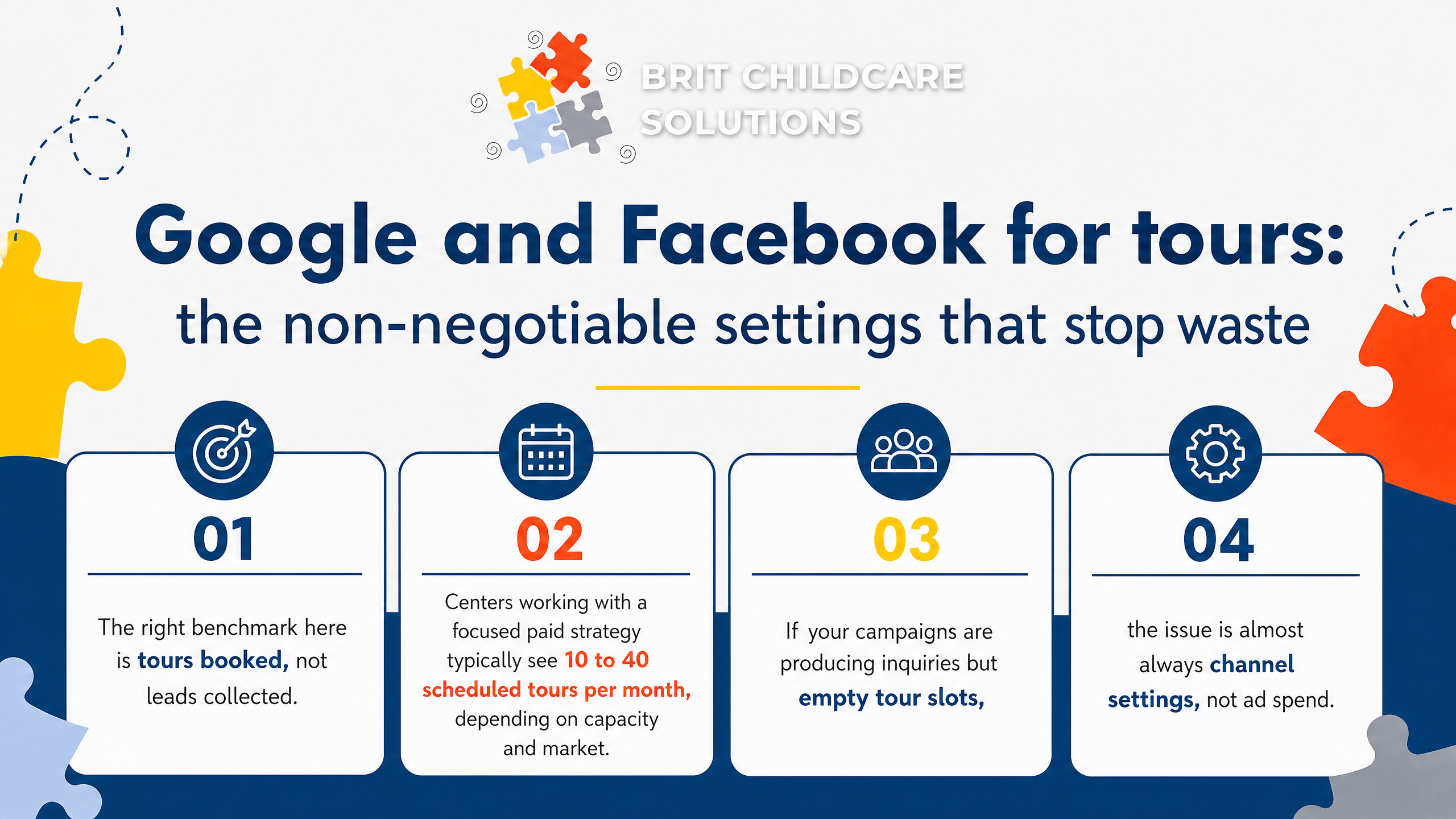
The right benchmark here is tours booked, not leads collected. Centers working with a focused paid strategy typically see 10 to 40 scheduled tours per month, depending on capacity and market. If your campaigns are producing inquiries but empty tour slots, the issue is almost always channel settings, not ad spend.
Google Search that drives tours
Google Search works for childcare enrollment because parents searching for a spot are already in decision mode. The keyword themes that convert are specific: phrases like 'daycare near me,' 'preschool enrollment open,' 'infant care [city name],' and 'childcare with openings.' Broad terms like 'childcare' or 'early education' pull in researchers, not families ready to tour.
Location targeting should be set to a tight radius around your center, typically 3 to 5 miles, with bid adjustments that favor the zip codes where your enrolled families already live. Serving ads to the entire metro wastes budget on families who will never drive past two competitors to reach you.
Ad copy should do one job: move a qualified parent to book a tour. That means leading with availability, a specific age group served, and a direct call to action. 'Infant spots open, licensed center in [neighborhood], schedule a tour today' outperforms any generic headline about quality or care.
Turn off Search Partners
Google Search Partners is one of the most overlooked sources of wasted ad spend in childcare campaigns. When this setting is enabled, your ads appear across a network of third-party sites beyond Google Search itself, including low-quality directories, parked domains, and sites that generate clicks with no intent behind them.
Seer Interactive research found that some accounts waste 30% of their Search Partner budget on parked domains, bot clicks, and spam sites that never convert. For a childcare center running a modest monthly ad budget, that is a meaningful loss with no enrollment upside. Google does not publish a full list of partner placements, so you cannot audit where your ads are actually appearing.
The fix is simple: go to your campaign settings, find the Networks section, and uncheck 'Include Search Partners.' Google will flag this as lowering your optimization score and may prompt you to re-enable it. Ignore that prompt. Protecting your budget from low-intent clicks is more valuable than a higher optimization score.
Facebook that pre-qualifies families
Facebook works differently than Google. Parents are not actively searching, so your targeting has to do the qualification work. Set geographic targeting to a 3 to 5 mile radius around your center, then layer in demographic signals like parents of young children.
This keeps your spend focused on families who could realistically enroll.
On format, landing pages outperform native lead forms for tour-ready families. Lead forms lower friction but also lower intent, pulling in parents who are casually browsing rather than actively comparing centers. A landing page that requires a parent to read your offer, see your location, and click through to book filters for families who are genuinely interested.
Creative should do the same filtering work. Show your actual classrooms, your age groups served, and your enrollment availability. Ads that lead with 'Spots available for infants and toddlers, [neighborhood] location, schedule a tour this week' attract parents with a real need.
Lifestyle imagery without specifics tends to generate clicks from people who are months away from needing care.
Lead capture and validation: form friction that creates tour-ready families
More form submissions do not mean more tours. The fastest way to stop wasting time on unqualified families is to build qualification directly into your intake step, before anyone reaches your calendar.
Required fields that qualify
Your intake form should do two jobs at once: collect contact information and screen for fit. The fields you choose determine whether you hear from tour-ready families or anyone with a spare minute.
HubSpot's form research shows that reducing fields from four to three can increase conversions by 50%, so every field you add needs to earn its place. The ones that earn it are the ones that reveal eligibility.
Child age and anticipated start date: confirms your program serves their child and that they need care within your enrollment window
Preferred schedule and location: filters out families outside your service area or seeking hours you do not offer
Budget range: a single dropdown or range question removes families whose expectations do not align with your tuition before you invest time in a tour
A form that captures these three data points gives your team everything needed to make a pass or fail decision in under 60 seconds.
CAPTCHA and anti-spam stack
Bogus submissions are not a minor annoyance. They inflate your lead count, distort your conversion metrics, and send your team chasing contacts that never existed. A basic anti-spam stack closes most of that gap.
Place CAPTCHA on every form, including your tour request, general inquiry, and waitlist pages. Bots submit thousands of forms per day and CAPTCHA stops the majority without adding meaningful friction for real parents.
Pair CAPTCHA with honeypot fields, hidden form inputs that real users never see or fill but bots complete automatically. Any submission that triggers the honeypot is filtered out before it reaches your inbox. For phone inquiries, call tracking validation ties each inbound call to a specific ad source, so you can identify which campaigns generate real conversations versus dead-end clicks.
Tour-ready scoring rules
Not every submission that clears your spam filters deserves a tour booking. A simple scoring framework lets your team move fast on strong leads and hold back on weak ones.
Set a clear eligibility pass or fail threshold. A family whose child age, location, schedule, and budget all align passes. A family missing two or more of those fields, or whose budget is well below your tuition floor, fails and should receive a different response path rather than a calendar invite.
Watch for intent signals and red flags in the same review step.
Strong intent signals: specific start date within 60 days, full contact details provided, schedule needs match your open slots
Red flags: vague or missing start date, out-of-area zip code, budget listed well below your lowest tuition tier, no phone number provided
Block bookings automatically when a submission fails two or more eligibility criteria, and route those contacts to a nurture sequence instead
This keeps your tour calendar filled with families who are genuinely ready to enroll, not families who are still six months from needing care or three zip codes away.
Follow-up and show-up systems that reduce no-shows
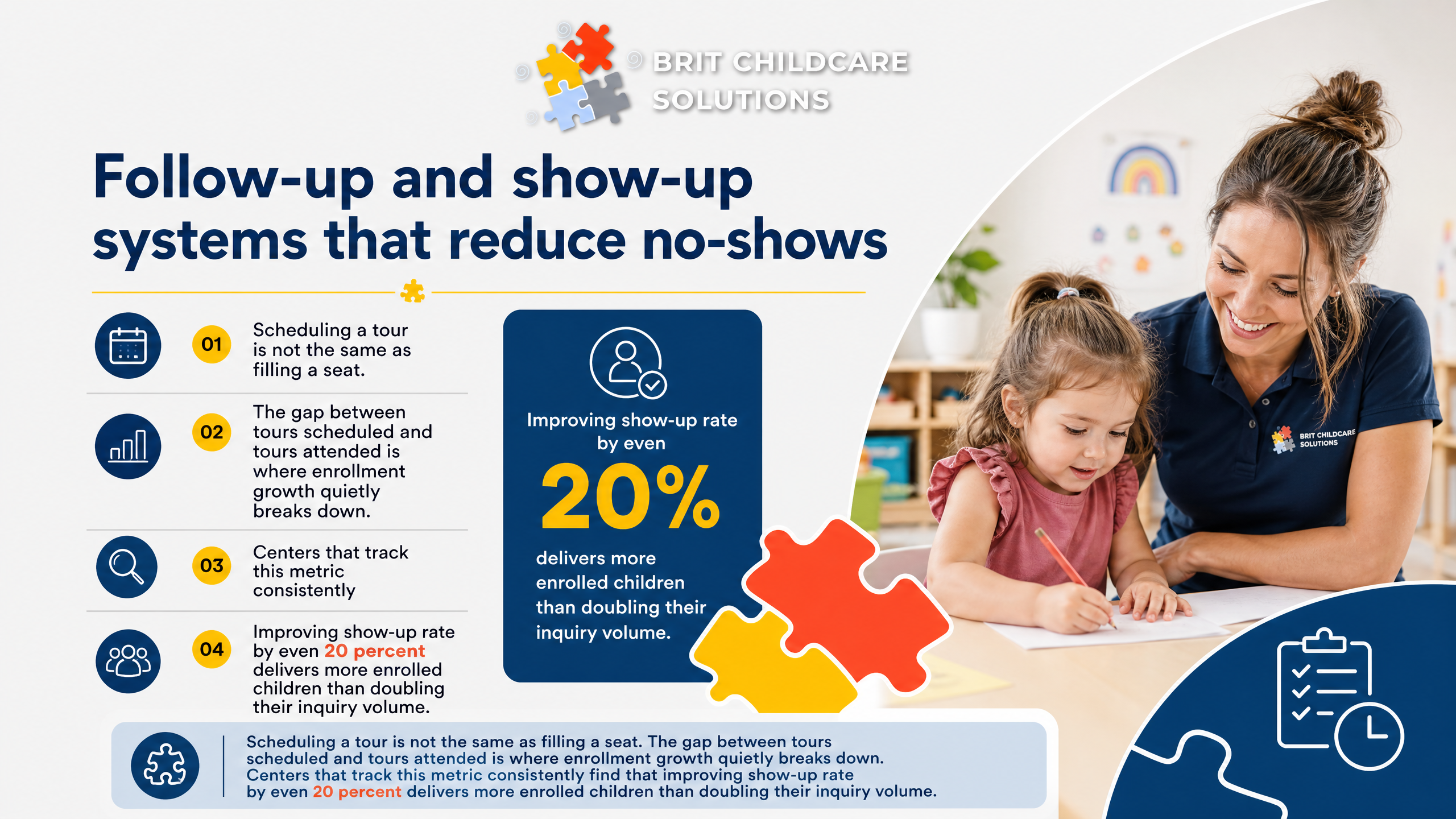
Scheduling a tour is not the same as filling a seat. The gap between tours scheduled and tours attended is where enrollment growth quietly breaks down. Centers that track this metric consistently find that improving show-up rate by even 20 percent delivers more enrolled children than doubling their inquiry volume.
Speed-to-lead and routing
Your response time is your first competitive advantage. Harvard Business Review research found that responding within 5 minutes makes you 100 times more likely to make contact than waiting 30 minutes. Parents comparing three centers will book a tour with whoever reaches them first.
The sequence that works: send an automated text within 60 seconds of the inquiry, then follow with a call attempt within 5 minutes. Text gets read; the call builds trust and moves the family to booking.
Automated text confirms receipt and includes a two-click tour booking link
Staff call attempt within 5 minutes during business hours
After-hours inquiries get the text immediately, call routed to next morning's queue
Owners should not be the ones fielding inquiry calls. Routing to a designated staff member or an automated system protects your time while keeping response speed intact.
Confirmation and reminders
A single confirmation message is not enough. Use a two-step confirmation: an immediate booking confirmation via text, then a second confirmation email with tour details, what to bring, and what to expect. This reduces last-minute cancellations because the family feels prepared, not just scheduled.
Reminder timing matters more than most centers realize. Research published in PMC shows automated reminder systems can reduce no-show rates by up to 38 percent. Send a 24-hour reminder and a 2-hour reminder, both via text.
Immediate confirmation: booking details plus a calendar invite
24-hour reminder: tour time, address, parking, and a brief note on what the tour covers
2-hour reminder: short, warm text with the director's name and a reschedule link if needed
No-show prevention playbook
Every reminder should include a one-tap reschedule link. When families can reschedule without calling, they do. Without it, they simply do not show and do not respond.
A reschedule is not a lost lead; a ghost is.
Childcare-specific objections come up most often in the 24-hour window. Common ones include schedule conflicts, sibling care issues, and uncertainty about whether they can afford tuition. Your reminder sequence should pre-address these with a single line: 'If anything has come up, here is a quick link to pick a new time.
We hold your spot for 48 hours.'
Track show-up rate per location every week. The metric to watch is tours attended divided by tours scheduled. If that number drops below 60 percent, your reminder sequence or response time needs adjustment before you invest more in inquiry volume.
Which lead generation type fits your center: a fair comparison of real options
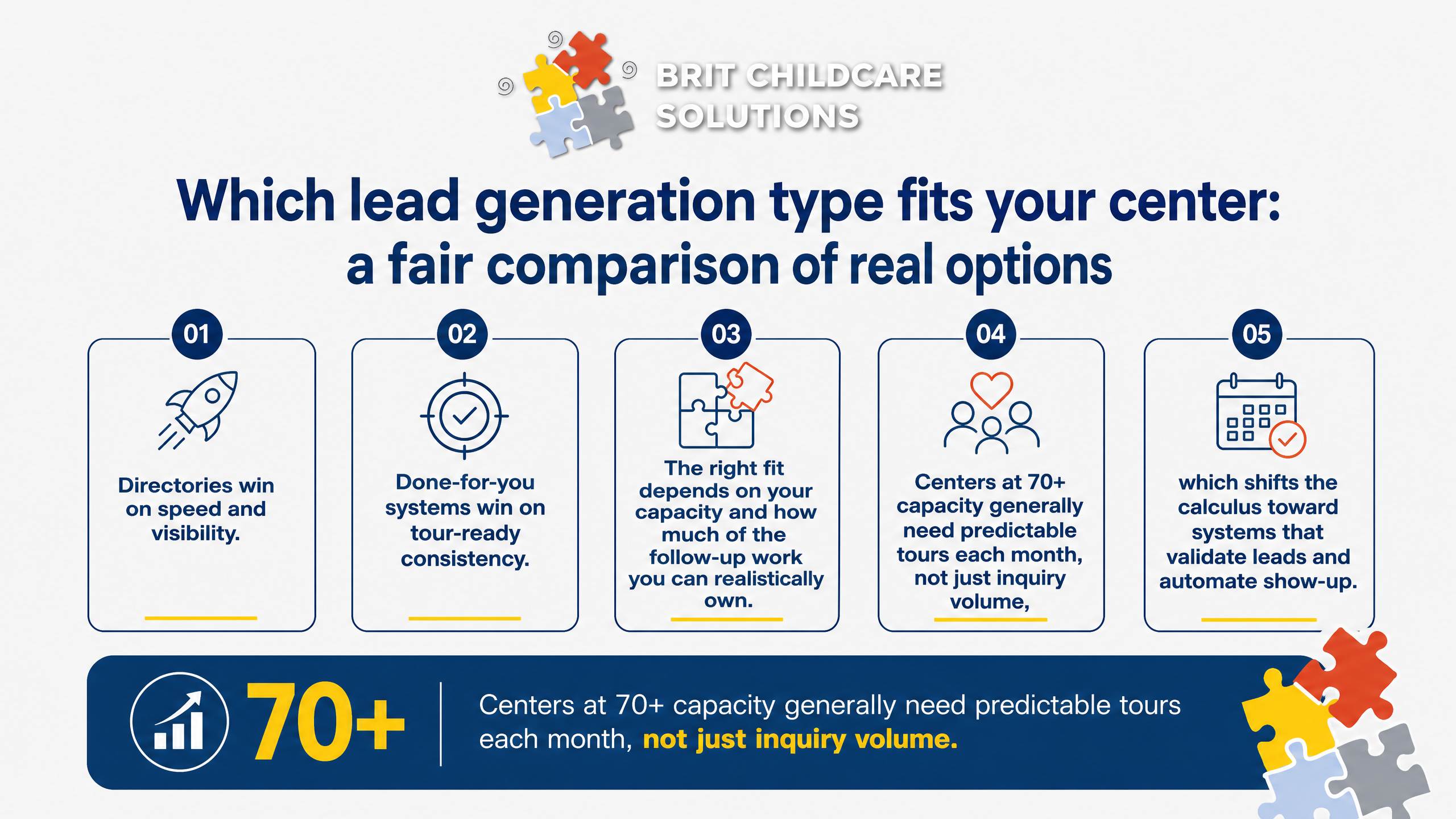
Directories win on speed and visibility. Done-for-you systems win on tour-ready consistency. The right fit depends on your capacity and how much of the follow-up work you can realistically own.
Centers at 70+ capacity generally need predictable tours each month, not just inquiry volume, which shifts the calculus toward systems that validate leads and automate show-up.
Care.com listings and ads
Care.com reaches a large audience. With 29 million families using the platform, your listing gets in front of parents who are actively searching, which is a real advantage for visibility.
The tradeoff is lead ownership. Families on Care.com are browsing multiple providers simultaneously, and the platform does not hand you an exclusive relationship with those contacts. Tour intent also varies widely.
A parent clicking your profile may be in early research mode, not ready to schedule, which means your follow-up system carries the weight of converting that interest into an actual visit.
Winnie directory presence
Winnie is strong for local discovery. Over 15 million parents use it to search by neighborhood, licensing status, and reviews, so a complete profile puts you in front of families who are geographically ready to enroll.
Profile completeness matters more than most owners realize. Winnie pulls from public licensing databases, and centers that claim their page and add photos, tuition ranges, and availability data consistently outperform unclaimed listings. The gap is that Winnie gives you presence, not a funnel.
Once a parent leaves the platform to contact you, the conversion process is entirely yours to manage.
BRIT Childcare done-for-you system
Our work is built exclusively for childcare, preschools, Montessori schools, and before- and after-school programs. That specialization means the automations, messaging, and conversion benchmarks are calibrated for how childcare families actually make decisions, not adapted from a generic marketing template.
The system handles lead validation and show-up in one connected workflow:
Owners stay out of the day-to-day entirely. CRM management, reminder sequences, and reactivation of stale inquiries run without manual follow-up. For centers at 70+ capacity or multi-location operators who need consistent, measurable tours each month, this structure removes the bottleneck between inquiry and enrollment.
Automated response within minutes of inquiry submission
Two-click tour booking to reduce friction
Text and email reminders that reduce no-shows
Conversion tracking across inquiry, tour, and enrollment stages
Clients typically see 10 to 40 scheduled tours per month, giving operators a concrete benchmark to plan staffing and capacity around.
Ready to Stop Paying for Leads That Never Show Up?
If you have worked through this playbook and you can see exactly where your funnel is leaking, but you do not have the bandwidth to rebuild it yourself, that is the conversation we have every week with operators just like you.
At BRIT Childcare, we work exclusively with childcare centers, preschools, and Montessori programs across the U.S. Our done-for-you Enrollment Engine handles inquiry capture, automated follow-up, tour booking, and reminder sequences so your team is not chasing leads manually while also running a center.
Before you book a strategy call with us, take two minutes to confirm two things. First, you are operating at 70 or more capacity or running multiple locations. Second, you know your current lead sources and have a target number of tours you want to book each month.
Come with those two pieces of information and we will build a clear plan to improve your tour show-up rate and cut the bogus leads and partner-network click waste that are draining your budget right now.
Book your enrollment growth strategy call with the BRIT Childcare team at britchildcare.com/work-with-us.
Frequently Asked Questions
What's the difference between an inquiry and an enrollment?
An inquiry is a parent who raised their hand and expressed interest. An enrollment is a parent who signed, paid, and placed their child in your care. The gap between those two outcomes is where most centers lose families, and closing that gap requires a consistent follow-up and tour conversion system, not just more inquiries.
Why do we have leads but empty seats?
Lead volume tells you how many parents noticed you, not how many will actually enroll. Most centers lose families somewhere between the initial inquiry and the tour, often because follow-up is slow, tour booking has too much friction, or no-show prevention is nonexistent. Fixing those conversion points matters more than generating additional inquiries.
How fast should we respond to childcare inquiries?
Your target response window is five minutes or less. Parents comparing childcare options are contacting multiple centers at the same time, and the first center to respond with a clear next step earns a significant advantage. Automated response systems make this achievable without adding to your staff's workload.
