Childcare Marketing Automation for Tour Follow-Up
Childcare marketing automation that actually converts inquiries into attended tours works by combining minute-response sequences, automated tour booking, and CRM pipeline tracking built specifically around how childcare families make enrollment decisions.
Here is what the centers filling seats consistently are doing differently:
Automation fails most centers at the tour stage, not the lead stage, because lead capture and tour conversion are two different problems.
Responding to a new inquiry within minutes is the single highest-leverage action in your enrollment funnel.
Your CRM pipeline should track tours scheduled, tours attended, and enrollments as three separate, reportable stages.
Stale inquiries from families who went quiet before touring can be reactivated automatically without owner involvement.
The metric that reveals whether your system is working is tour show-up rate, not lead volume or cost per click.
Any done-for-you partner worth hiring should show you tour attendance metrics from current clients before you sign anything.
At BRIT Childcare, we work exclusively with childcare centers, preschools, and Montessori schools across the U.S., and tour no-shows are one of the most consistent problems our clients bring to us before we build their system. Our done-for-you enrollment automation handles the CRM setup, the response sequences, the tour booking reminders, and the conversion tracking so you are not managing any of the tech stack yourself.
Before any of the automation pieces make sense, you need to understand exactly where your inquiry funnel is breaking down and why most automation setups never get families past the scheduling step.
Why most childcare automation fails at the tour stage
Most childcare centers automate the wrong thing. They invest in capturing inquiries and stop there, leaving the steps that actually produce enrollment completely unmanaged.
Lead capture is not conversion
A filled contact form is not a booked tour. Centers that measure success by inquiry volume are tracking the wrong metric entirely.
When a parent submits a form and hears nothing for hours, the urgency they felt disappears fast. Parents searching for childcare contact three to five centers at the same time. The center that responds first earns the tour. Harvard Business Review research confirms that contacting a lead within one hour makes you seven times more likely to qualify that family compared to waiting longer.
No shows have predictable causes
Tour no-shows are not random. They follow a pattern, and that pattern points directly to gaps in your follow-up process.
Three missing pieces drive most no-shows:
No confirmation sequence after booking, so the appointment never feels real to the parent
No reminders that include directions, parking details, or what to bring, leaving families uncertain the day of
No reschedule path when life interrupts, so a missed tour becomes a lost family instead of a rebooked one
A large-scale appointment study found no-show rates ranging from 15% to 50% depending on lead time and reminder protocols. Childcare tours face the same dynamics, and the fix is the same: structured sequences, not hope.
Track three numbers only
Most centers track inquiries. Almost none track what happens after. Narrow your dashboard to three numbers that actually predict enrollment growth:
Tours scheduled per week: your pipeline health indicator
Tours attended percentage: the number that exposes follow-up gaps immediately
Enrollments by source: tells you which channels produce paying families, not just clicks
If you cannot pull these three numbers today, your automation is not set up to drive enrollment. It is set up to collect data you never use.
Build your inquiry to tour map before you automate
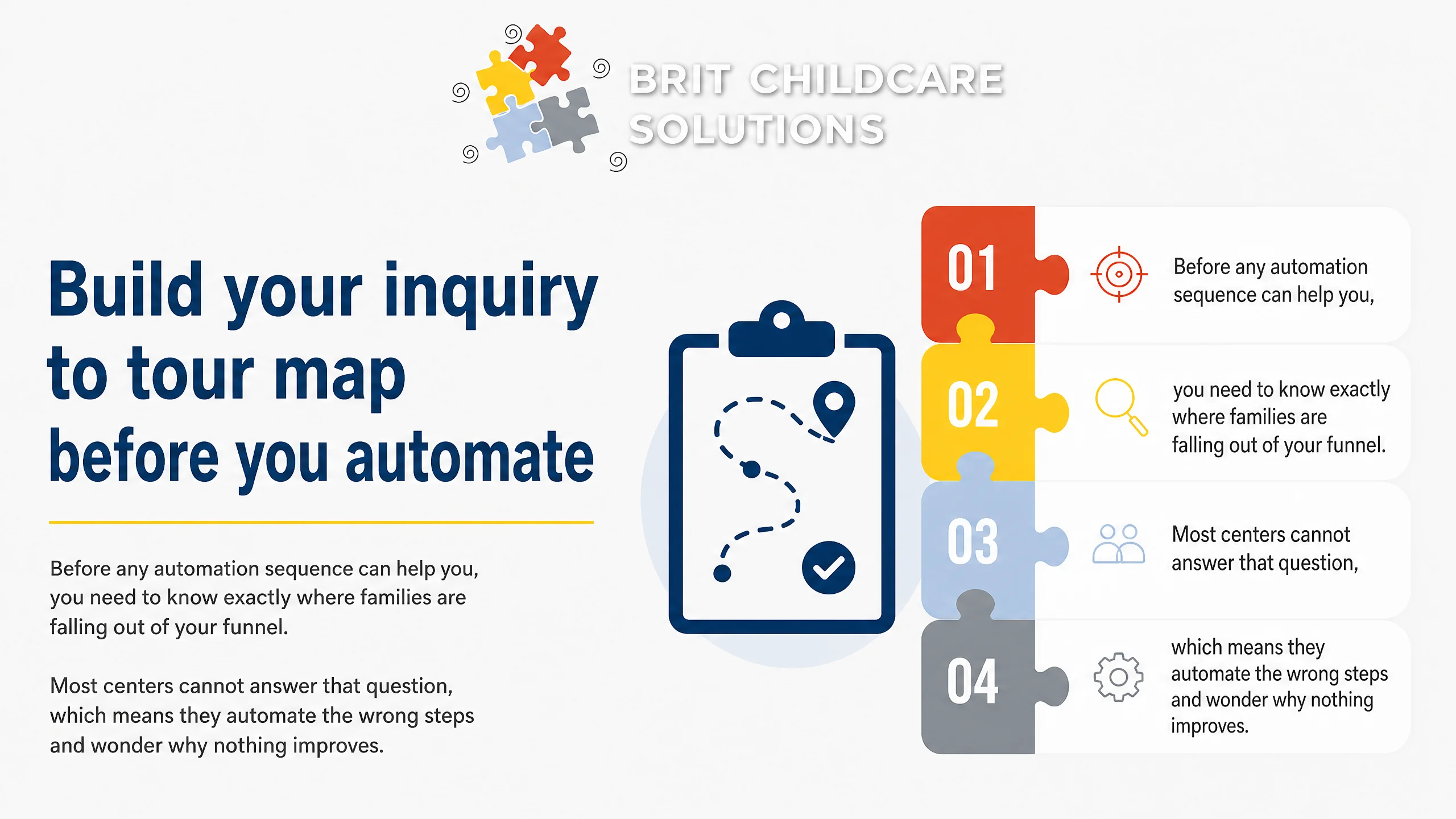
Before any automation sequence can help you, you need to know exactly where families are falling out of your funnel. Most centers cannot answer that question, which means they automate the wrong steps and wonder why nothing improves.
Define each handoff point
Your inquiry-to-enrollment journey has four distinct moments where a family either moves forward or disappears.
New inquiry intake: the moment a parent submits a form, sends a message, or calls
this is where the clock starts on your response time
Tour scheduling moment: the transition from interested parent to confirmed appointment - this is where most centers lose families to silence
Tour day check-in: confirming the family actually arrived - a no-show here erases all the work before it
Post-tour enrollment follow-up: the 24 to 72 hours after a tour when a family decides whether to enroll or keep looking
Each handoff is a decision point for the family. If your center has no defined action at any one of these moments, that is where your leads are leaking.
Measure the drop offs
Once you have named each handoff, you can measure what percentage of families make it through each one. Harvard Business Review research confirms that contacting a new inquiry within one hour makes you seven times more likely to qualify that family, so time to first response is your most urgent number to track.
Pull your last 30 days of data and calculate four rates:
Inquiry to booked rate: how many inquiries converted to a scheduled tour
Booked to attended rate: how many scheduled tours actually showed up
Attended to enrolled rate: how many tour attendees became enrolled families
Time to first response: average minutes between inquiry submission and your first reply
Most centers discover their biggest drop-off is between inquiry and booked tour, not between tour and enrollment.
Set your baseline benchmarks
You cannot improve what you have not measured. Before any automation is in place, document four numbers that will serve as your starting point.
Weekly lead volume: total new inquiries across all sources in a typical week
Monthly tours scheduled: how many confirmed tour appointments your center books in a month
Show-up rate estimate: percentage of scheduled tours where the family actually arrived
Enrollment close rate: percentage of attended tours that converted to an enrollment
These four numbers tell you which stage of your funnel needs the most attention and give you a clear target for what automation should move.
The tour follow-up automation stack that works in childcare
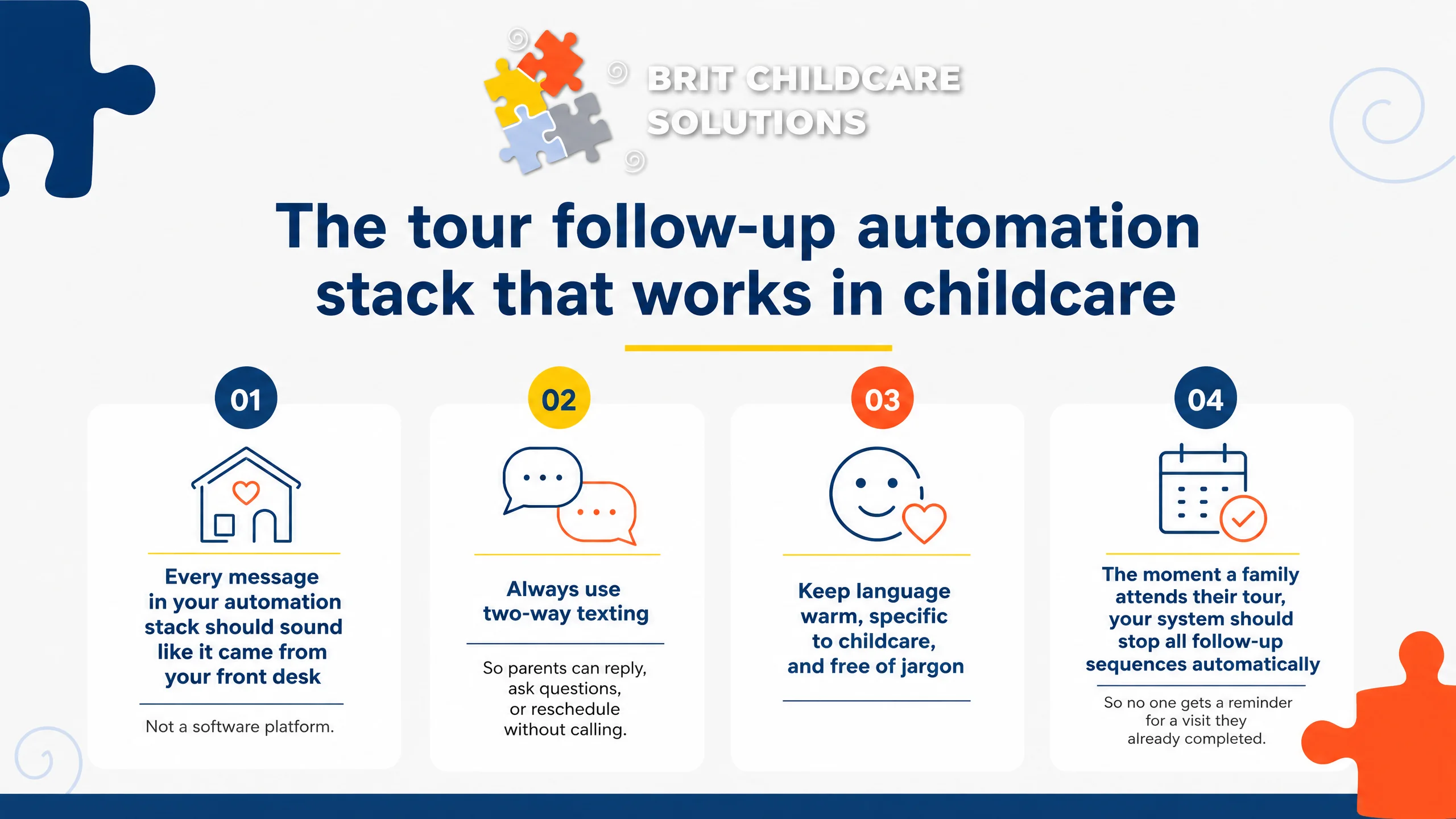
Every message in your automation stack should sound like it came from your front desk, not a software platform. Keep language warm, specific to childcare, and free of jargon. Always use two-way texting so parents can reply, ask questions, or reschedule without calling.
And the moment a family attends their tour, your system should stop all follow-up sequences automatically so no one gets a reminder for a visit they already completed.
Instant response within five minutes
The first message a parent receives sets the tone for everything that follows. Send an SMS within five minutes of the inquiry, then follow with an email as a backup for families who miss the text.
The SMS should be brief: confirm you received their inquiry, invite them to book a tour, and include a direct scheduling link or a simple question like 'What days work best for you?' Harvard Business Review research shows companies that contact leads within one hour are seven times more likely to qualify them compared to those who wait longer. Five minutes is even better.
SMS first reply: short, warm, with a tour link or open question
Email backup: slightly more detailed, includes center name, hours, and next step
Language filter: if your area has a significant Spanish-speaking population, send bilingual messages
Hours filter: after-hours inquiries get the same instant SMS but route tour booking to next-day availability
Speed alone does not convert. The message has to match where the parent is emotionally, which is cautious and evaluating, not ready to sign.
Tour scheduled confirmation sequence
Once a parent books, send a calendar confirmation SMS immediately. This is not optional. Families book tours across multiple centers, and a confirmation locks in your spot in their schedule.
Calendar confirmation SMS: date, time, and your center address sent within seconds of booking
What to bring list: ID, any enrollment questions, and their child's age and care needs
Directions and parking: one short text with a map link and any parking notes
Two-way reschedule text: include a simple reply option like 'Reply CHANGE to pick a new time' so rescheduling happens before a no-show does
This sequence removes every logistical friction point that causes families to quietly drop off between booking and showing up.
Tour show-up reminder sequence
A pediatric clinic study found that text message reminders reduced no-show rates from 38.1% to 23.5%. That same principle applies directly to childcare tour attendance. A structured reminder sequence is the difference between a full tour schedule and an empty lobby.
Send a 24-hour reminder with the tour details and a friendly confirmation prompt. Two hours before, send a shorter text with your address and a 'We'll see you soon' message. If a family is running late, a brief check-in text at the scheduled start time keeps communication open without pressure.
If they do not show, a no-show recovery text sent within two hours offers a simple reschedule option with no guilt framing.
Your CRM pipeline must match real tour outcomes
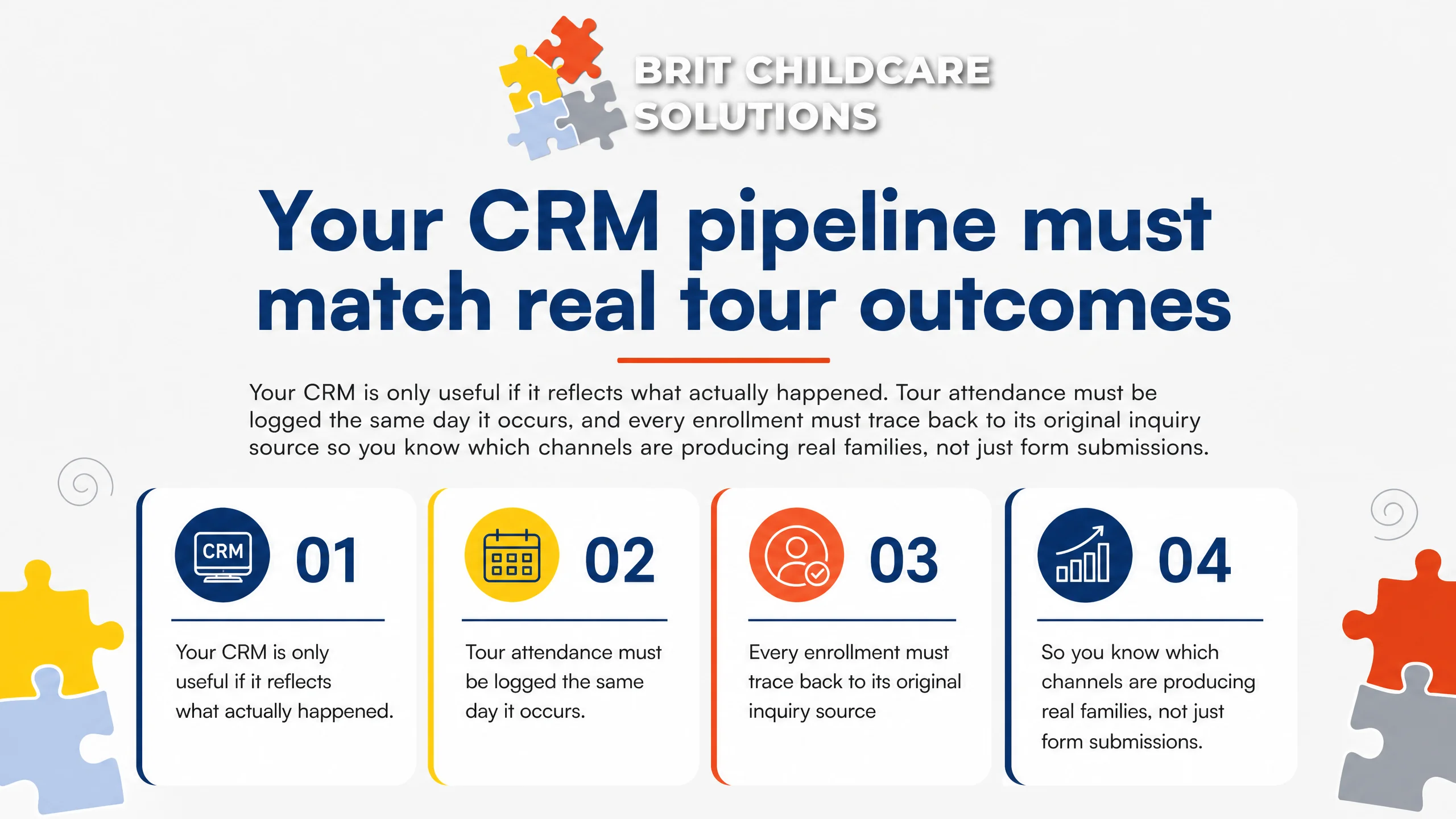
Your CRM is only useful if it reflects what actually happened. Tour attendance must be logged the same day it occurs, and every enrollment must trace back to its original inquiry source so you know which channels are producing real families, not just form submissions.
Use four pipeline stages
Most centers track leads. The centers filling seats track four specific stages that mirror how families actually move toward enrollment.
Inquiry: A new contact has submitted a form, called, or messaged. No tour is scheduled yet.
Tour Scheduled: A specific date and time is confirmed. Unconfirmed interest does not qualify.
Tour Attended: Staff verifies the family showed up.
This stage only moves on same-day confirmation, not assumption.
Enrolled: A signed agreement or deposit is received and tied back to the original inquiry source.
These four stages turn your pipeline into a reporting tool that shows where families are dropping off, not just how many entered.
Automations tied to each stage
Each stage needs a defined trigger to enter, a clear rule to exit, and a task or alert so nothing stalls silently.
Stage entry triggers fire when a family meets the criteria above. Exit rules require a verified action, not just elapsed time. Staff receive task alerts when a stage has not advanced within 48 hours.
Owner escalation kicks in when a tour attended record is missing after a scheduled tour date passes, or when an inquiry has sat in the pipeline for more than seven days without a scheduled tour.
Does it work: the proof is in show-up rate and speed
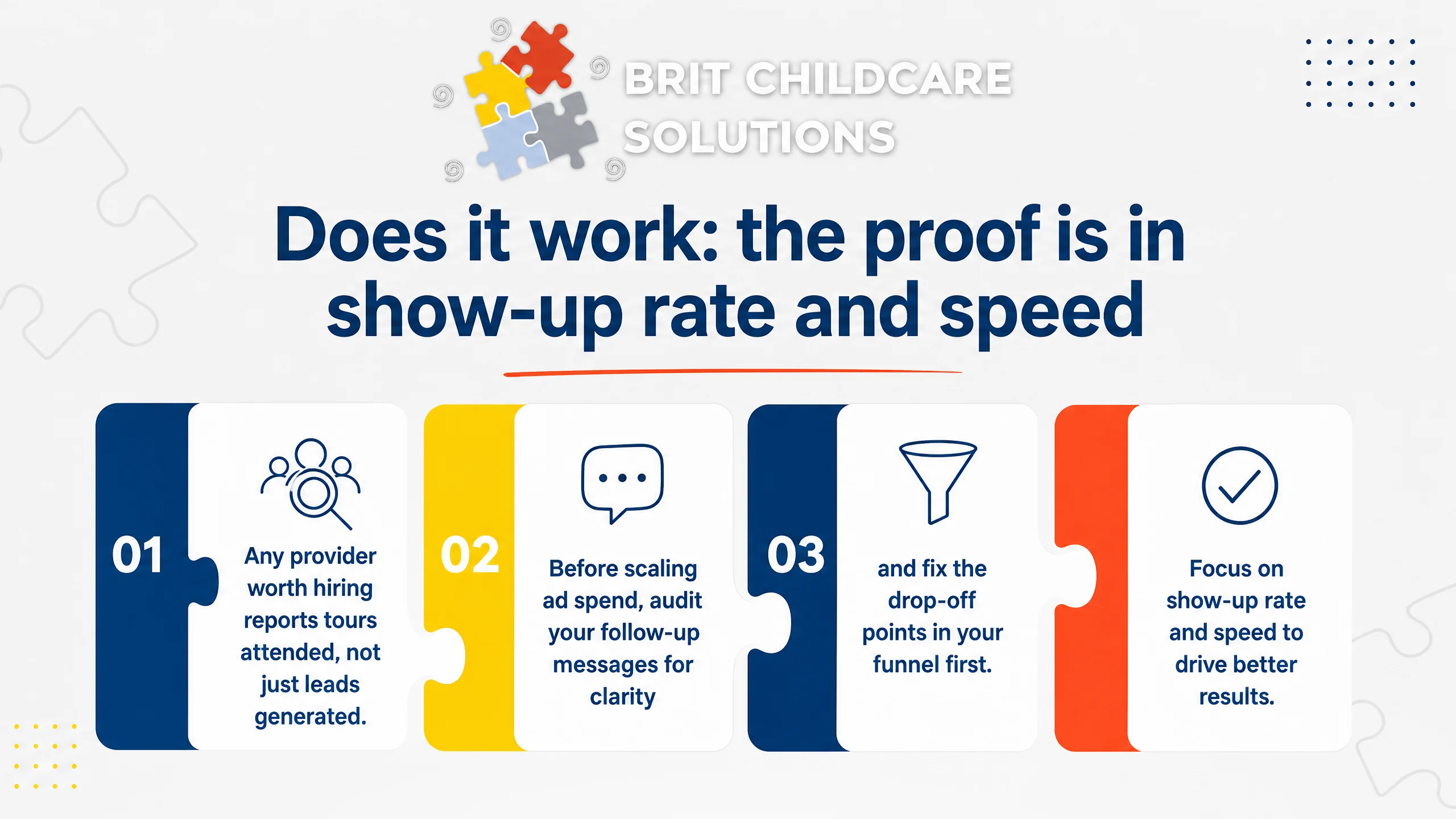
Any provider worth hiring reports tours attended, not just leads generated. Before scaling ad spend, audit your follow-up messages for clarity and fix the drop-off points in your funnel first.
What good performance looks like
Centers using a managed enrollment automation system typically see 10 to 40 scheduled tours per month, with show-up rates climbing as reminders and confirmation sequences replace manual follow-up.
On the staffing side, daily qualified applicants flow in when the intake system is running correctly. Weekly reporting should show tours scheduled, tours attended, and enrollments, not clicks or impressions.
Why childcare follow-up converts
Harvard Business Review research confirms that contacting a lead within one hour makes you seven times more likely to qualify that family than waiting longer. Minutes matter more than ad budget.
Parents research childcare by text. They respond faster to SMS than email, and a well-timed message reduces the anxiety that causes families to go quiet after their first inquiry.
When a family misses a tour, an automated reschedule sequence recovers the opportunity before it becomes a lost enrollment. That single step alone protects weeks of marketing spend.
What to demand from a done-for-you automation partner
Before signing with any automation partner, ask to see real tour metrics from current childcare clients. Confirm who edits follow-up sequences when a message stops converting, and clarify exactly what hours their team covers inquiry responses. If those three questions get vague answers, keep looking.
Non-negotiables in writing
Any done-for-you partner worth the investment should put these commitments in your service agreement, not just in a sales call.
Done-for-you CRM setup: they build and configure it, you never log in to troubleshoot
Two-way SMS included: families can reply, and those replies trigger the next automation step
Tour attended reporting: not just tours scheduled, but who actually showed up each week
Owner time cap: a defined weekly limit on what they will ask you to do, typically under two hours
At BRIT Childcare, these are baseline requirements, not add-ons, because tour attendance is the number that drives enrollment.
Red flags that waste money
A partner who hands you a tool list without tying each tool to a specific enrollment outcome is selling you complexity, not results.
Watch for these warning signs before you commit:
Tool list without outcomes: they describe software features but cannot show you tour conversion data
No no-show recovery plan: if a family misses a tour, there is no automated sequence to rebook them
No pipeline stage definitions: inquiry, tour scheduled, tour attended, and enrolled are not tracked separately
Owner runs daily follow-up: if you are the one sending reminders, the system is not done-for-you
How BRIT Childcare runs tour follow-up automation for you
We work exclusively with childcare centers, preschools, and Montessori schools. That specialization matters because childcare enrollment funnels are not like other service businesses, and generic marketing agencies treat them that way. Our partnership model is built for centers with 70 or more licensed capacity that are ready to grow through a managed system, not another tool to learn.
What we build and manage
We set up and operate the entire enrollment infrastructure for you. That includes a managed CRM with pipeline stages mapped to your actual funnel: inquiry received, tour scheduled, tour attended, and enrolled.
SMS and email follow-up sequences that trigger automatically at each stage, so no inquiry sits unanswered
Ads targeted to tour-ready families in your local market, not just clicks or impressions
Weekly reporting on tours attended and conversion rates so you can see exactly where families are moving or dropping off
You get a complete picture of your enrollment funnel without building or maintaining any of it yourself.
What you do versus we do
Your job is to show up for tours and interview applicants. Our job is everything that gets families to that point.
We handle the full tech stack, including CRM configuration, automation sequences, and AI-powered follow-up tools that respond to new inquiries within minutes. We also optimize your follow-up sequences weekly based on what the data shows, adjusting timing, messaging, and targeting as your pipeline evolves.
Centers that work with us typically see 10 to 40 scheduled tours per month without the owner managing a single automation. If you want to bring that system to your center, book a Zoom strategy call at britchildcare.com/work-with-us. Bring your current lead volume and tour numbers, and we will show you exactly where your funnel is losing families.
You Have the Leads.
Now Let's Get Families Through the Door.
If this article made one thing clear, it is that the gap between an inquiry and an enrolled child is not a lead problem. It is a follow-up problem. The centers filling seats consistently are not the ones spending more on ads.
They are the ones responding faster, confirming tours automatically, and tracking exactly where families drop off before they ever walk through the door.
That is what we build and manage for you at BRIT Childcare.
Frequently Asked Questions
Is childcare marketing automation just another lead generation tool?
Not at all. Childcare marketing automation is designed for centers that already have inquiries coming in but are losing families somewhere between first contact and the tour. The focus is entirely on what happens after the inquiry arrives, specifically response speed, tour booking, and show-up rates.
How is done-for-you childcare marketing different from hiring an agency?
A generalist agency typically hands you a tool or a report and leaves the execution to your front desk. Done-for-you childcare marketing means the automation sequences, CRM pipeline, tour reminders, and monthly strategic planning are all built and managed for you by a team that works exclusively in the childcare industry.
What metric matters most when choosing a childcare marketing partner?
Cost per enrolled seat is the number that actually tells you whether your marketing is working. Cost per click and cost per lead sound measurable, but they do not tell you whether a single family walked through your door and signed an enrollment agreement.
