Cons of Childcare Marketing Automation for Tours
Automating your tour follow-up is one of the highest-leverage moves you can make for enrollment growth, but only when you automate the right things. Most childcare centers that struggle with automation are not failing because the technology is wrong.
Here is what the research and real enrollment data show:
Responding to a new inquiry within five minutes dramatically increases the likelihood a family books a tour compared to manual front desk follow-up.
Robotic, generic messages erode parent trust fast, which is why message tone and childcare-specific sequencing matter as much as speed.
Tour-to-enrollment conversion rates above 95% are achievable when booking, confirmation, and reminder automation are working together correctly.
Stale leads, families who went quiet before ever touring, are a recoverable segment when reactivation sequences are built to feel human, not spammy.
Most automation abandonment happens not because the tools fail, but because centers never defined their baseline metrics at inquiry, tour, and enrollment before launching.
At BRIT Childcare, we work exclusively with U.S. childcare centers and multi-location operators, and we built our Done-For-You Marketing Service around one job: getting qualified families to book and show up to tours, then tracking every conversion point from inquiry to enrolled agreement.
We have seen centers with strong inquiry volume and empty classrooms because no one measured where families were dropping off. That is the problem we designed our Enrollment Engine to solve, not just generating leads, but closing the gap between a raised hand and a signed enrollment agreement.
Before you add a single automation sequence, there is one step that separates the centers that see real enrollment lift from the ones that spin their wheels: a clear-eyed look at where your funnel is actually breaking right now. Start with a 10-minute self-audit that reveals your true five-minute response reality and pinpoints the exact drop-off points at inquiry, tour, and enrollment, including the routing gaps that multiply across every location you operate.
A 10 minute self-audit before you automate anything
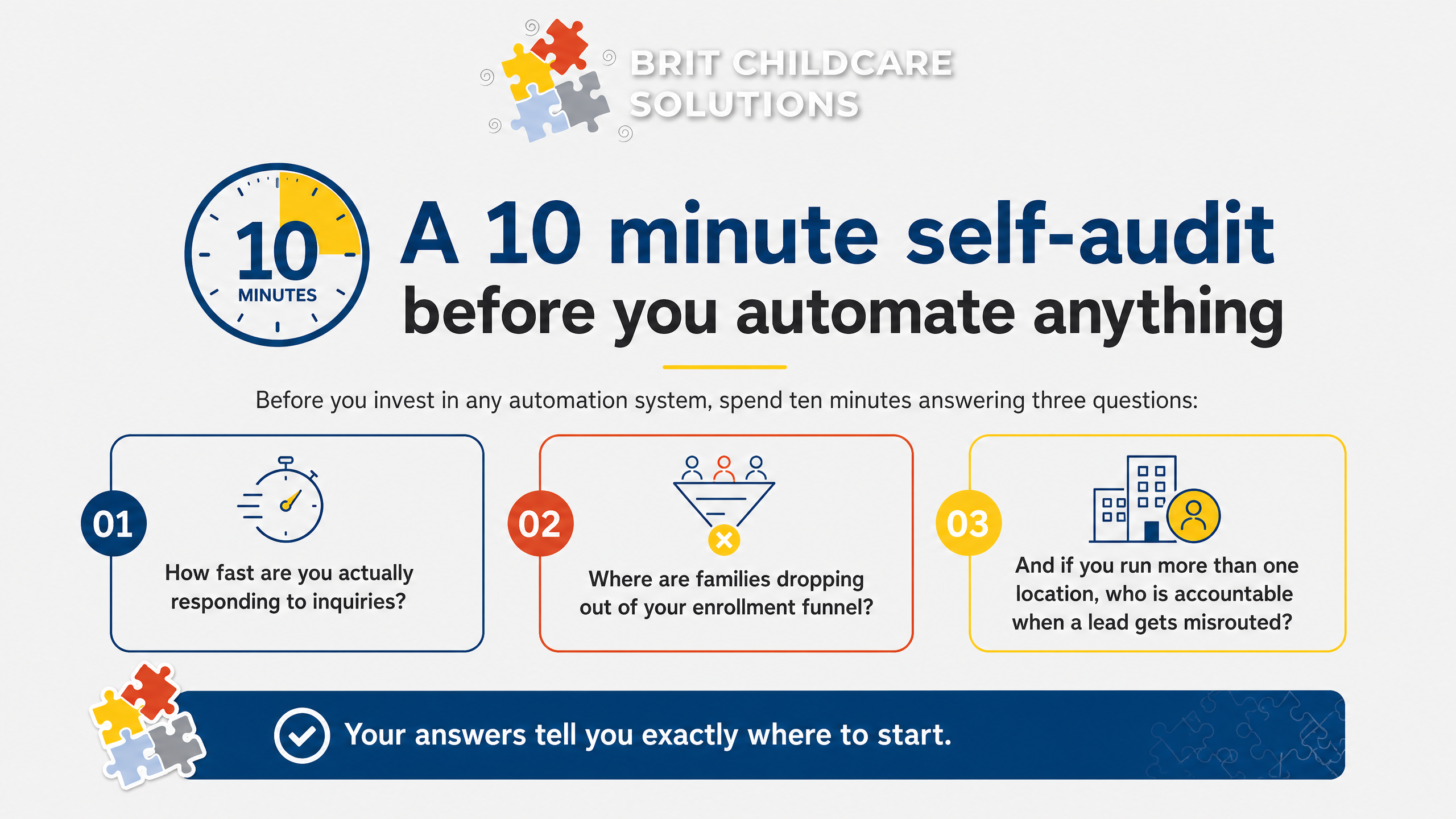
Before you invest in any automation system, spend ten minutes answering three questions: How fast are you actually responding to inquiries? Where are families dropping out of your enrollment funnel? And if you run more than one location, who is accountable when a lead gets misrouted?
Your answers tell you exactly where to start.
Your five minute response reality
Send a test inquiry to every channel your center uses today: your website form, Facebook page, Google Business Profile, and any ads running right now. Note the timestamp. Then check when each one received a reply.
HubSpot customer expectations research found that companies responding within five minutes are 21 times more likely to qualify a lead than those waiting 30 minutes. Most centers discover their email response time runs six to twelve hours. Text inquiries often sit unanswered even longer because no single staff member owns them.
After-hours is where the gap becomes critical. If a parent submits an inquiry at 9 PM on a Tuesday and your front desk opens at 7 AM, that family has likely contacted two other centers before you call back.
Three drop-offs that matter
Most enrollment loss does not happen in lead generation. It happens in the three conversion steps that follow.
Pull your numbers for the last 90 days and calculate each rate:
Inquiry to tour rate: What percentage of inquiries resulted in a scheduled tour? Below 40% signals a response speed or booking friction problem.
Tour show-up rate: Of scheduled tours, how many families actually arrived? A rate below 70% points to weak confirmation and reminder processes.
Tour to enrollment rate: Of families who toured, how many signed an enrollment agreement?
Below 50% often reflects a follow-up gap after the visit.
If you cannot pull these numbers today, that gap itself is the finding. You cannot fix a funnel you are not measuring.
Multi-location routing stress test
For operators running two or more sites, routing errors quietly drain enrollment. Ask your team these three questions:
First, have families ever received a reply referencing the wrong location? Wrong site replies erode trust immediately and are nearly impossible to recover from. Second, does your team share one inbox across locations?
Shared inboxes create delay because no one person feels accountable for a reply. Third, when a lead comes in, who is responsible for following up and by when? If the answer is unclear, handoff accountability gaps are costing you tours.
Document what you find. The pattern across these three areas tells you whether your biggest problem is speed, booking friction, or routing breakdown, and that determines which automation to build first.
The real cons of childcare tour automation and what causes them
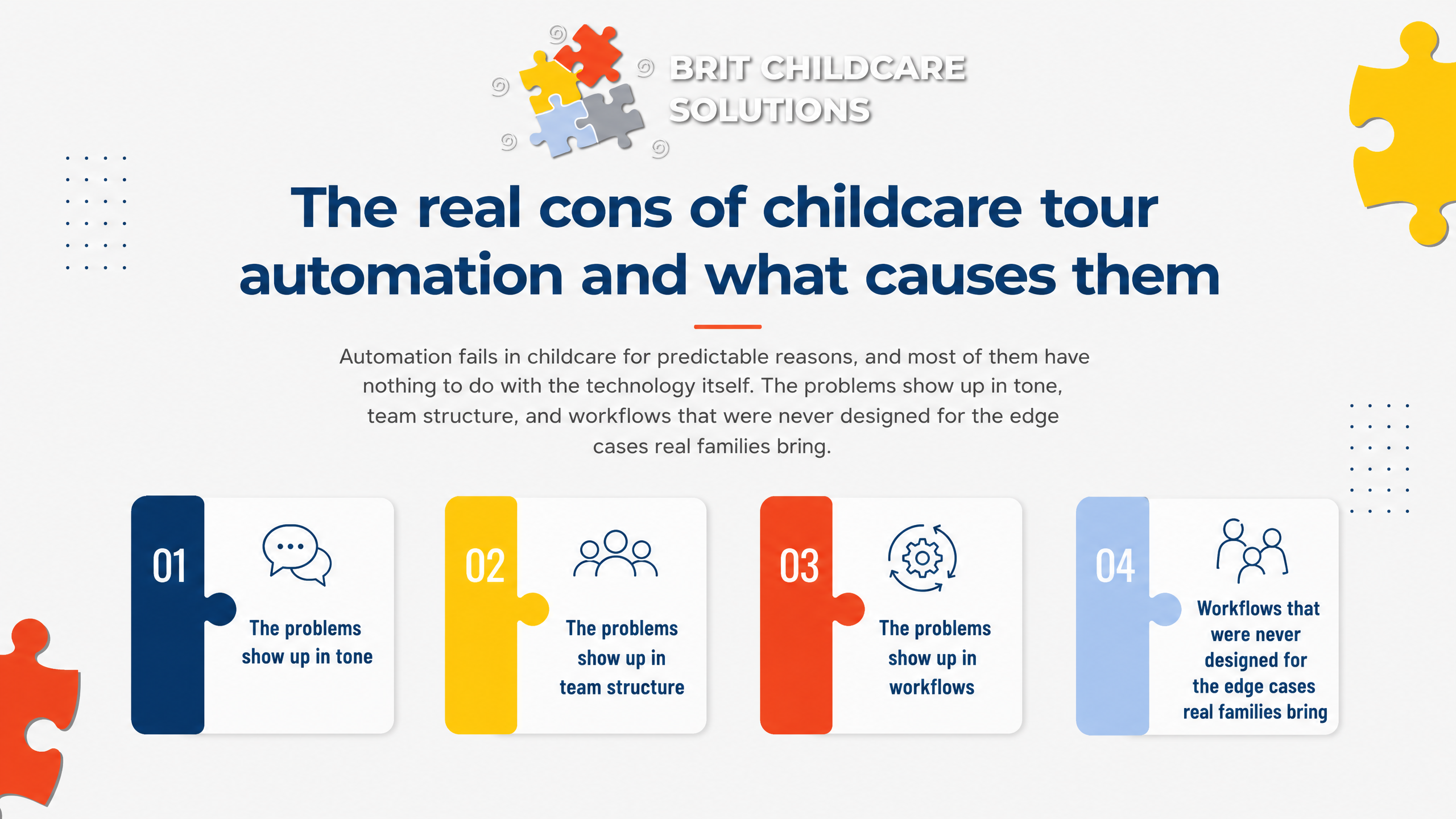
Automation fails in childcare for predictable reasons, and most of them have nothing to do with the technology itself. The problems show up in tone, team structure, and workflows that were never designed for the edge cases real families bring.
Robotic messages lose parent trust
Generic automation templates are built for e-commerce, not childcare. A message that reads 'Thank you for your inquiry. A representative will follow up shortly' carries zero emotional weight for a parent who is worried about their child's safety, schedule, or waitlist position.
Childcare inquiries often arrive with urgency attached. A parent reaching out on a Tuesday morning may need care by Monday. Research published in Scientific Reports confirms that users perceive empathetic, timely responses as more genuine, while delays and repetitive waiting messages actively erode trust.
Automation that does not acknowledge urgency reads as indifferent.
The other failure point is missing the questions parents actually ask. Most off-the-shelf sequences never address age ranges, curriculum approach, or what happens if a child is sick. When your automated reply skips those details, parents assume you are not paying attention.
Automation adds staff confusion
Automation creates a new problem when roles are not clearly defined before the system goes live. If both the owner and the director have access to the same lead pipeline, duplicate follow-ups happen. A parent receives two calls in one hour and immediately questions your organization.
The deeper issue is the absence of a single source of truth. When one person follows up in the CRM and another sends a manual text, there is no unified record of what was said or promised. Staff spend time reconstructing conversations instead of booking tours.
Assign one owner per lead stage: who handles new inquiries, who manages tour confirmations, who follows up after no-shows
Set automation triggers that pause manual outreach once a sequence is active
Use one platform to log every touchpoint so the full conversation history is visible to anyone on the team
Without these guardrails in place before launch, automation amplifies the disorganization it was supposed to solve.
Tours break on edge cases
Standard tour booking flows assume one child, one guardian, one schedule. Real families are more complicated, and that is where automation breaks down without proper configuration.
Three scenarios consistently expose gaps in childcare tour workflows:
Siblings with different age groups or program needs: A single booking form that captures one child's information will miss the second child entirely, creating a mismatched tour experience
Waitlist versus immediate care: Families who need a spot now require a different sequence than families planning three months out. Sending waitlist messaging to an urgent inquiry is a fast way to lose an enrollment
Two-guardian coordination: When both parents need to attend a tour, a single confirmation text to one phone number is not enough. Schedules conflict, one parent does not know the time, and the tour becomes a no-show
These are not rare situations. In our experience, edge cases account for a significant share of the tours that fall apart before they ever happen. The playbook sections ahead address each one with specific workflow adjustments.
A tour-first automation playbook that avoids those cons
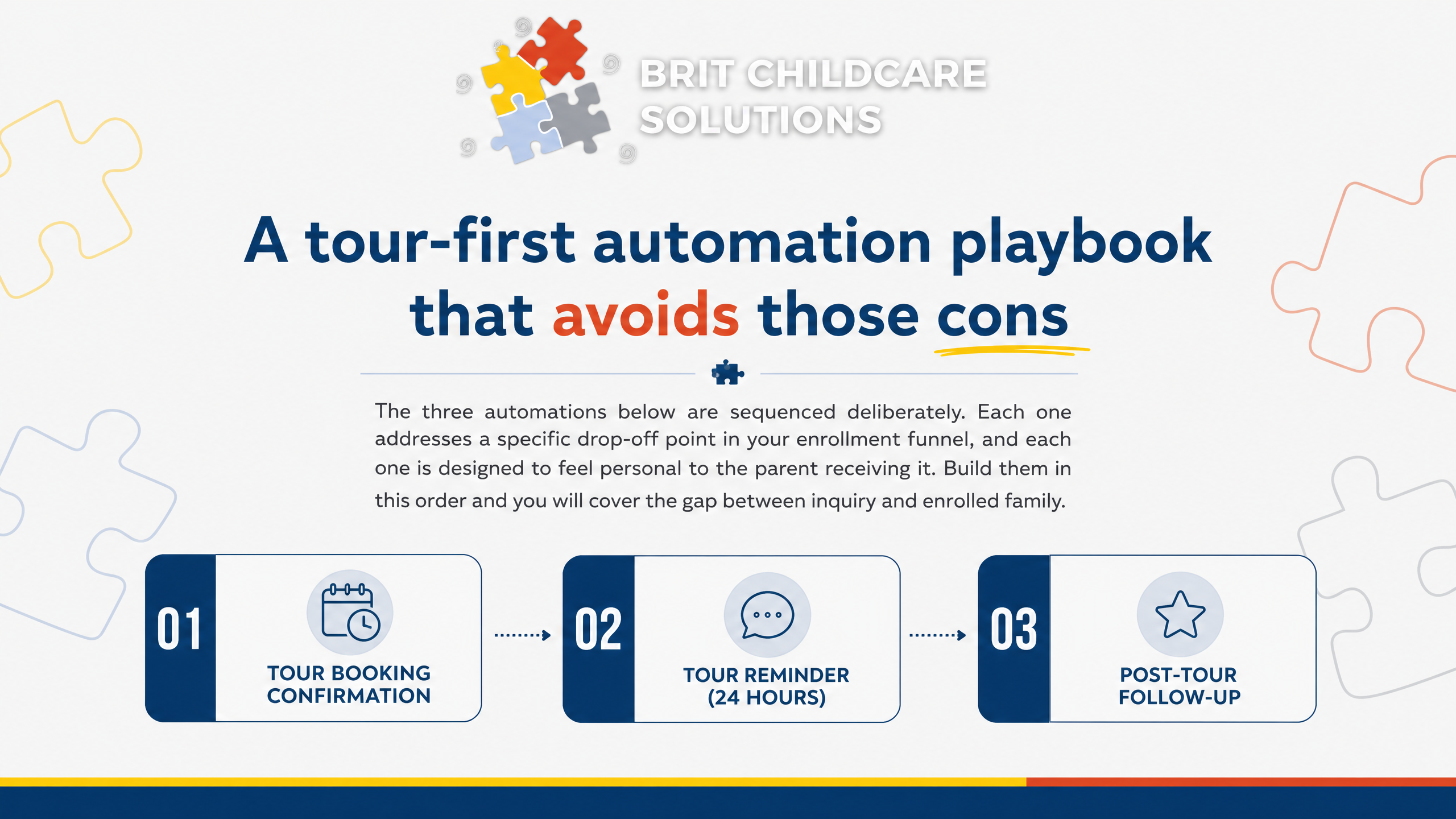
The three automations below are sequenced deliberately. Each one addresses a specific drop-off point in your enrollment funnel, and each one is designed to feel personal to the parent receiving it. Build them in this order and you will cover the gap between inquiry and enrolled family.
Instant text reply on every inquiry
Every inquiry channel you have, your website form, Facebook ad, Google Business Profile, and any paid landing page, needs to feed into a single lead capture system. When inquiries scatter across inboxes and spreadsheets, response time suffers. Unifying those inputs means one automation handles all of them.
The first message a parent receives should not read like a bot wrote it. A message like 'Hi [First Name], this is Sarah at Sunshine Learning Center. We got your inquiry and would love to show you around.
Can I send you a link to pick a time?' lands differently than a generic confirmation email. Warm, specific, and short is the standard.
Automation handles the first reply, but a staff member should be looped in within minutes if the parent responds. Set your system to notify your front desk or director the moment a reply comes back. The automation opens the door; your team walks through it.
Two-click tour booking flow
Most parents who inquire are doing it from their phone during a lunch break or after bedtime. A booking flow that requires logging in, filling out a long form, or navigating multiple pages will lose them. The goal is a link in that first text that opens a mobile-friendly scheduling page and lets them pick a time in two taps.
If you operate more than one location, each site needs its own calendar. Routing a parent to the wrong location's availability creates confusion and erodes trust before they ever visit. Location-specific calendars also give you cleaner data on which sites are generating tours and which are not.
Before the parent locks in a time, ask two or three short eligibility questions upfront, such as the child's age, desired start date, and full-time or part-time need. This filters out families who are not a fit and gives your director context before the tour. Keep it brief; anything longer than three questions increases drop-off.
Text confirmations cut no-shows
The moment a tour is booked, send a confirmation text that includes the date, time, address, and a one-click link to directions. Do not rely on parents to remember what they scheduled or to find your address on their own. Remove every possible friction point between booking and showing up.
A pediatric clinic study found that text message reminders reduced no-show rates from 38.1% to 23.5%, a difference of nearly 15 percentage points. That same principle applies directly to childcare tours. Send a reminder 24 hours before and again 2 hours before the scheduled visit.
Every reminder should include a reschedule link. Parents who cannot make the original time will simply not show up if rescheduling feels like work. A one-tap reschedule option keeps them in your funnel instead of sending them to a competitor.
This is the detail most centers skip, and it is one of the highest-impact adjustments you can make to your show-up rate.
Stale inquiry reactivation without sounding spammy
Silent leads are not lost leads. Most families who go quiet are still looking for care. They just need the right nudge at the right moment.
Who counts as stale
A stale inquiry is any family who expressed interest but stopped moving forward. Knowing exactly when a lead crosses that threshold helps you act before they enroll somewhere else.
No reply within 72 hours of your initial outreach
Inquiry received but no tour booked within 7 days
Toured your center but gave no decision after 5 or more days
Post-tour undecided families are often the warmest of the three. They have already seen your center. A single well-timed message can close them.
The three message reactivation sequence
A three-step text sequence is enough to reactivate most stale inquiries without feeling pushy. Keep each message short, specific, and easy to respond to.
Start with a one-question check-in text. Something like: 'Hi Sarah, still looking for care for Emma this fall?' One question, no pressure. It reopens the conversation without demanding anything.
Your second message adds a single sentence of value proof. Remind them of a concrete outcome your center delivers, such as your infant-to-toddler transition process or your low staff turnover rate. One sentence is enough.
Your third message offers a last-chance calendar option. Give them two specific tour times and a simple way to pick one. Families who are still looking will act.
Those who are not will self-select out, which is also useful information for your enrollment funnel.
Why automation fails in childcare and how to prevent abandonment
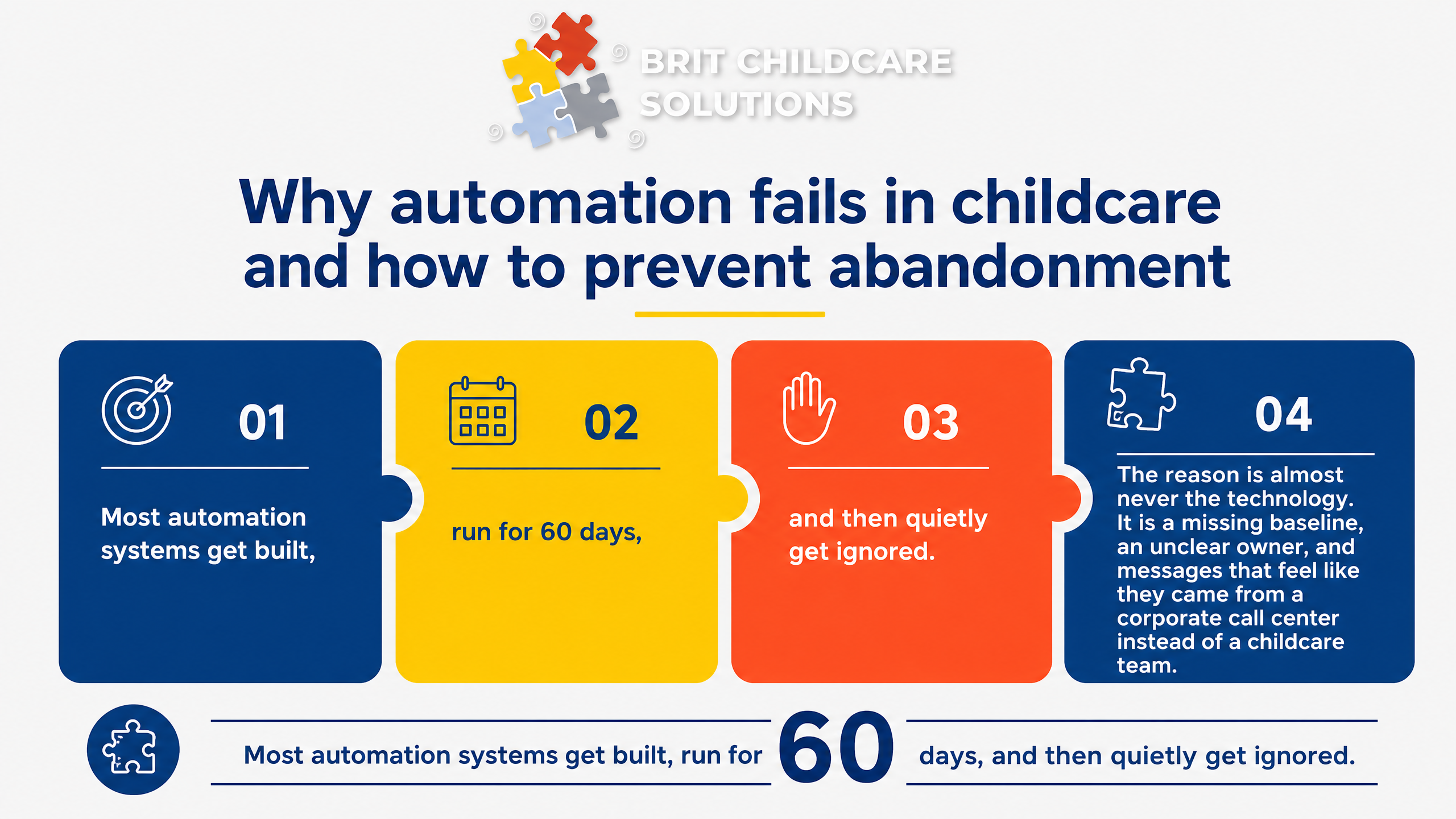
Most automation systems get built, run for 60 days, and then quietly get ignored. The reason is almost never the technology. It is a missing baseline, an unclear owner, and messages that feel like they came from a corporate call center instead of a childcare team.
ROI benchmarks that prove it
Automation earns its place when you can measure what changed. Three numbers tell the story for childcare centers.
Response time under five minutes is the first benchmark that matters. HubSpot customer expectations research shows 90% of customers rate an immediate response as essential, with 60% defining immediate as 10 minutes or less. For childcare inquiries, five minutes is the standard to beat.
Centers that hit it consistently report meaningfully higher tour booking rates than those relying on front desk callbacks.
Inquiry-to-tour conversion should improve by 20 to 40 percentage points once automated follow-up replaces manual outreach. If you are currently booking tours on 20% of inquiries, a well-built system should move that toward 40 to 60%. Tour show-up rate is the third benchmark.
Text-based reminders are the single highest-impact lever here. A pediatric clinic study found no-show rates dropped from 38% to 23% with text reminders alone. For childcare tours, a 75 to 85% show-up rate is a realistic and measurable target.
Setup timeline and training plan
Three weeks is a realistic build timeline for a center that is starting from scratch. Rushing past any phase is the most common reason systems get abandoned.
Week one is funnel mapping. Document every place a family can find you and submit an inquiry: your website, Google Business Profile, Facebook, and any paid ads. Identify where responses currently happen and how long they take.
This audit reveals your actual drop-off points before you build anything.
Week two is build and QA. Set up your automated text reply for each inquiry source, connect your tour booking link, and configure confirmation and reminder messages. Test every trigger with a real phone number before going live.
Broken automations erode staff trust faster than no automation at all.
Week three is staff training. Your team needs to know what the system sends, when it sends it, and what their job is after automation hands off. A 30-minute walkthrough with a one-page reference sheet is enough for most centers.
Make automation feel human
Parents do not object to fast replies. They object to replies that feel like they were generated by a company that does not know their child's name or their situation.
Approved tone means warm and specific, not corporate. Phrases like 'We would love to show you around' and 'We have a spot that might be a great fit for your family' outperform generic confirmations every time. Avoid phrases like 'Your inquiry has been received' or 'A representative will contact you shortly.'
Personalization fields that move the needle are first name, the child's name, and the program type they asked about. Those three fields, pulled from your inquiry form, transform a broadcast message into a conversation starter.
Automation should hand off to a human in three situations:
A family has a child with special needs or a complex care situation
A parent replies with a question your sequence cannot answer
A tour no-show occurs and no reschedule has been booked within 24 hours
These are the moments where a personal call from your director converts a hesitant family into an enrolled one. Automation handles the volume; your team handles the relationship.
When you want it done for you: BRIT Childcare installs the enrollment engine
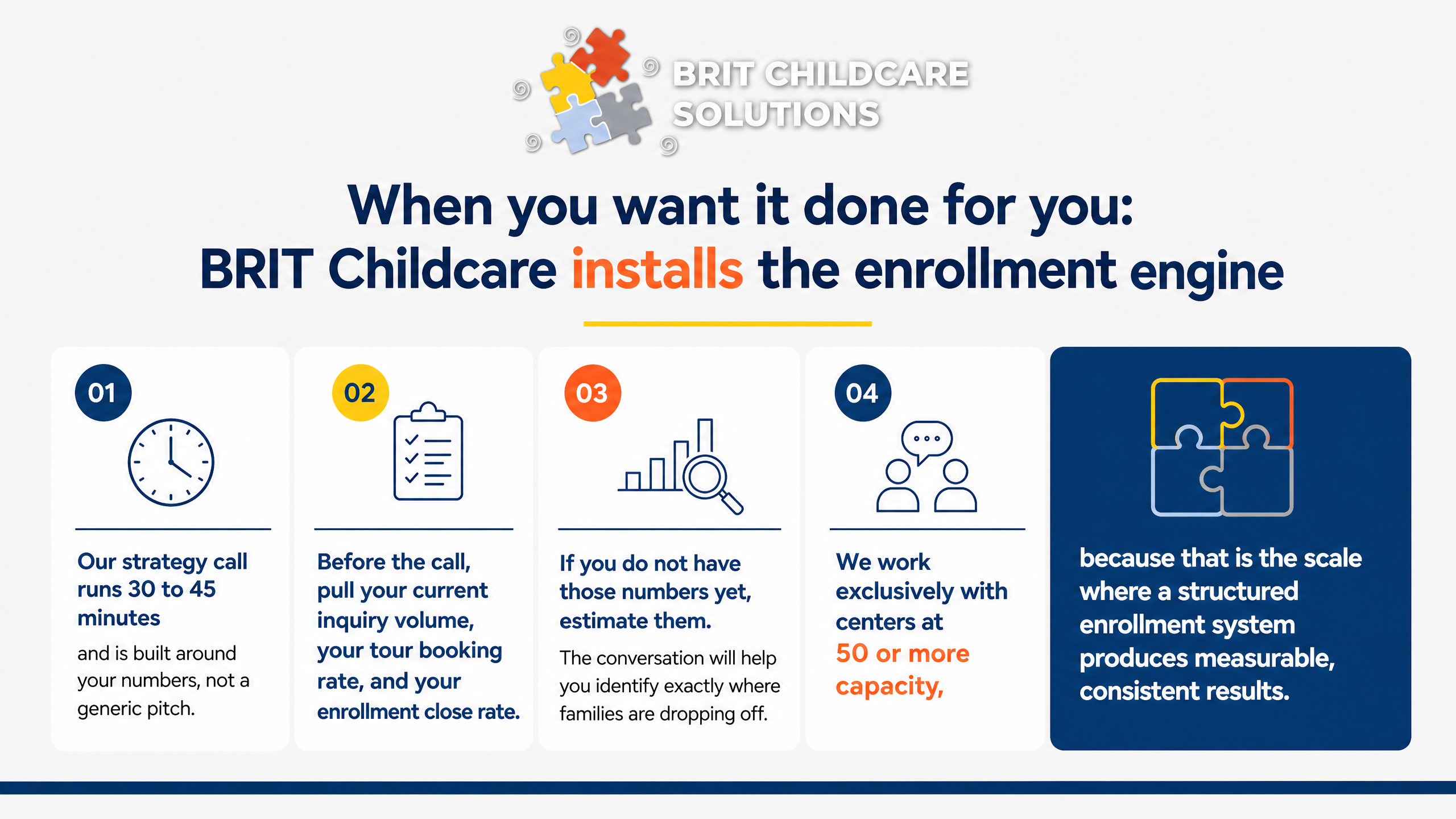
Our strategy call runs 30 to 45 minutes and is built around your numbers, not a generic pitch. Before the call, pull your current inquiry volume, your tour booking rate, and your enrollment close rate. If you do not have those numbers yet, estimate them.
The conversation will help you identify exactly where families are dropping off. We work exclusively with centers at 50 or more capacity, because that is the scale where a structured enrollment system produces measurable, consistent results.
What gets installed for you
We build and install the full enrollment system so you do not have to manage the technical setup yourself. Every inquiry channel gets connected: your website, Google Business Profile, social media, and paid ads all route leads into one unified system with automated responses firing within minutes.
Tour booking automation handles confirmations and text reminders so families show up. A pediatric clinic study found no-show rates dropped from 38.1% to 23.5% with text reminders alone. We apply that same logic to your tour pipeline.
Lead capture from all inquiry sources, routed by location for multi-site operators
Two-click tour booking with automated text confirmations and reminder sequences
Funnel tracking dashboard configured per location so you see performance by site
Multi-location operators get location-based routing built in from day one, so no inquiry lands in the wrong inbox or falls through a gap between sites.
How we measure enrollment impact
Counting leads without measuring what happens next tells you almost nothing. We track five conversion metrics per location so you always know where families are dropping off and what to fix.
Every reporting cycle shows you inquiry source and location breakdown, inquiry-to-tour conversion rate, and tour-to-enrollment conversion rate. Those three numbers tell you whether your problem is lead quality, booking friction, or tour execution.
Source and location reporting: see which channels and sites drive the most qualified inquiries
Inquiry-to-tour conversion: measure how many leads actually book and show up
Tour-to-enrollment conversion: track how many tours result in a signed enrollment agreement
With these metrics in place, your monthly strategy session with our team focuses on the specific drop-off point costing you enrollments, not on guessing where the problem might be.
Stop Losing Enrollments to a System That Was Never Built for Childcare
You have now seen exactly where automation breaks down in childcare, and more importantly, why it breaks down. The problem is almost never the technology. It is the sequence, the timing, and the fact that most automation tools were built for e-commerce or B2B sales, not for a parent who needs to feel confident before she hands you her child.
If you are ready to stop patching together generic tools and start running a system built around one outcome, getting families to book and show up to tours, we are here to do that work with you.
