Do Google Search Partners Hurt Childcare Leads?
Google Search Partners can quietly drain your ad budget on clicks that never become tours. The direct answer: yes, Search Partners often hurt childcare lead quality, but disabling them without a plan can shrink your inquiry volume before you have anything to replace it.
Here is what you need to know before you touch a single campaign setting:
Tour show-up rate, not inquiry count, is the metric that reveals whether your ad network is working.
A 20-minute audit of your Search Partners data can show whether that traffic is generating real families or burning budget on clicks that go nowhere.
A 14-day split test gives you enough data to make a confident decision on disabling Search Partners without guessing.
Statewide targeting is one of the fastest ways to replace lost volume with the wrong families, so geography matters more than network reach.
Centers with 70 or more capacity or multiple locations get the clearest return from a done-for-you system that handles lead validation and tour conversion together.
At BRIT Childcare, we work exclusively with childcare centers, preschools, and Montessori schools across 40+ states, and we built our Enrollment Engine around one outcome: tour-ready families showing up. We have seen too many owners pay for inquiries that never convert because no one validated the lead or followed up within five minutes. You focus on your staff and the children in your care.
We handle the rest.
To understand why Search Partners create this problem in the first place, it helps to know exactly what you are buying when Google splits your budget between core search and its partner network, and how that split affects the quality of families landing in your pipeline.
Google Search vs Search Partners: what you are buying
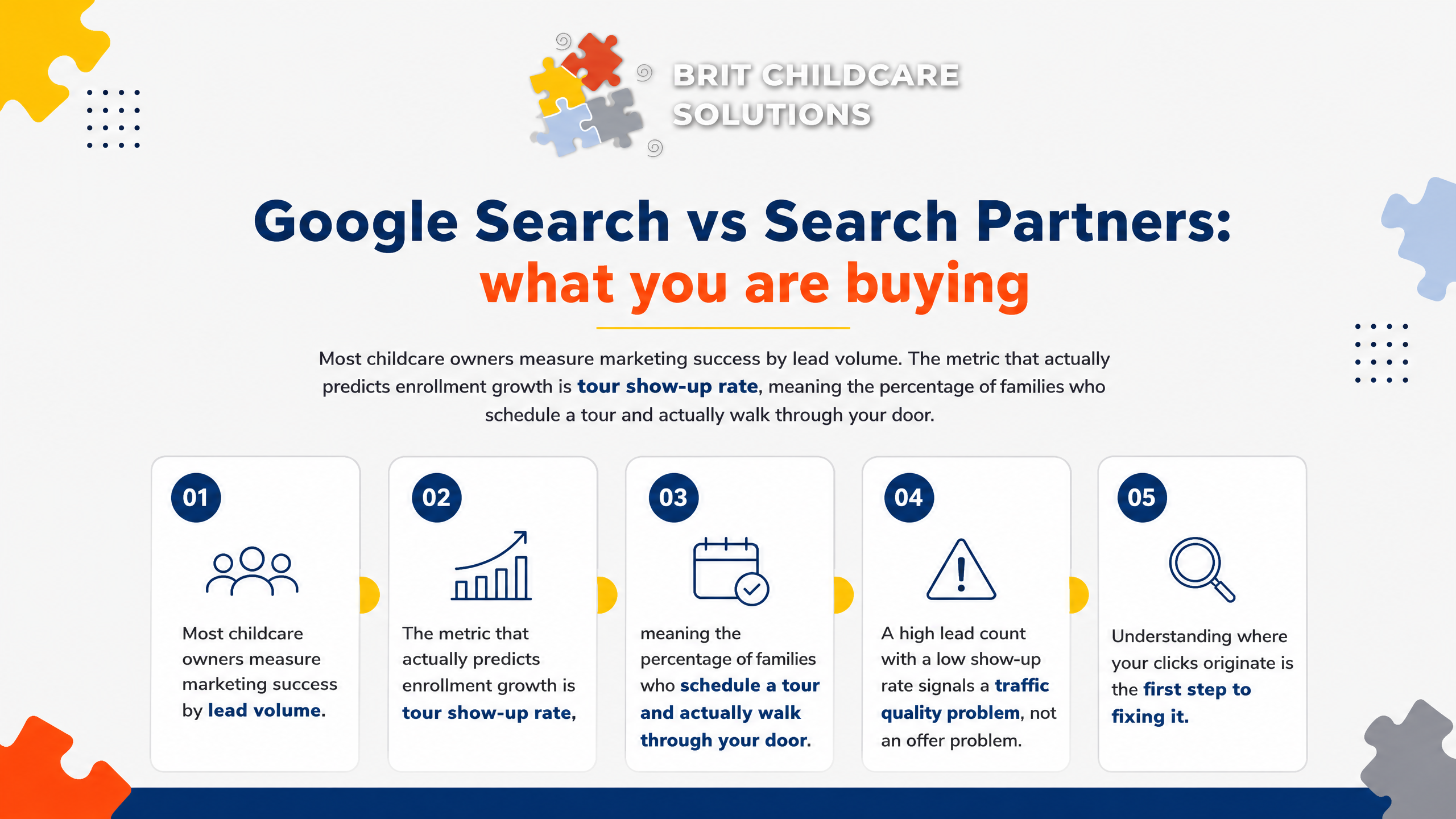
Most childcare owners measure marketing success by lead volume. The metric that actually predicts enrollment growth is tour show-up rate, meaning the percentage of families who schedule a tour and actually walk through your door. A high lead count with a low show-up rate signals a traffic quality problem, not an offer problem.
Understanding where your clicks originate is the first step to fixing it.
Where Search Partners ads appear
When you run a Google Search campaign, your ads do not only appear on Google.com. According to Google's official documentation, Search Partners extend your reach to hundreds of non-Google websites, including YouTube, site directory pages, and product detail pages. This happens by default unless you manually opt out.
The problem is intent. A parent searching on Google for 'infant daycare near me' is in active decision mode. That same query surfaced on a third-party directory or content site carries far less urgency.
The user may be browsing, comparing broadly, or simply landing there by accident.
Placements include non-Google search engines, directory sites, and product listing pages
Google does not publish a full list of partner sites, making it difficult to audit where your budget goes
Click-through behavior on partner sites often differs significantly from Google.com traffic
Less transparency means less control, and for a local childcare center with a fixed monthly budget, uncontrolled placements are a direct threat to lead quality.
Why childcare gets hit harder
Childcare searches carry strong local urgency. Parents looking for an open spot near a specific zip code are high-value prospects on Google Search. On partner sites, that same query attracts a much wider mix of users, including price shoppers comparing multiple providers at once and families who are months away from needing care.
Childcare lead forms are also a known target for bot submissions. Because enrollment inquiries represent real revenue, fraudulent publishers have an incentive to inflate form completions on their sites. The result is a lead report that looks healthy but produces tours that never materialize.
Local urgency queries lose precision outside Google's core search environment
Price and availability shoppers on partner sites rarely convert to scheduled tours
Bot-driven form submissions are more common when partner placements are active
This is why childcare operators consistently see their cost per actual tour rise when Search Partners are enabled, even when cost per lead appears stable.
The 20-minute Search Partners damage check
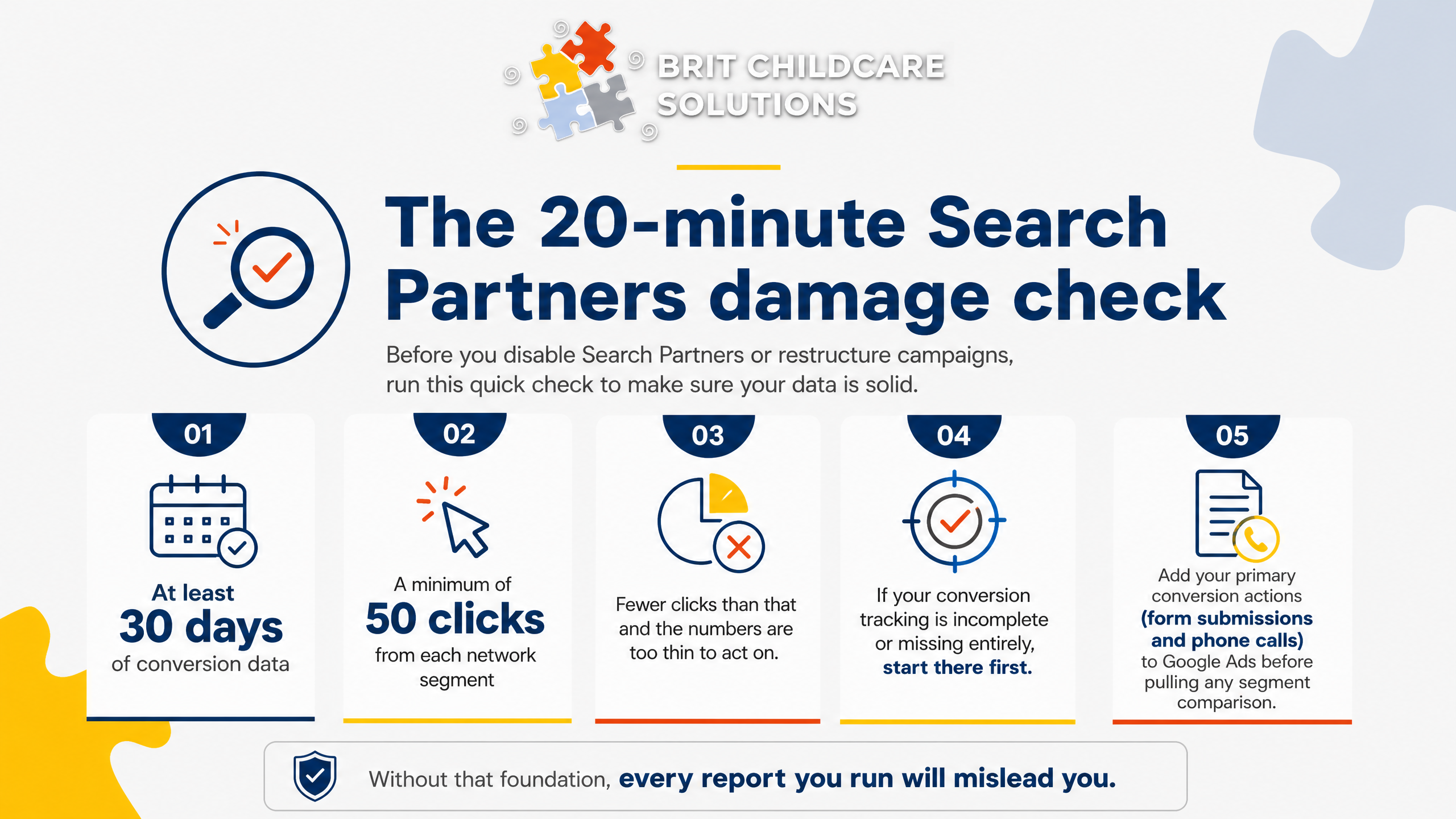
Before you disable Search Partners or restructure campaigns, you need at least 30 days of conversion data and a minimum of 50 clicks from each network segment. Fewer clicks than that and the numbers are too thin to act on. If your conversion tracking is incomplete or missing entirely, start there first.
Add your primary conversion actions (form submissions and phone calls) to Google Ads before pulling any segment comparison. Without that foundation, every report you run will mislead you.
Pull the right Google Ads views
Open your Google Ads campaign, click Segment, and select Network (with search partners). This splits your performance data into Google Search and Search Partners rows so you can compare them directly.
Look at cost per conversion by segment. If Search Partners is delivering form submissions at two or three times the CPA of Google Search, that gap is worth investigating. A higher CPA alone is not proof of fraud, but it is a clear signal to dig deeper.
Also check which conversion actions are firing from each segment. If Search Partners is counting page visits or low-intent micro-conversions while Google Search is counting phone calls and tour bookings, the CPA comparison is misleading. You want apples to apples: tour-intent actions only.
Spot the tour-killer patterns
Three patterns in your raw lead data suggest Search Partners is generating noise rather than real families. Each one is worth checking before you draw conclusions from aggregate numbers.
High clicks, low calls: Search Partners shows strong click volume but your call tracking shows little to no inbound calls from those sessions. Genuine childcare parents almost always call or book a tour. Clicks without calls are a warning sign.
Fast form timestamps: Pull your form submission timestamps.
Submissions completed in under 10 seconds are almost certainly bot-generated. Legitimate parents read the form, fill in details, and take at least 30 to 60 seconds.
Same ZIP repeated: If you see clusters of form submissions from a ZIP code outside your enrollment radius, or the same ZIP appearing dozens of times in a short window, that pattern points to coordinated fake submissions rather than real local families.
You can request source IP addresses and submission timestamps directly from Google to validate specific leads. That data makes the pattern visible rather than theoretical.
Match leads to tour outcomes
The most defensible check happens in your CRM, not in Google Ads. Tag every inbound lead with its source: Google Search or Search Partners. Most centers skip this step and then have no way to trace a no-show back to where the inquiry originated.
Once you have source tagged, compare show-up rates by segment over 60 to 90 days. LineLeader's Q1 2026 benchmarks show approximately 75% of scheduled tours are completed across the industry. If your Search Partners leads are showing up at 40% or lower, that segment is costing you more than the click spend suggests.
Finally, track enrollment yield by source. A lead that tours but never enrolls is still a loss. If Search Partners produces inquiries that tour at low rates and enroll at even lower rates, the math is clear.
That segment is not contributing to filled seats.
Run a 14-day split test that answers the question
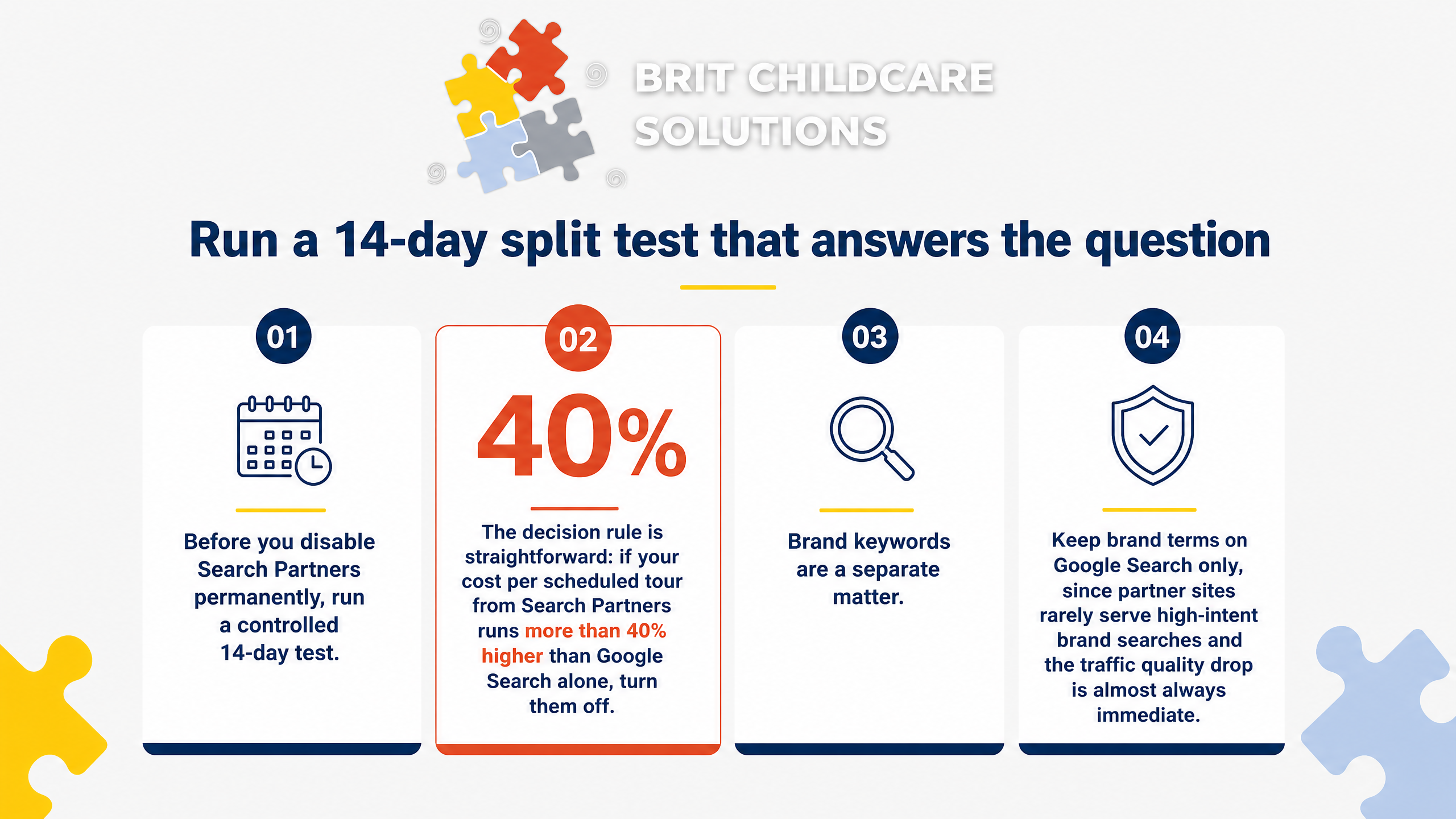
Before you disable Search Partners permanently, run a controlled 14-day test. The decision rule is straightforward: if your cost per scheduled tour from Search Partners runs more than 40% higher than Google Search alone, turn them off. Brand keywords are a separate matter.
Keep brand terms on Google Search only, since partner sites rarely serve high-intent brand searches and the traffic quality drop is almost always immediate.
Test setup that stays fair
Duplicate your existing campaign into two identical versions. One runs with Search Partners enabled, one runs with Search Partners disabled. Everything else must match exactly, or your results will reflect the difference in setup rather than the difference in traffic source.
Lock in the same settings across both campaigns:
Same geographic targeting, down to the zip codes or radius around your center
Same ad schedule, including days of week and hours
Same keywords, match types, and negative keyword list
Same ad copy and landing page URL
Equal daily budget split between both campaigns
Any variable you leave unmatched becomes a confounding factor that makes the results unreadable.
Success metrics for childcare
Lead volume is the wrong scorecard. The metrics that actually tell you whether Search Partners are helping or hurting your enrollment funnel are tour-based, not click-based.
Track these three numbers for each campaign over the 14 days:
Cost per scheduled tour: total spend divided by tours booked, not inquiries received
Tour show-up rate: what percentage of scheduled tours actually walked through your door
Cost per enrollment: total spend divided by families who signed and paid
LineLeader's Q1 2026 benchmarks put the average tour completion rate at approximately 75%. If your Search Partners campaign is pulling that rate down significantly, the traffic quality problem is real and the data will show it clearly.
How to interpret messy results
Fourteen days is a short window, and childcare enrollment does not move in a straight line. Before drawing conclusions, apply a few safeguards.
On small sample sizes: if either campaign generated fewer than 10 scheduled tours, the data is not statistically reliable. Extend the test by another week rather than making a permanent decision on thin numbers.
On seasonality and waitlists: if your center is in a peak enrollment period or currently running a waitlist, Search Partners may appear to perform well simply because all traffic converts at a higher rate. The real test comes during slower months when lead quality separates good traffic from wasted spend.
On staffing and tour capacity: if your team can only conduct a limited number of tours per week, a campaign that generates more inquiries will not produce more tours. It will produce more no-shows and unanswered follow-up. Factor your actual tour capacity into the comparison before concluding that one campaign outperformed the other.
If you disable Search Partners, what replaces the volume
The fear of losing inquiry volume is real, but volume without quality is just noise. Broad statewide targeting and generic awareness campaigns generate clicks from families who are nowhere near your center, cannot afford your rates, or are simply browsing. Replacing that volume means replacing it with something better: families who are close, who fit your program, and who are ready to book a tour.
Pick 1 to 2 neighborhoods
Tighter geography produces more tours per dollar. Start by drawing a realistic drive-time radius around your center, typically 10 to 15 minutes, and build your targeting around that boundary. Families rarely cross town for childcare, so advertising beyond that radius fills your pipeline with leads that never show up.
Within that radius, layer in age-range fit. If your program serves infants through pre-K, target parents of children aged 0 to 5. Broad demographic targeting wastes spend on families whose children have already aged out of your program or are not yet born.
If you are running a waitlist or have premium pricing, add those filters explicitly. Target households with income levels that match your tuition range, and use your ad copy to signal that you have limited openings. This pre-qualifies families before they ever click.
Use Google and Facebook for tours
Google Search captures families who are actively looking right now. Search terms like "daycare near me" or "preschool enrollment open" signal high intent, and those clicks convert to tours at a much higher rate than display or partner traffic. Keep your Google campaigns focused on exact and phrase match keywords tied to your neighborhood.
Facebook works differently. Most parents are not searching for childcare on Facebook, but they are scrolling. Facebook lets you reach families in a specific zip code who match your age and demographic profile before they start actively searching.
Think of it as demand capture: you get in front of the right family before your competitor does.
The non-negotiable step is turning off Search Partners in your Google campaign settings. That single change stops your budget from flowing to third-party sites where click fraud and low-quality traffic are far more common. Between tight geo-targeting on Google and demographic targeting on Facebook, you replace the volume with something that actually books tours.
Add friction that improves quality
A shorter form gets more submissions, but not better ones. Adding required fields filters out families who are not serious and gives you the information you need to qualify a lead before your team spends time on follow-up.
Include CAPTCHA on every inquiry form. Bot submissions inflate your lead count and distort your conversion data. A simple CAPTCHA step eliminates most automated submissions without adding meaningful friction for a real parent filling out the form.
Beyond CAPTCHA, build in tour-ready qualifiers. Ask for the child's age, desired start date, and preferred tour time. These three fields tell you immediately whether the family fits your program and whether they are ready to move forward.
Families who skip these fields or give vague answers are rarely the ones who show up.
Required fields: child's name and age, parent contact, desired start date, preferred tour time
CAPTCHA to block bot submissions and protect your lead data
Start date question to separate active searchers from casual browsers
When your form does this filtering work upfront, your team spends time on families who are genuinely ready, not chasing leads that were never going to convert.
Which childcare lead sources hold up when you grade tours
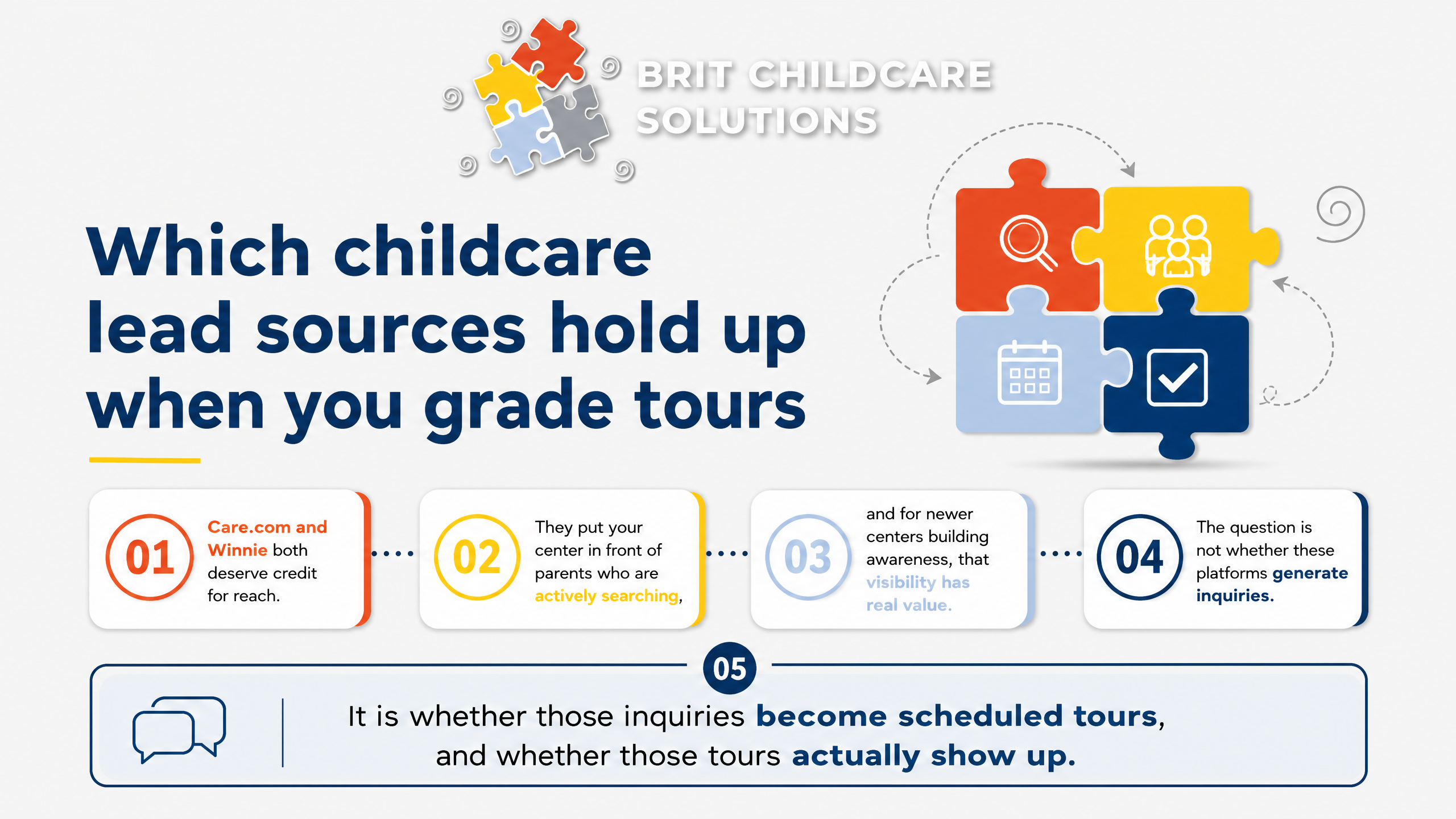
Care.com and Winnie both deserve credit for reach. They put your center in front of parents who are actively searching, and for newer centers building awareness, that visibility has real value. The question is not whether these platforms generate inquiries.
It is whether those inquiries become scheduled tours, and whether those tours actually show up.
Care.com listings and ads
Care.com brings strong marketplace intent. Parents on the platform are actively looking for childcare, not passively scrolling, which means the inquiry signal is real.
The limitation is exclusivity. A parent submitting a Care.com inquiry may contact three to five centers simultaneously. You are not getting a warm lead handed to you.
You are entering a race with your competitors.
Tour conversion control is also limited. Once a parent leaves the platform, follow-up is on you. Care.com does not validate whether a family fits your enrollment criteria, confirm their start date, or send reminders before a scheduled tour.
Centers with 50 or more capacity and no automated follow-up system often see inquiry-to-tour rates drop significantly because response time and nurture sequences are handled manually.
Winnie directory presence
Winnie functions more as a local discovery tool than a high-intent lead source. Parents browsing Winnie are often in research mode, comparing programs, reading reviews, and checking licensing status before they are ready to book.
Profile quality matters more here than on other platforms. Winnie surfaces detailed program information including photos, cost data, and real-time openings. A thin or outdated profile will lose families to a competitor with a complete one, even if your program is stronger.
Inquiry-to-tour conversion on Winnie varies widely depending on how quickly you respond and whether your profile communicates a clear reason to choose your center. According to 2026 childcare marketing data, standard tour-to-enrollment conversion rates hover around 30 to 40 percent, which means every inquiry that stalls before a tour is a compounding loss.
BRIT Childcare done-for-you system
We work exclusively with childcare, preschool, Montessori, and before and after school programs across 40 or more states. That niche focus means our systems are built around how childcare families actually decide, not adapted from a generic marketing template.
Where Care.com and Winnie stop at the inquiry, our Enrollment Engine continues. Lead validation filters out families who do not match your enrollment criteria before they reach your calendar. Automated responses go out within minutes, not hours, which is the window that determines whether a parent books with you or the center down the street.
Tour show-up systems are built into the process. Text-based confirmation sequences and reminder cadences run automatically, reducing no-shows without requiring your staff to chase families manually. Our clients with 70 or more capacity typically see 10 to 40 scheduled tours per month with show-up rates that reflect a validated, nurtured inquiry pool rather than raw lead volume.
When a tour-first agency is the right next step
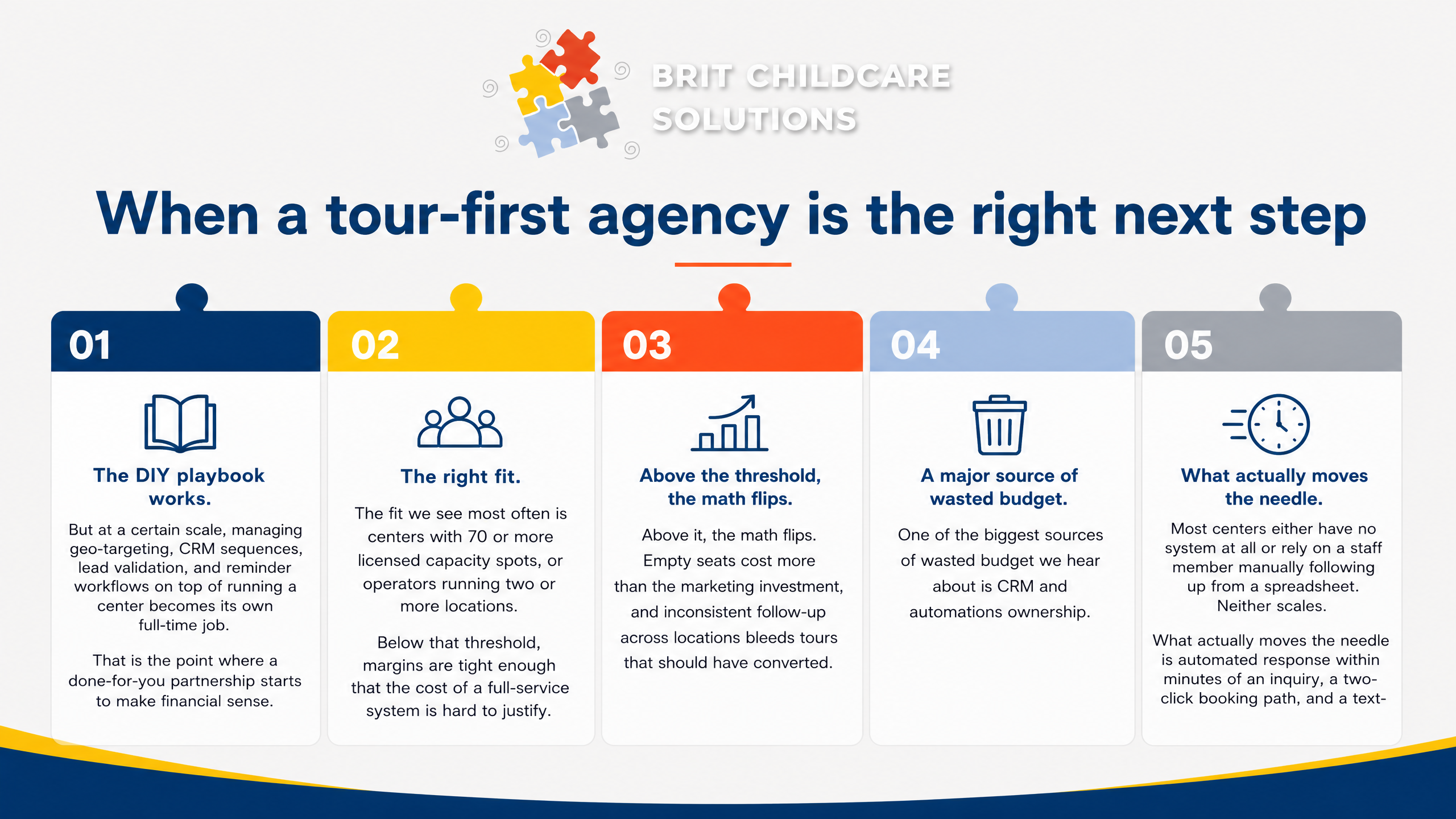
The DIY playbook works. But at a certain scale, managing geo-targeting, CRM sequences, lead validation, and reminder workflows on top of running a center becomes its own full-time job. That is the point where a done-for-you partnership starts to make financial sense.
The fit we see most often is centers with 70 or more licensed capacity spots, or operators running two or more locations. Below that threshold, margins are tight enough that the cost of a full-service system is hard to justify. Above it, the math flips.
Empty seats cost more than the marketing investment, and inconsistent follow-up across locations bleeds tours that should have converted.
One of the biggest sources of wasted budget we hear about is CRM and automations ownership. Most centers either have no system at all or rely on a staff member manually following up from a spreadsheet. Neither scales.
What actually moves the needle is automated response within minutes of an inquiry, a two-click booking path, and a text-based reminder sequence that runs without anyone babysitting it. When we work with a center, we own and manage all of that so the director's job is simply to show up and give the tour.
In terms of what to expect, our clients typically see between 10 and 40 scheduled tours per month depending on their market, capacity, and current inquiry volume. That range is not a promise. It reflects what centers with healthy lead flow and a working conversion system actually produce.
If you are currently booking fewer than 10 tours monthly and have 70-plus capacity, the gap is almost always in follow-up speed and tour booking friction, not ad spend.
Before a strategy call, we do a brief pre-call qualification to confirm the fit. Come prepared with your current lead sources, your monthly inquiry volume, and a target number of tours you want to reach. We will ask about capacity and whether you are single or multi-location.
The call itself runs 30 to 45 minutes and focuses on where your enrollment funnel is leaking, not a generic pitch. If the fit is not there, we will tell you that too.
Ready to Stop Paying for Clicks That Never Become Tours?
If this article confirmed what you already suspected, that Search Partners traffic is quietly draining your budget on clicks that never show up for a tour, the next step is not another ad tweak. It is building a system where every inquiry is validated, followed up within minutes, and converted into a scheduled tour with a high show-up rate.
That is exactly what we do at BRIT Childcare.
Before you book your enrollment growth strategy call, take two minutes to confirm you are the right fit. We work best with centers at 70 or more capacity, or operators running multiple locations. Come to the call with your current lead sources and a target number of tours you want to book each month.
We will build a plan focused on improving your tour show-up rate and cutting the bogus lead waste that is costing you real money right now.
Book your BRIT Childcare enrollment growth strategy call at britchildcare.com/work-with-us.
Frequently Asked Questions
What's the difference between an inquiry and an enrollment?
An inquiry is a parent who raised their hand. An enrollment is a parent who signed, paid, and placed their child in your care. The gap between those two points, tour booking, show-up, and the enrollment decision, is where most centers lose families, and where the right follow-up system makes the biggest difference.
Why do we have leads but empty seats?
Because lead volume and enrollment growth are not the same metric. If your inquiry-to-tour rate is low, or your tour show-up rate is inconsistent, more leads will not fix the problem. The issue is almost always what happens after the inquiry arrives, not how many inquiries you are generating.
How fast should we respond to childcare inquiries?
Within five minutes. Parents comparing childcare centers are making fast decisions, and the center that responds first has a measurable advantage in booking the tour. Waiting hours to follow up, even with a strong ad campaign, hands that family to a competitor.
