Growing daycare business with staffing limits
Growing a daycare business when staffing ratios set a hard ceiling on capacity is possible, but only when you stop chasing leads and start building a system that converts inquiries into attended tours and staffed classrooms. Most childcare owners we talk to are not short on interest from parents.
Here is what actually drives enrollment growth when ratios are working against you:
Start with a monthly enrollment number, then back into exactly how many attended tours you need to hit it.
A parent inquiry without a fast follow-up response is a lost seat, not a warm lead to revisit later.
Your website needs one clear tour booking path, not multiple contact options that scatter parent attention.
Staffing ads and enrollment ads require separate pipelines, because solving one without the other stalls growth.
Ads only produce a return after your tour booking and follow-up system is ready to convert the traffic they send.
At BRIT Childcare, we work exclusively with childcare centers, preschools, and Montessori schools across 40+ states, and we measure our success in tours scheduled and attended, not leads delivered. Our done-for-you enrollment system handles inquiry capture, automated follow-up, tour booking, and tracking so you can stay focused on your staff and the children in your care.
Before any of the execution steps make sense, it helps to understand exactly why ratio-driven growth feels like running into a wall, and what is actually causing the ceiling to hold.
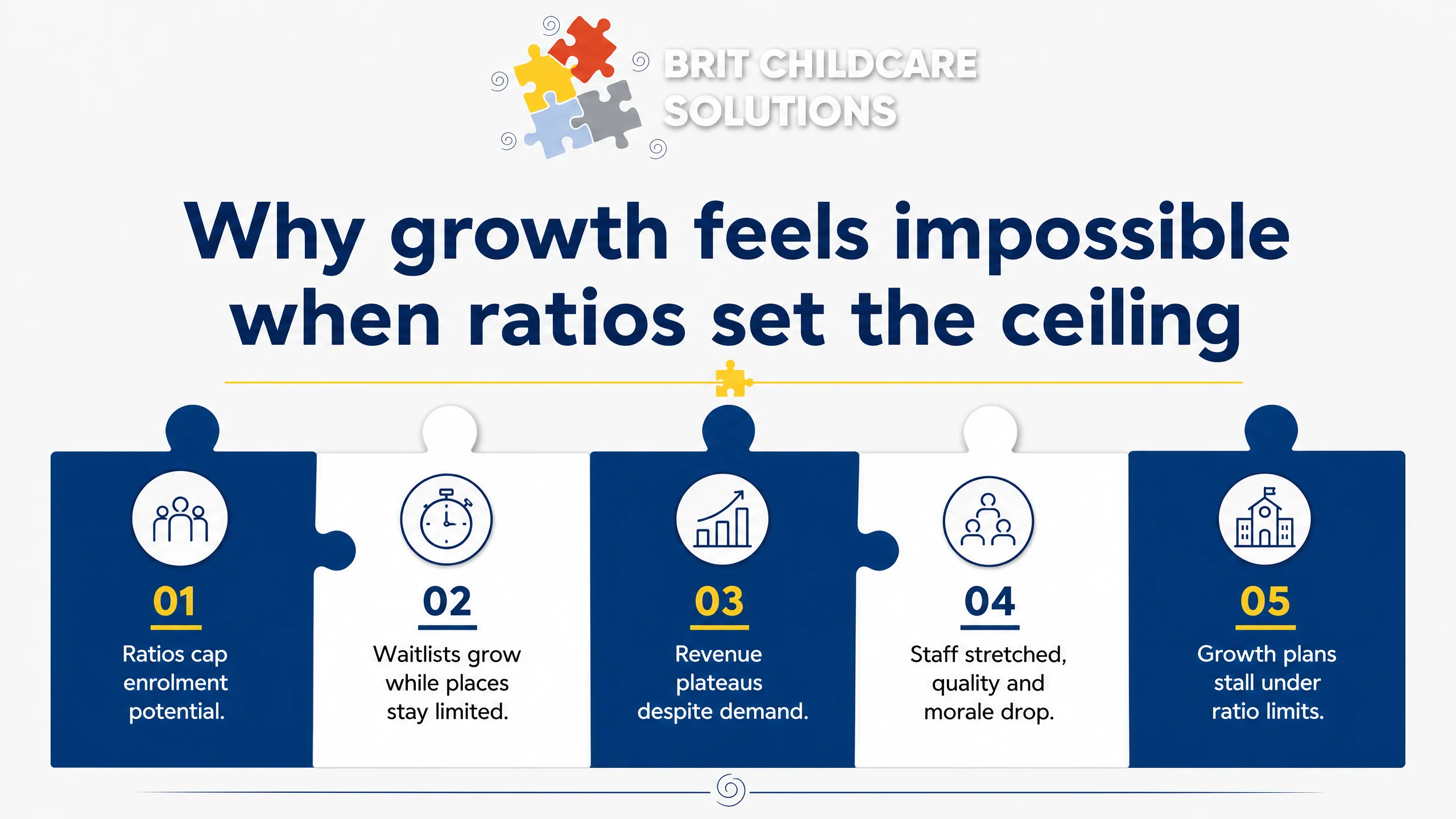
Why growth feels impossible when ratios set the ceiling
The two complaints we hear
Childcare owners running centers at 50+ capacity tell us the same two things: margins are thin, and ratios make it feel like the walls are closing in.
Staffing ratios are a hard regulatory ceiling. Adding one classroom of toddlers means hiring two or three more qualified staff before a single new child walks through the door. That cost hits before the tuition revenue does, which is why so many owners stall at the same enrollment number year after year.
On top of that, owner time disappears fast. Between compliance, staff management, and parent communication, there is rarely a spare hour to think strategically about growth, let alone execute a marketing plan.
Tours are the real bottleneck
The constraint is not leads. Most centers already get inquiries. The problem is what happens to those inquiries after they come in.
An inquiry that never becomes a scheduled tour is wasted capacity. A tour that is booked but not attended is just as costly, because that time slot cannot be recovered. The LineLeader Benchmark Report shows call-to-enrollment conversion rates in childcare can be as low as 6%, which means most of the interest centers generate never becomes revenue.
Attended tours are where predictable enrollment starts. When you know how many families actually show up each month, you can back into a real growth number and build a system around it.
Inquiries without tours: time spent, no enrollment outcome
Booked tours without show-ups: capacity blocked, revenue lost
Attended tours: the only metric that produces consistent enrollments
Fixing enrollment growth means fixing tour attendance first, not adding more leads to a leaking funnel.
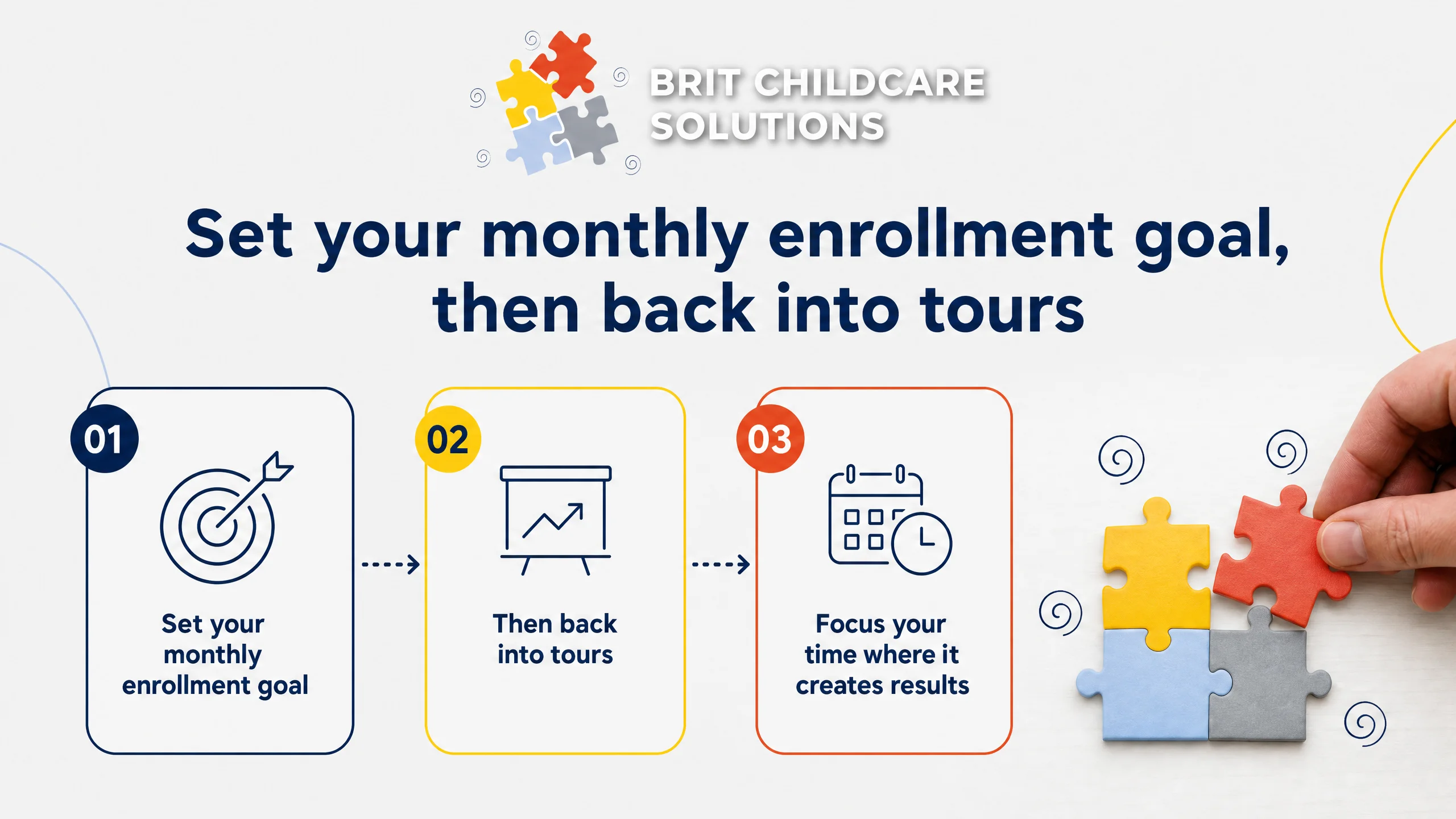
Set your monthly enrollment goal, then back into tours
The tour math model
Start with a concrete enrollment target, then work backward to find out exactly how many leads you need each month. This model removes the guesswork and exposes where your funnel is leaking.
Assume a tour show-up rate between 50% and 70%. That means if you book 20 tours, expect 10 to 14 families to actually walk through your door. Tour-to-enrollment close rates typically run between 60% and 80% for centers with a strong director and a clear parent promise.
Enrollment target example: 8 new enrollments in 30 days
At a 65% show-up rate, you need roughly 12 to 13 attended tours
At a 70% close rate, that means booking 18 to 19 tours
At a 20% lead-to-tour booking rate, you need 90 to 95 qualified inquiries
Most centers are not short on inquiries. They are short on a system that converts those inquiries into booked, confirmed, attended tours.
Spot the unqualified lead trap
Paying for ads that generate leads without a tour conversion system is one of the most common ways childcare owners waste their marketing budget. A lead that never books a tour is not a lead, it is a missed seat.
Without a filter for pricing and availability upfront, your inquiry volume fills with families who cannot afford your rates or need an age band you cannot serve. Every follow-up call your team makes to an unqualified family is time taken from a family who was ready to enroll.
Response speed compounds the problem. The LineLeader Benchmark Report shows that call-to-enrollment conversion rates in childcare can fall as low as 6% without fast follow-up systems in place. Families shopping multiple centers will book the first one that responds with a clear next step.
Front desk staff were not hired to be a sales team. Missed calls, voicemails, and slow callbacks are not a people problem, they are a systems problem. Automation handles the first response so your team focuses on families who are already tour-ready.
Where BRIT Childcare fits after the math
What done-for-you replaces
Most childcare owners know what needs to happen. The problem is execution takes time, technical skill, and weekly attention that running a center simply does not leave room for.
At BRIT Childcare, we handle the full stack so you stay focused on tours and staff.
Website fixes and conversion tracking so inquiries do not disappear into a contact form
CRM setup, AI-powered follow-up sequences, and automations that respond within five minutes
Ad build, audience testing, and ongoing optimization across Google and Facebook
Weekly performance reviews tied to tours booked and show-up rate, not vanity metrics
Every piece connects back to one outcome: families who schedule and attend a tour.
Proof you can benchmark
Our clients across 40+ states typically see 10 to 40 scheduled tours per month once the enrollment system is fully running, with daily qualified staff applicant flow running alongside it.
Show-up rate is the metric we track most closely. A booked tour that does not happen is lost revenue, and most centers cannot tell you their current show-up rate. We build the tracking and reminders that change that number.
Make one website path that books tours
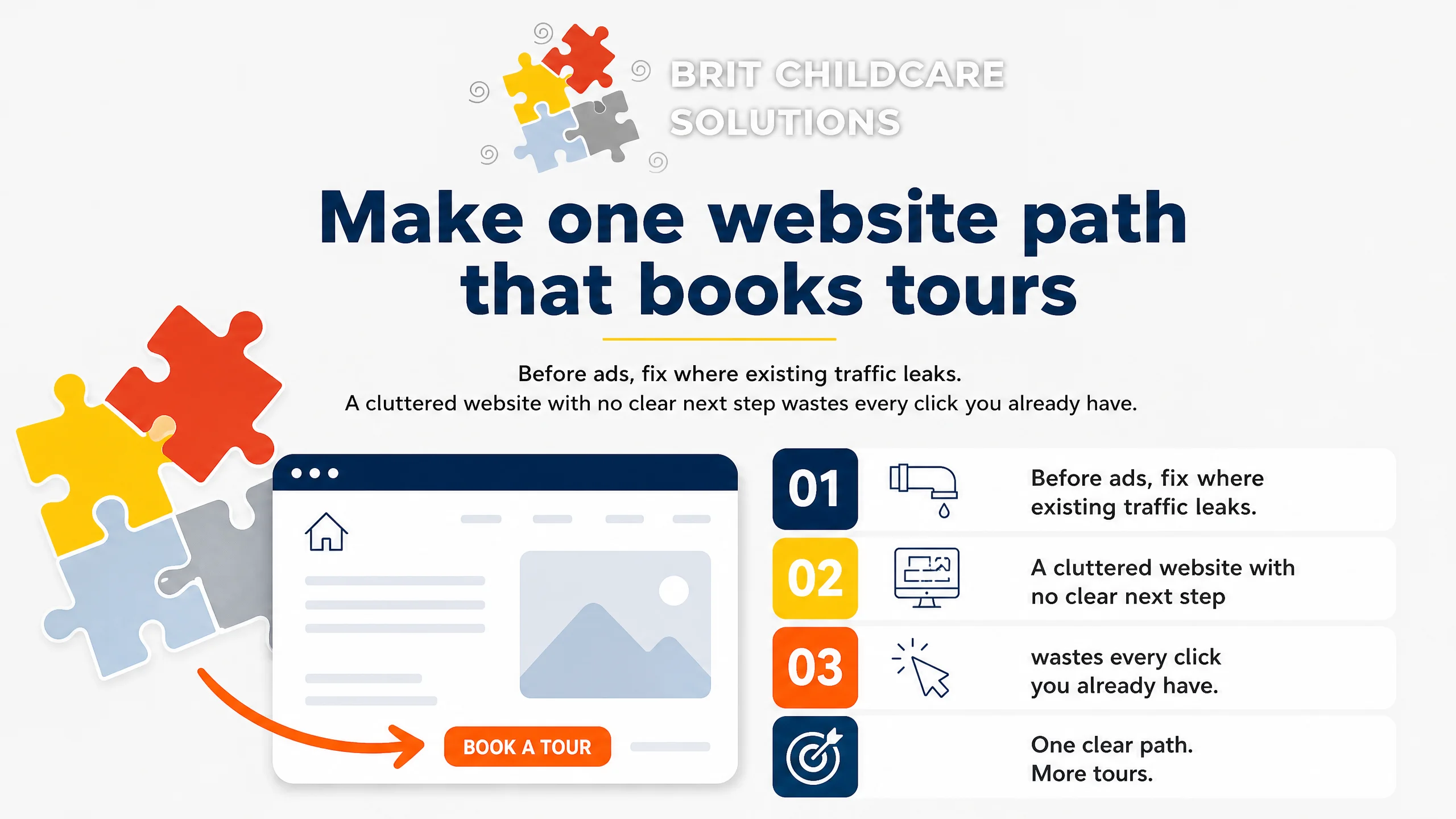
Before ads, fix where existing traffic leaks. A cluttered website with no clear next step wastes every click you already have.
One primary tour CTA
Your website has one job: get a parent to request a tour. Every other element is secondary.
Put the tour request button above the fold so parents never have to scroll to find it. Build one dedicated page per location, not a generic contact page shared across your center. Parents searching in a specific zip code want to see that location's availability, not a corporate overview.
List two or three available tour times so parents know slots exist before they click
Set expectations: how long the tour runs, who they will meet, what they will see
Include a starting tuition range or a phrase like 'rates starting at' so families self-screen before submitting
Showing pricing context upfront reduces the volume of inquiries that go nowhere and protects your team's time.
Qualification baked into forms
A tour request form should do two things: capture the lead and filter out families who are not a fit yet. Ask for the child's age group and desired start date on the first screen. This tells you immediately whether you have an opening that matches.
Add fields for schedule needs and preferred days. A family needing Monday through Friday full-time is a different conversation than one needing two mornings a week. Include a simple budget checkpoint, such as a tuition range selector, so families confirm fit before your director spends time on a call.
Finally, build in waitlist and availability logic. If your infant room is full, route that inquiry to a waitlist confirmation rather than a live tour booking. This keeps your calendar manageable and sets honest expectations from the first touchpoint.
Follow-up automation that turns booked tours into show-ups
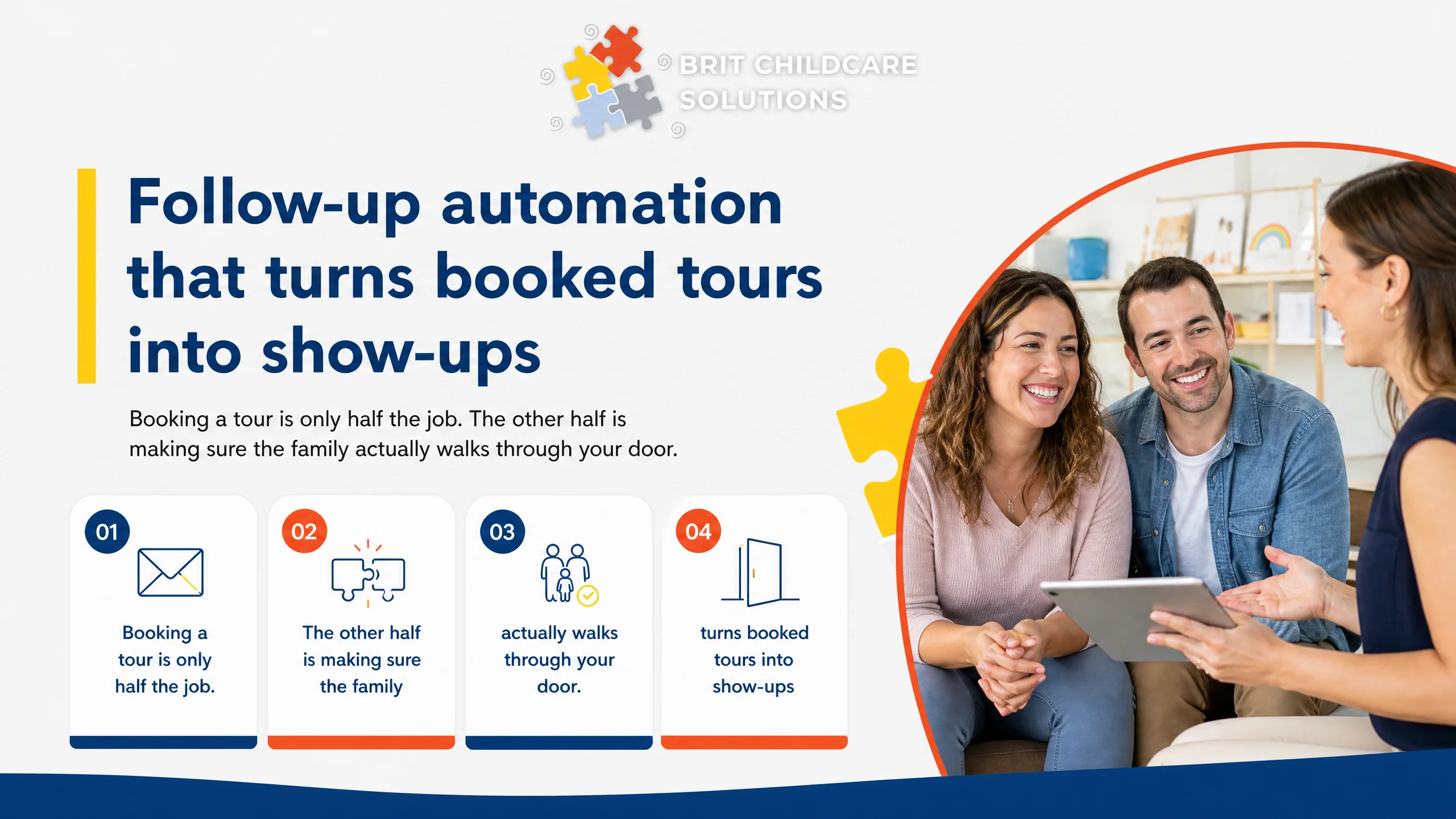
Booking a tour is only half the job. The other half is making sure the family actually walks through your door.
Fast response wins the tour
The LineLeader Benchmark Report found that the first center to respond has around an 80% higher chance of winning enrollment. That window closes fast. Parents searching for childcare are contacting multiple centers at once, and whoever responds first earns the tour.
Your target is a 5-minute response window. Manual follow-up cannot hit that consistently, so automation handles the first touch. The most effective approach pairs an immediate SMS with a phone call from your team within the same window.
Text gets seen; a call builds trust.
That first message should include a calendar link so parents can book in two clicks without waiting on hold. Automated confirmations go out the moment they select a time. For after-hours inquiries, your system should send the same automated text and email sequence overnight so no lead sits cold until morning.
The show-up sequence
Most tour no-shows are preventable with a simple three-touch sequence after booking.
Run this cadence for every booked tour:
24-hour reminder text: Confirm the time, share your address, and include a one-sentence parent promise that sets emotional tone before arrival
Same-day confirmation call: A brief check-in from your front desk that morning reduces last-minute cancellations and signals you are expecting them
Tour prep video and checklist: Send a short video showing your classrooms and a simple checklist of what to bring, which builds anticipation and reduces first-visit anxiety
No-show rescue and rebook: If a family misses their tour, trigger an automated rebook message within two hours while interest is still warm
Centers that run this full sequence consistently see show-up rates climb without adding meaningful work to their front desk staff.
Turn on parent ads only when your tour system is ready
Ads work when your tour system is ready to catch what they send. Without that foundation, you are paying for inquiries that stall.
Google ads for high intent
Google captures parents who are actively searching right now, making it the highest-intent channel for childcare enrollment. According to 2026 daycare marketing benchmarks, Google Ads convert at 7.2%, nearly double the average website conversion rate.
Target location-specific, age-band keywords such as 'infant daycare in [city]' or 'preschool openings near [zip code].' Add call extensions and lead form extensions directly to your ads so a parent can book or call without an extra click.
Add negative keywords for job seekers: 'childcare jobs,' 'daycare hiring,' 'ECE positions,' and similar terms drain budget fast
Set your conversion event to 'tour booked,' not 'form submitted,' so you are optimizing for attended tours, not raw inquiries
Use location-specific ad groups for each center if you operate multiple sites
Tracking booked tours as your conversion event tells Google's algorithm exactly which clicks are worth paying for.
Facebook ads for demand creation
Facebook does not catch parents mid-search. It creates demand by reaching parents before they start comparing centers. Short video walkthroughs of your classrooms and authentic clips from current families perform consistently well here.
Run two angles: one ad highlighting open spots in specific age groups, and a second building waitlist interest for programs filling soon. Both angles create urgency without pressure.
Use Facebook's native lead forms with two to three qualifying questions, such as child's age and target start date, to filter low-intent clicks before they reach your calendar
Set tour booking as your campaign conversion event, not lead volume
UGC clips from real parents outperform polished studio video for trust and click-through rate
Build a staffing pipeline so enrollment does not create chaos
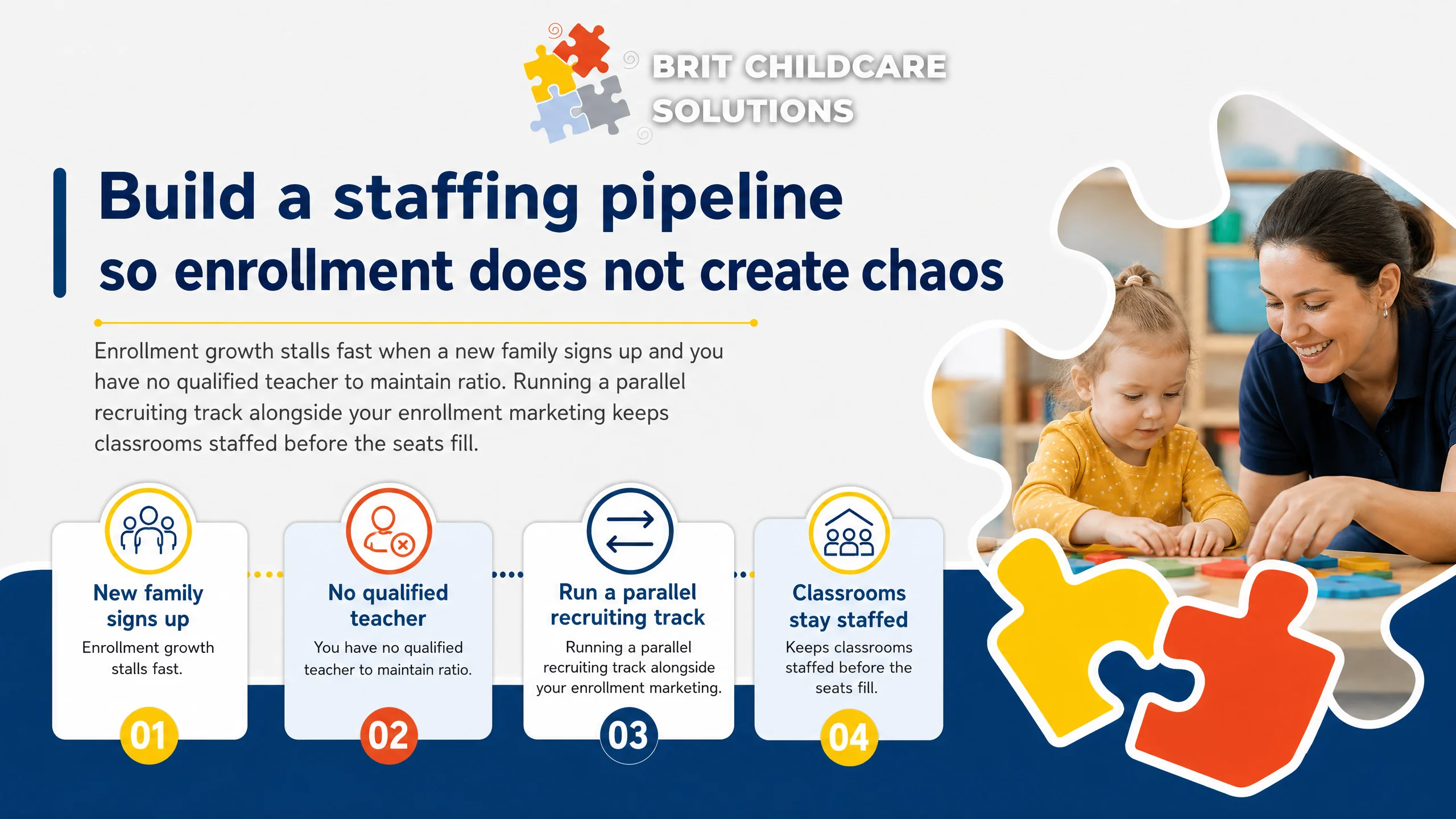
Enrollment growth stalls fast when a new family signs up and you have no qualified teacher to maintain ratio. Running a parallel recruiting track alongside your enrollment marketing keeps classrooms staffed before the seats fill.
Staffing ads and screening
Role-specific ads outperform generic job posts because a lead teacher and a floater assistant have different motivations. Write separate creative for each role, name the classroom age group, and lead with what makes your center worth choosing.
Include pay range and schedule in the ad itself. Applicants who see vague compensation skip your listing. Transparency filters out poor fits before they reach your inbox.
Ask about required certifications in the application form, such as CPR, First Aid, and state-mandated ECE credentials
Use a five-field fast-apply form to reduce friction and capture mobile applicants
Set an automated reply that confirms receipt and books a phone screen within 24 hours
Respond to qualified applicants within 60 minutes to protect interview show-up rates
Speed to interview is your competitive edge. The Child Care Aware report confirms the workforce is still below pre-pandemic levels, so qualified candidates have options and move quickly.
Compliance and ad policy basics
Every job ad must use EEO-compliant language and avoid phrases that imply age, gender, or national origin preferences. Phrases like 'recent graduate' or 'energetic young team' can trigger discrimination claims.
On the ad platform side, avoid targeting by age range, zip code proxies that correlate with race, or any demographic filter that excludes protected classes. Facebook and Google both restrict employment ad targeting, so build your audience on job title and interest signals instead.
Applicant data requires the same care as parent inquiry data. Store it securely, limit access to hiring staff, and delete records you no longer need. If you follow up by text, collect explicit consent in the application form before sending any SMS messages.
Ready to Turn Your Tour Math Into a Growth Plan?
If you have worked through the numbers in this article, you already know what your center needs: a monthly tour target, a system that books and confirms those tours, and a staffing pipeline that keeps your classrooms compliant when enrollment climbs. Knowing the math is step one. Building the system that executes it consistently is where most owners get stuck.
At BRIT Childcare, we work exclusively with childcare centers, preschools, and Montessori schools across the U.S. Our done-for-you enrollment system handles lead capture, automated follow-up, tour booking, and show-up confirmation so your team focuses on the tour itself, not the logistics around it. We measure our results in tours scheduled, tours attended, and seats filled, not clicks or impressions.
If your center has 70 or more licensed spots and you are ready to grow, book a strategy call with our team. Come prepared with your last 90 days of leads, tours booked, and enrollments. That data tells us exactly where your funnel is leaking and what it will take to hit your next enrollment target.
