How Automation in Childcare Marketing Books Tours
Automating your inquiry response, tour booking, and no-show follow-up are the three childcare marketing tasks that move families from interest to enrollment fastest. If your center is sitting on a full inquiry pipeline but still has empty spots, the problem is not lead volume.
Here is what the research and our work with childcare centers across 40+ states consistently shows:
Responding to a new inquiry within five minutes dramatically increases the likelihood a family books a tour compared to manual front desk follow-up.
Tour no-shows drop significantly when confirmation and reminder texts replace email-only communication.
Most enrollment loss happens after the inquiry arrives, not during lead generation, making conversion tracking more valuable than chasing more leads.
Stale leads, families who went quiet before touring, are a recoverable segment with the right reactivation sequence.
Automation fails in childcare most often because message tone feels robotic, not because the technology is wrong.
At BRIT Childcare, we work exclusively with childcare centers, preschools, and Montessori schools across the United States, and we built our Done-For-You Marketing Service around one job: getting families to book and show up to tours. Our Enrollment Engine tracks inquiry-to-tour and tour-to-enrollment conversion at every stage, so you always know where families are dropping off, not just how many leads came in.
Before you build a single automation sequence, you need an honest look at where your enrollment funnel is actually breaking down. Start with a 10-minute audit that tests your current response time and maps your three biggest drop-off points.
Run this 10-minute audit before you automate anything
Before you add any automation to your enrollment process, you need to know exactly where families are slipping away today. This audit takes ten minutes and tells you which fixes will move the needle fastest.
The five-minute response test
Submit a test inquiry through every channel your center uses: your website contact form, Facebook page, Google Business Profile, and any paid ad landing pages. Then time how long it takes to receive a real, human-like reply.
MIT and InsideSales research shows the probability of reaching a lead drops by 80% within just five minutes of inquiry submission. If your front desk is responding two hours later, or not at all after 5 PM, you are losing families to whoever picks up the phone first.
Log the exact response time for each channel
Note which channels send an automated acknowledgment versus silence
Flag any inquiry submitted after 6 PM that goes unanswered until the next morning
After-hours gaps are almost always the largest single leak in a childcare center's inquiry funnel, and they are the easiest to close with automation.
Find your three drop-offs
Pull your last 30 days of inquiry data and calculate three numbers. These are the only metrics that tell you whether your enrollment funnel is working.
Most centers measure lead volume and stop there. That number tells you almost nothing about where families are actually disappearing.
Inquiry-to-tour conversion rate: What percentage of inquiries result in a scheduled tour?
Tour show-up rate: Of tours scheduled, how many families actually walk through the door?
Tour-to-enrollment conversion rate: Of families who tour, how many sign an enrollment agreement?
If your tour show-up rate is below 70% or your inquiry-to-tour rate is below 40%, those are your highest-ROI targets before you touch anything else.
Multi-location routing reality check
If you operate more than one site, run one additional check: trace three recent inquiries from submission to follow-up and confirm each one reached the correct location's team.
In our experience working with multi-location operators, the most common failure is not a broken system but an ownership gap. A family inquires about your north campus, the call rings to a shared front desk, and no one follows up because each location assumes the other handled it.
Wrong site follow-up: Did any family receive information about a location they did not ask about?
Missed calls to one desk: Are all locations routing to a single phone number, creating a bottleneck?
Ownership of the lead: Is there a named person at each location responsible for every inquiry that comes in?
Automation 1: Instant text reply on every inquiry source
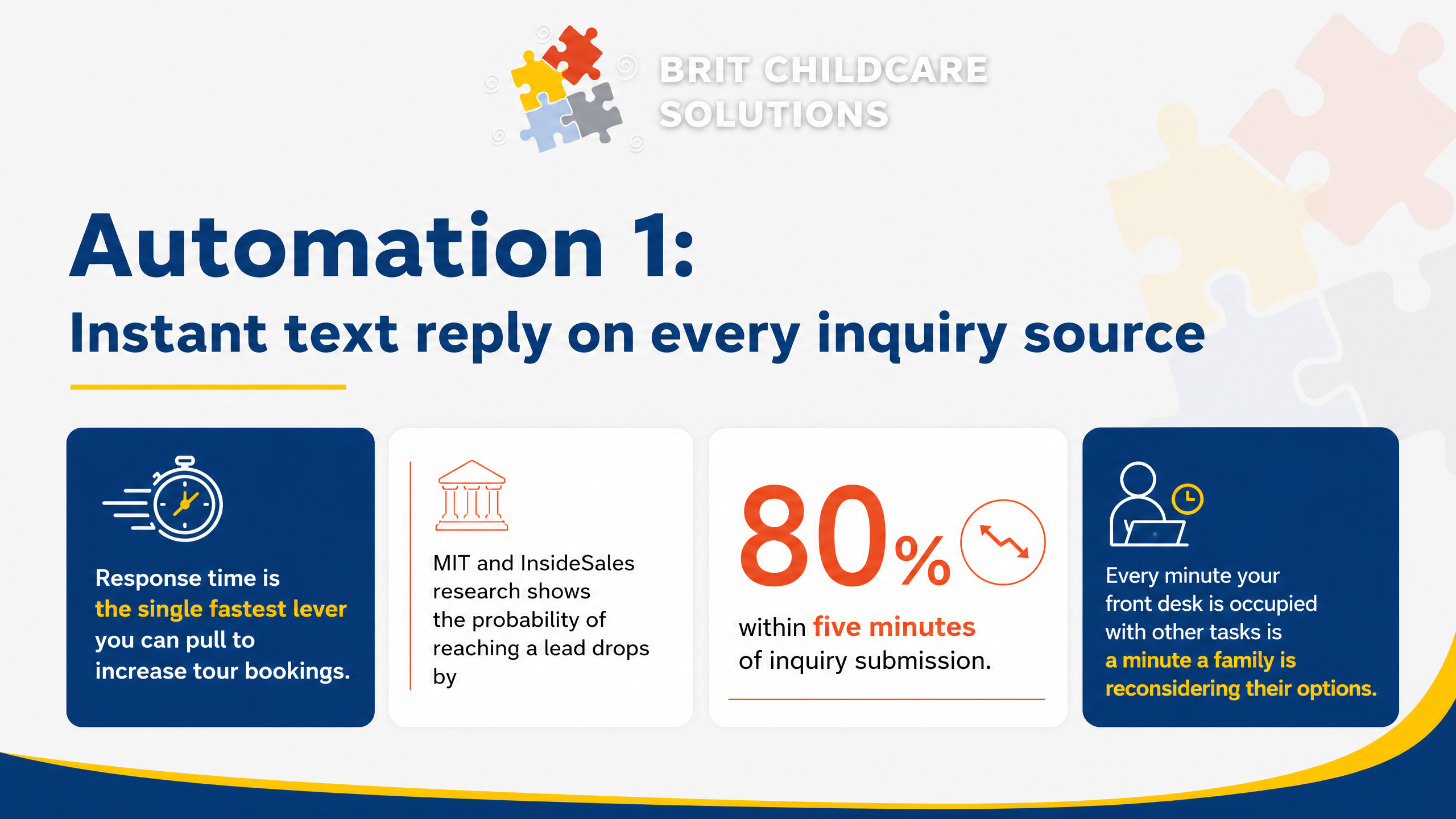
Response time is the single fastest lever you can pull to increase tour bookings. MIT and InsideSales research shows the probability of reaching a lead drops by 80% within five minutes of inquiry submission. Every minute your front desk is occupied with other tasks is a minute a family is reconsidering their options.
What your first text must do
Your first automated text needs to accomplish three things before a parent puts their phone down: confirm you received their inquiry, tell them what happens next, and give them a direct path to book a tour.
A message that reads 'Hi, this is Sunshine Academy. We received your inquiry and would love to show you our center. Click here to pick a tour time that works for you' does all three in under 30 words.
It closes the loop, removes uncertainty, and puts the decision back in the parent's hands immediately.
Confirm receipt so parents know their inquiry did not disappear into a form
Set the next step clearly, such as 'A team member will follow up within the hour'
Include a direct tour booking link so motivated families can self-schedule without waiting
Parents who can act immediately are far more likely to book than those who have to wait for a callback.
Channel coverage that matters
A single automated reply only works if it fires from every channel where families find you. Gaps in coverage mean some inquiries get instant responses while others sit unanswered for hours.
SMS marketing research shows 90% of text messages are read within three minutes of delivery, which makes text the right format regardless of where the inquiry originated. Your automation should connect to all three primary sources.
Website forms and live chat: trigger an immediate text the moment a form is submitted or a chat conversation ends
Google and social leads: connect your Google Business Profile and Facebook or Instagram lead forms directly to your automation so no inquiry routes to a spreadsheet
Missed call to text: when a parent calls and no one answers, an automatic text fires within seconds acknowledging the call and offering a tour booking link
Multi-location operators need this routing to be location-specific so parents hear from the right center, not a generic brand response.
Make it feel like staff
Automated does not mean impersonal. The difference between a message that feels warm and one that feels robotic is in the details: your center's name, a staff member's name in the signature, and language that matches how your team actually speaks.
Keep the parent's choices simple. Offer two tour time options rather than an open calendar that requires decision-making. Then close the message with a named handoff, such as 'Sarah from our enrollment team will be in touch shortly,' so the parent knows a real person is involved.
Automation 2: Two-click tour booking with text confirmations and reminders
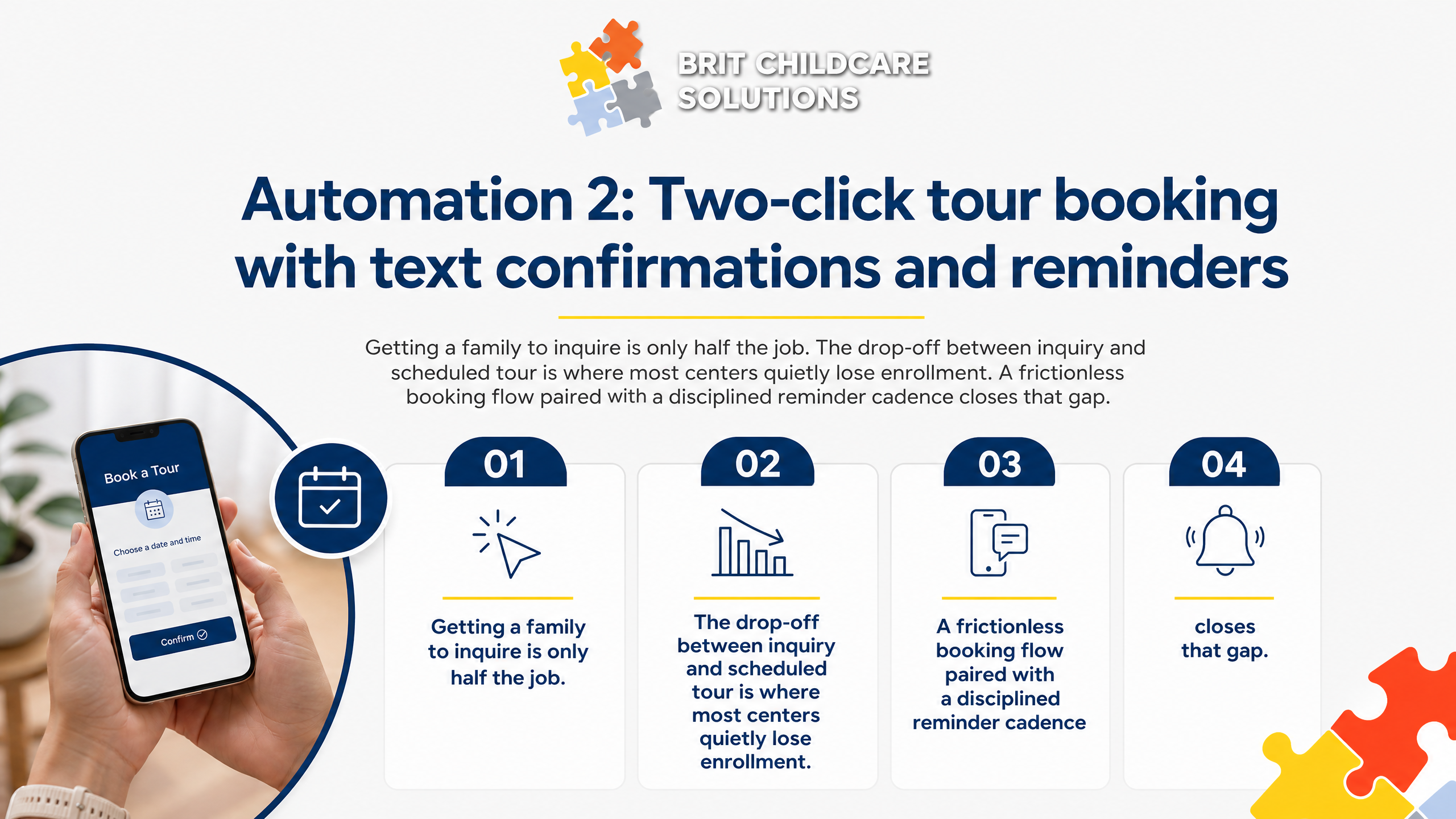
Getting a family to inquire is only half the job. The drop-off between inquiry and scheduled tour is where most centers quietly lose enrollment. A frictionless booking flow paired with a disciplined reminder cadence closes that gap.
Two clicks means fewer drop-offs
Most parents research childcare on their phones during nap time or a lunch break. If your tour booking process requires more than two taps, a long form, or a desktop login, you will lose them before they finish.
A mobile-first booking flow means a parent can select a date, confirm their spot, and see a confirmation page in under 60 seconds. Keep form fields to the minimum: name, phone number, child's age, and preferred tour time. That is all you need to get them on your calendar.
No account creation or password required
Date and time selector optimized for mobile tap targets
Instant confirmation page with tour location, time, and what to bring
The confirmation page is not just a receipt. It sets expectations and starts building trust before the family ever walks through your door.
Reminder cadence that cuts no-shows
A confirmation text sent immediately after booking is your first no-show prevention tool. It locks the appointment in the parent's mind and gives them something to reference. Email confirmations get buried; a text does not.
A randomized controlled trial found that text message reminders reduced no-show rates from 38.1% to 23.5%, a difference of 14.6%. That same principle applies directly to childcare tour bookings. Two follow-up texts do most of the work:
Send a reminder 24 hours before the tour and a second reminder 2 hours before. Each message should include the tour time, your address, and a one-tap option to reschedule. Making it easy to reschedule is not giving families an out.
It protects your calendar from ghost slots and gives you time to fill the opening with another family.
What to track weekly
Three numbers tell you whether your booking automation is actually working. Review them every week, not monthly.
Your inquiry-to-tour booking rate shows how many families who contact you actually schedule a visit. If this number is below 50%, the friction is in your booking flow or your response speed. Your show-up rate by source tells you which lead channels produce families who follow through versus those who ghost.
This matters because not all inquiry volume is equal. Finally, track your time-to-first-response median across all channels. A slow median here suppresses every downstream metric, including tour bookings.
Inquiry-to-tour booking rate: target above 50%
Show-up rate by source: compare Google, Facebook, referrals, and walk-ins separately
Time-to-first-response median: should be under 5 minutes with automation in place
If any of these three numbers is trending down, you have a specific, fixable problem rather than a vague enrollment slump.
Automation 3: Reactivate silent leads without annoying parents
Most centers focus all their automation energy on new inquiries and forget about the families already in their pipeline who went quiet. Those are leads you already paid to generate. A reactivation sequence recovers that value without requiring your front desk to manually track down every cold contact.
Who counts as a stale lead
A stale lead is any inquiry that has not progressed to a booked tour within seven days of first contact. That window matters because family interest drops off quickly after the initial inquiry, and waiting longer reduces your chances of re-engaging them.
Three situations trigger stale lead status in a well-built enrollment funnel:
No tour booked within seven days of inquiry, despite receiving your initial automated response
No reply after two follow-up touches, meaning the family opened your messages but did not respond
Tour no-show with no rescheduling, where the family confirmed but did not appear
Each of these represents a different drop-off point, and each needs a slightly different reactivation message to feel relevant rather than generic.
A three-message reactivation sequence
The goal of reactivation is to restart a conversation, not push for an immediate booking. A three-message sequence does that without feeling like a broadcast.
Message one leads with a helpful question, not a pitch. Something like: 'Hi, we noticed you reached out recently. Are you still looking for care, or has your situation changed?' That single question signals you are paying attention and gives the parent an easy way to re-engage.
Message two, sent two to three days later if there is no reply, prompts specifics: 'What age is your child, and are mornings or afternoons better for a quick tour?' Availability and age prompts do two things: they personalize the follow-up and move the conversation toward a concrete next step.
Message three closes the loop cleanly: 'We want to make sure we have not missed you. If now is not the right time, no worries at all. We are here when you are ready.' This final message removes pressure, protects your reputation with the parent, and often generates a reply simply because it feels human.
Why automation fails in childcare
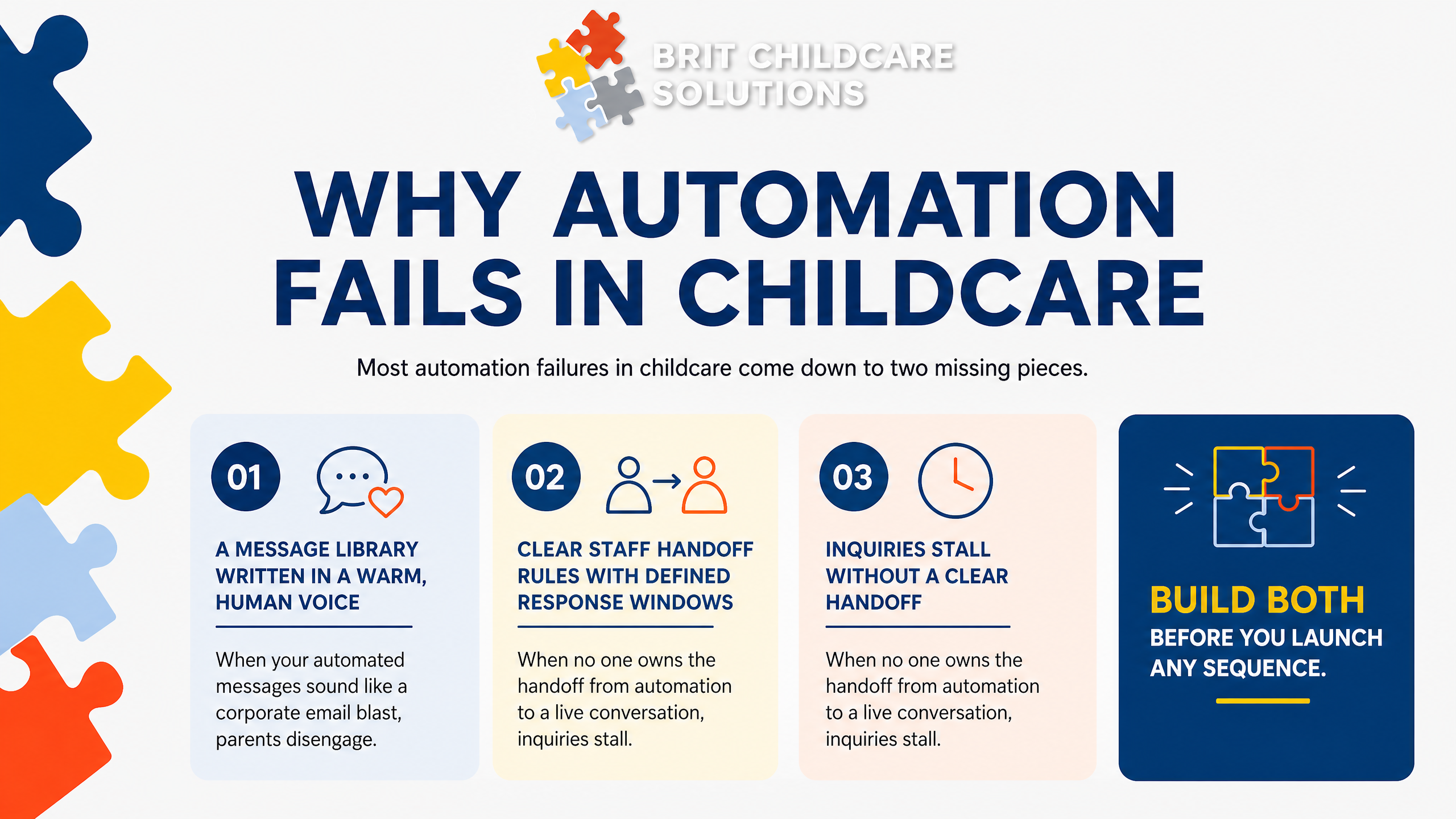
Most automation failures in childcare come down to two missing pieces: a message library written in a warm, human voice and clear staff handoff rules with defined response windows. When your automated messages sound like a corporate email blast, parents disengage. When no one owns the handoff from automation to a live conversation, inquiries stall.
Build both before you launch any sequence.
The wrong things get automated
Centers most often automate the wrong part of the funnel first. They build long nurture email sequences when what families actually need is a fast response and a simple way to book a tour.
Speed beats nurture at the top of the funnel. A parent who submits an inquiry on Tuesday afternoon and gets a broadcast newsletter on Thursday has already called two other centers. The first response wins the tour, not the fifth email.
The booking process itself is a common drop-off point. If a parent has to call during business hours, wait for a callback, or fill out a multi-step form just to schedule a visit, many will not finish. Two-click booking with an immediate text confirmation removes that friction.
The third failure is ownership. Automation can route an inquiry and send a reminder, but someone on your team must own the follow-up when a family goes quiet. Without a named person and a defined window, leads fall through with no one noticing.
Timeline and training expectations
A realistic setup runs three weeks, not three days. Expecting a fully optimized enrollment funnel in 48 hours is how centers end up with broken sequences and confused staff.
Here is how we structure the rollout with our clients:
Week 1: Set up lead capture across all inquiry sources and configure location-based routing so every inquiry reaches the right team member automatically.
Week 2: Activate tour booking automation, text confirmations, and reminder sequences. A randomized controlled trial found text reminders cut no-show rates from 38% to 23%, so this step directly protects your tour pipeline.
Week 3: Review funnel data, identify where families are dropping off, and adjust message timing or routing rules based on real behavior.
Staff training happens in parallel. The goal is not to replace your team but to remove the tasks that slow them down so they can focus on the families who are ready to tour.
Childcare edge cases to design for
Generic automation tools assume one inquiry equals one family with one child starting on one date. Childcare does not work that way.
Design your sequences to handle these situations from the start:
Siblings and staggered start dates: A family enrolling a toddler now and a preschooler in the fall needs separate confirmation flows, not one generic message.
Custody and two-parent communication: Some families require all tour confirmations and enrollment updates sent to two separate contacts. Build a two-contact field into your intake form so no parent feels left out.
Multiple programs and age groups: If you offer infant, toddler, and preschool programs, your booking automation should route families to the correct program tour, not a generic open house.
These edge cases are not rare. They are the norm in most centers with 50 or more children enrolled. Accounting for them upfront prevents the awkward manual corrections that undermine parent trust in your process.
When done-for-you enrollment automation is the smarter move
Building this system yourself takes time most childcare owners do not have. Done-for-you setup means the automation is installed, tested, and monitored for you, so your team focuses on showing up for tours, not managing software. The goal is not more leads.
It is more families sitting across from you at your center.
You need speed across locations
Multi-location operators face a problem single-site centers do not: an inquiry that lands at the wrong location, or gets no response because staff assumed another site handled it, is a family you lose quietly.
Location-based lead routing sends each inquiry to the right team automatically, with no manual sorting required. Every site follows the same follow-up standards, so a family contacting your Northside location gets the same five-minute response experience as one contacting your Downtown location.
Inquiries routed by location the moment they arrive
Consistent follow-up timing and messaging across all sites
Shared reporting so you see performance gaps by location, not just totals
Shared reporting is where multi-location operators catch the real problems. If one site has a 40% tour show-up rate and another has 75%, you now know where to act.
What BRIT Childcare installs
Our Done-For-You Marketing Service builds the enrollment system around one outcome: getting families booked and confirmed for a tour.
Every inquiry channel is captured, whether it comes from your website, a Facebook ad, Google, or a direct text. Automated responses go out within five minutes, which is the window where booking likelihood is highest. From there, tour booking is handled through a two-click process with text confirmations and reminders built in.
Inquiry capture from website, social, ads, and Google Business Profile
Automated responses within five minutes of every new inquiry
Tour booking with text confirmations and reminder sequences to cut no-shows
Proof you can ask for
Any enrollment automation system worth using should give you numbers, not just activity. Before committing to any done-for-you service, ask for three specific reports.
A response time report shows how quickly your system is reaching new inquiries. A tour pipeline by location shows how many families are booked, confirmed, and pending at each site. Inquiry-to-enrollment metrics show where families are dropping off so you can fix the right problem instead of guessing.
These three data points tell you whether your automation is moving families forward or just creating the appearance of activity.
Ready to Stop Managing Enrollment Manually?
You now have the playbook. Fast inquiry response, two-click tour booking, text reminders, and stale lead reactivation are the four moves that close the gap between a full inquiry pipeline and a full classroom.
The challenge most owners face is not knowing what to do. It is finding the time and technical setup to do it consistently across every channel and every location.
That is exactly what we built BRIT Childcare's Done-For-You Marketing Service to handle. We install your full enrollment automation system, from lead capture and instant inquiry response to tour booking, no-show reminders, and inquiry-to-enrollment tracking. You get a working system, not a software login and a tutorial video.
Before your strategy call, take ten minutes to document three numbers: your current inquiry response time, your inquiry-to-tour conversion rate, and your tour-to-enrollment conversion rate. Those three numbers will shape everything we build together.
When you are ready to install a system that turns inquiries into booked tours and booked tours into enrolled families, book your BRIT Childcare strategy call at britchildcare.com/work-with-us.
