How childcare center advertising works for tours
Childcare center advertising fills tours when it targets local, high-intent families and routes them into a booking system built around tour conversion, not just lead volume.
Here is what actually moves families from ad click to enrolled:
Empty seats cost you money every week, so measuring advertising by tours booked is the only metric that matters.
Your Google Business Profile is the fastest free tool to capture families already searching for childcare near you.
Paid ads produce tours when the offer is built around booking a visit, not just building awareness.
Automated follow-up sequences are what separate centers with strong show-up rates from those with chronic no-shows.
Boosted social posts are not a primary enrollment strategy, and treating them as one quietly drains your budget.
At BRIT Childcare, we work exclusively with childcare centers, preschools, and Montessori schools across the U.S. Our done-for-you enrollment marketing service is built around one outcome: tour-ready families. We handle lead capture, automated follow-up, tour booking, and enrollment tracking so you stay focused on your staff and the children in your care, not on chasing down inquiries.
Before spending another dollar on ads, there is one rule that determines whether any of it pays off.
It starts with understanding what an empty seat actually costs you each month, and why tours, not leads, are the number your advertising should be optimized to produce.
The tours-first rule that makes advertising profitable
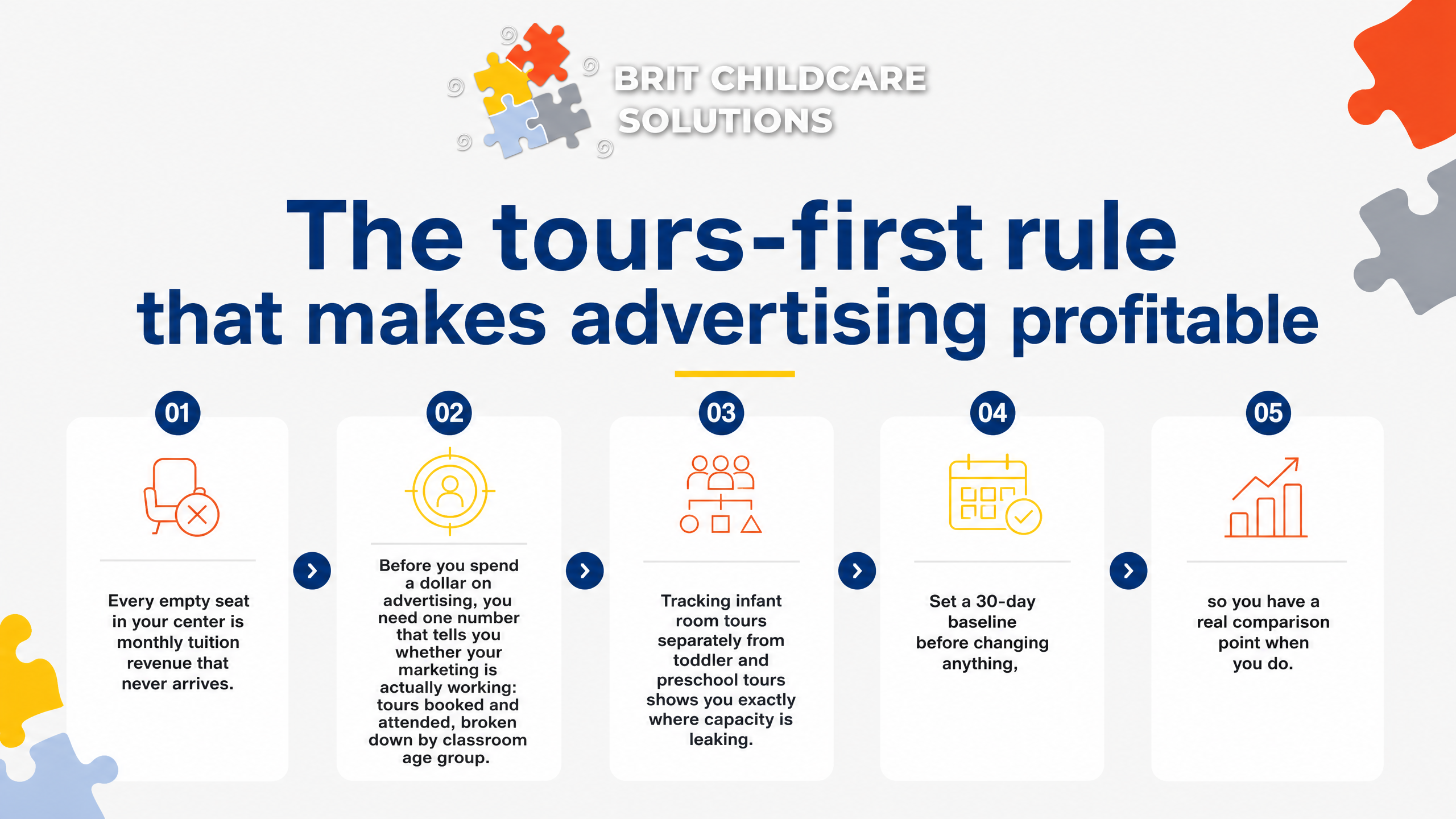
Every empty seat in your center is monthly tuition revenue that never arrives. Before you spend a dollar on advertising, you need one number that tells you whether your marketing is actually working: tours booked and attended, broken down by classroom age group. Tracking infant room tours separately from toddler and preschool tours shows you exactly where capacity is leaking.
Set a 30-day baseline before changing anything, so you have a real comparison point when you do.
Leads vs tour-ready families
A lead is a name and a phone number. A tour-ready family is a parent who has scheduled a visit and has genuine intent to enroll. These are not the same thing, and treating them as equivalent is where most childcare advertising budgets go wrong.
The true conversion in your enrollment funnel is not the inquiry form submission. It is the confirmed tour booking. A family who books a tour has demonstrated a level of intent that a casual website visitor has not.
That distinction changes how you evaluate every ad campaign and every marketing channel.
Show-up rate is the profit lever most owners overlook. You can book 20 tours a month and enroll almost no one if half those families never walk through the door. In our experience, centers that focus on reducing no-shows see faster enrollment growth than centers that simply generate more inquiries.
Your simple tour math
Three numbers tell you whether your advertising is profitable. Track them every month.
Cost per tour booked is your total marketing spend divided by the number of tours that actually get scheduled. This is more meaningful than cost-per-click or cost-per-lead because it connects spending directly to enrollment pipeline activity.
A healthy show-up rate for childcare centers typically falls between 60 and 80 percent of scheduled tours. If yours is below that range, the problem is not your ads. It is what happens after the inquiry arrives, specifically how fast you respond and whether families receive reminders before the visit.
Enrollment rate from tours is your final check. What percentage of families who complete a tour sign an enrollment agreement? Centers we work with often find this number is stronger than expected once no-shows are reduced, because families who actually visit tend to be serious.
Cost per tour booked: total monthly ad spend divided by confirmed tours scheduled
Show-up rate target: 60 to 80 percent of booked tours attended
Enrollment rate from tours: percentage of tour attendees who enroll
If your show-up rate is below 60 percent, fix that before increasing your ad budget. More leads into a leaking funnel will not improve your enrollment numbers.
Win the free visibility that captures high-intent searches
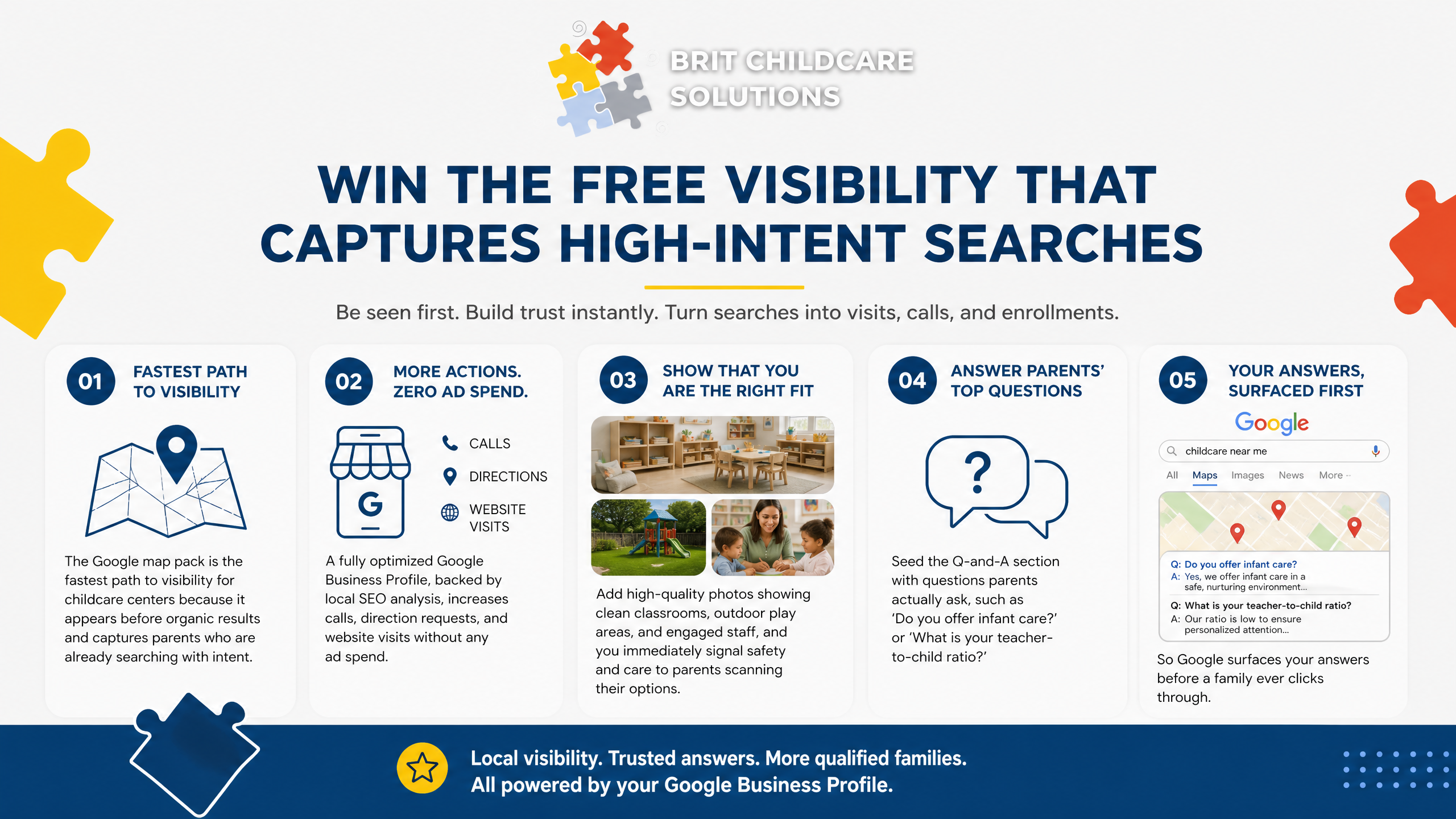
The Google map pack is the fastest path to visibility for childcare centers because it appears before organic results and captures parents who are already searching with intent. A fully optimized Google Business Profile, backed by local SEO analysis, increases calls, direction requests, and website visits without any ad spend. Add high-quality photos showing clean classrooms, outdoor play areas, and engaged staff, and you immediately signal safety and care to parents scanning their options.
Seed the Q-and-A section with questions parents actually ask, such as 'Do you offer infant care?' or 'What is your teacher-to-child ratio?' so Google surfaces your answers before a family ever clicks through.
Google Business Profile setup
Your primary category should be 'Child Care Agency' or 'Day Care Center' depending on your program mix. Choosing the wrong category is a common setup mistake that suppresses your map pack ranking for the searches that matter most.
Set your service area to cover the zip codes and neighborhoods within a realistic drive of your center. Update hours to reflect your actual open and close times, including any extended care options, since incorrect hours erode parent trust before they ever contact you.
Place your tour booking link directly in the 'Appointment URL' field within your profile. This single step removes friction between a parent finding you on Google and scheduling a visit, which is the outcome every other marketing effort is working toward.
Reviews that drive tour decisions
Peer-reviewed research shows that 93% of consumers say online reviews affect their purchasing decisions, and childcare is no different. A parent choosing between two centers with similar locations and pricing will almost always tour the one with more recent, detailed reviews.
The best time to request a review is within the first 30 to 60 days of a family enrolling, when their experience is fresh and their satisfaction is highest. A simple text or email with a direct link to your Google review page removes every barrier to leaving feedback.
When you reply to reviews, use language that mirrors how parents describe their search. Phrases like 'infant care in [city],' 'preschool with flexible hours,' or 'safe daycare near [neighborhood]' appear naturally in parent responses and reinforce your relevance for those searches. Keep replies warm, specific, and under three sentences.
Local pages that match searches
Parents searching for 'infant care near me' or 'preschool programs in [city]' are not looking for a generic homepage. Dedicated landing pages for each age group, such as infant, toddler, preschool, and pre-K, match search intent precisely and convert at a higher rate than a single program overview page.
Tuition transparency is a choice, not a requirement, but centers that display at least a starting range or a 'contact us for current rates' prompt reduce the friction that causes parents to leave without inquiring. Hiding pricing entirely often pushes high-intent families toward a competitor who is more upfront.
Place your tour scheduling tool above the fold on every program page. A parent who lands on your infant care page after a local search should be able to book a tour without scrolling. That single placement decision directly impacts how many inquiries convert into scheduled visits.
One page per age group: infant, toddler, preschool, pre-K, school-age
Include program hours, staff ratios, and curriculum highlights on each page
Tour scheduler visible without scrolling on desktop and mobile
Tuition range or a clear call to action for pricing inquiry
Centers that structure their site this way give Google a clear signal for each program type and give parents a frictionless path from search to scheduled tour.
Turn paid ads into booked tours with tight targeting
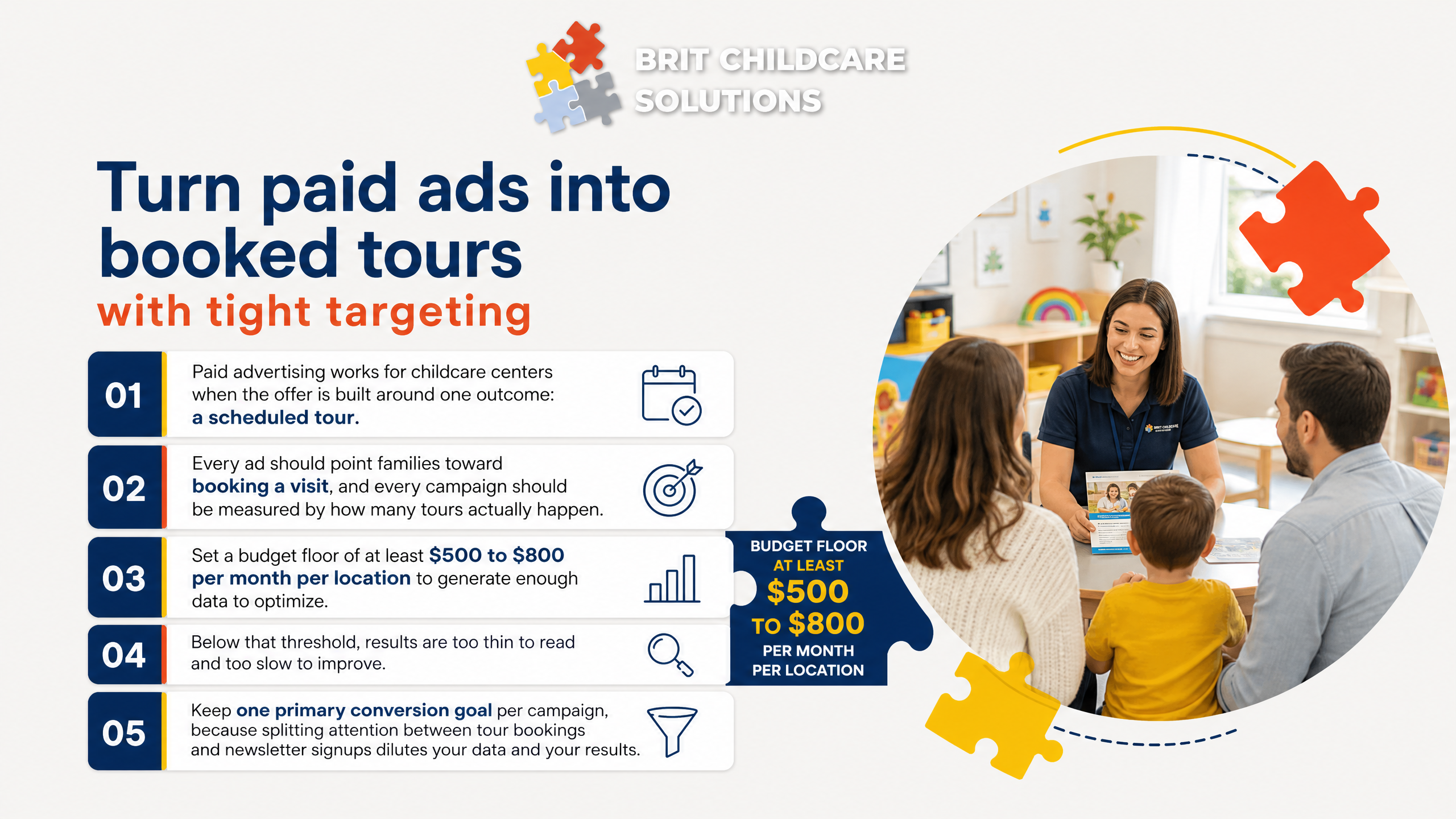
Paid advertising works for childcare centers when the offer is built around one outcome: a scheduled tour. Not a download, not a form fill, not a phone call that goes nowhere. Every ad should point families toward booking a visit, and every campaign should be measured by how many tours actually happen.
Set a budget floor of at least $500 to $800 per month per location to generate enough data to optimize. Below that threshold, results are too thin to read and too slow to improve. Keep one primary conversion goal per campaign, because splitting attention between tour bookings and newsletter signups dilutes your data and your results.
Geo-targeted Google Search ads
Google Search captures families who are already looking, which makes it the highest-intent channel available to childcare centers. The key is radius targeting set around realistic commute patterns, typically five to ten miles from your center, adjusted tighter in dense urban areas and wider in suburban or rural markets.
Keywords should reflect both age group and program type. Parents searching for 'infant daycare near me' are at a different stage than those searching for 'after school care for kindergartners.' Separate ad groups by program let you match the message to exactly what the parent is looking for, which improves click quality and reduces wasted spend.
Add call extensions and location extensions to every campaign. Google's local search data shows that 50% of smartphone users who perform a local search visit a business within a day, meaning a parent who finds your ad at 7 a.m. may be ready to tour that afternoon. Call and location extensions make it frictionless to act on that intent immediately.
Facebook ads that qualify fast
Facebook does not capture existing demand the way Google does, but it creates demand by reaching parents before they start actively searching. The targeting approach that works best combines zip code targeting within your commute radius with lookalike audiences built from your current enrolled families.
Creative angles should match where the parent is in their decision process. Parents with a newborn respond to messaging around infant care availability and waitlists. Parents of toddlers respond to curriculum and socialization themes.
Parents of school-age children respond to before and after school scheduling flexibility. One generic ad trying to speak to all three groups will underperform against three focused ones.
For lead capture, instant forms reduce friction and tend to generate higher volume, but landing pages produce better-qualified leads because they require more intent to complete. In our experience, centers focused on tour volume benefit from landing pages tied directly to a tour booking calendar, filtering out casual browsers before they enter the follow-up sequence.
Compliance and ad policy basics
Childcare advertising on Facebook and Google can trigger special ad category requirements, and missing this step can get campaigns rejected or accounts flagged. Facebook classifies ads related to housing, employment, and credit under restricted categories, and childcare ads that reference availability or enrollment can sometimes be flagged under these rules depending on how they are written.
Before launching any campaign, run a special ad category check in Meta Ads Manager. If your ads are flagged, you lose access to detailed demographic targeting, including age and parental status filters. Structuring creative around program benefits and tour invitations rather than availability or eligibility language typically keeps ads out of restricted territory.
Your privacy policy must be live and linked from any landing page collecting parent information. Google and Meta both require this, and it is also a basic trust signal for parents who are evaluating whether to share contact details. Conversion tracking should be verified before spending a dollar, because without it you cannot connect ad spend to actual tour bookings, which makes optimization impossible.
Automated follow-up that cuts tour no-shows
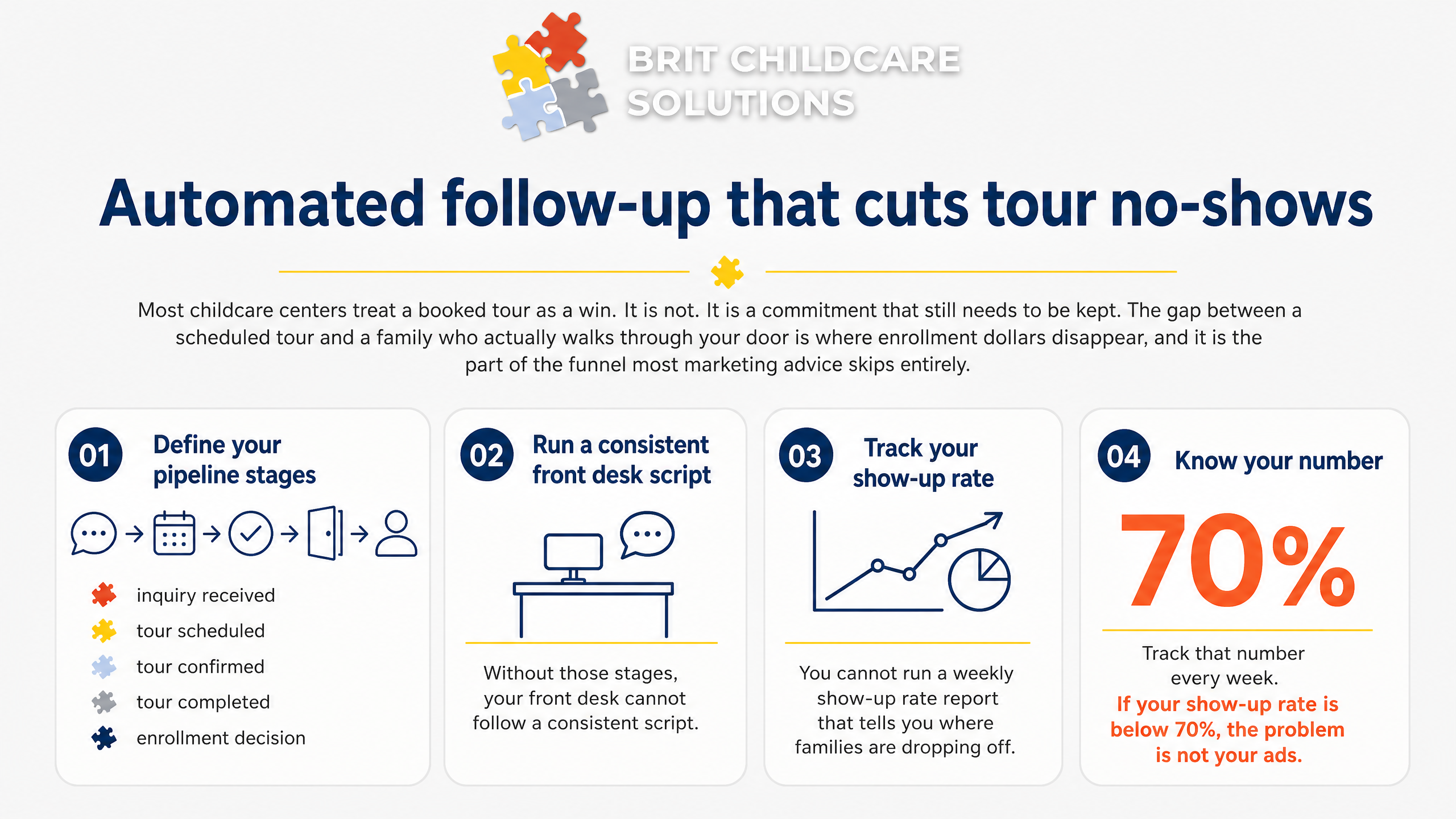
Most childcare centers treat a booked tour as a win. It is not. It is a commitment that still needs to be kept.
The gap between a scheduled tour and a family who actually walks through your door is where enrollment dollars disappear, and it is the part of the funnel most marketing advice skips entirely.
Before any automation can work, your CRM needs clearly defined pipeline stages: inquiry received, tour scheduled, tour confirmed, tour completed, and enrollment decision. Without those stages, your front desk cannot follow a consistent script, and you cannot run a weekly show-up rate report that tells you where families are dropping off. Track that number every week.
If your show-up rate is below 70%, the problem is not your ads.
Speed to lead in childcare
Response time is the single biggest controllable variable in tour booking. Harvard Business Review research found that contacting a lead within 5 minutes makes you 21 times more likely to qualify them compared to waiting 30 minutes. In childcare, where a parent is often comparing two or three centers at once, that window is real.
Set your system to send an automated text within five minutes of every inquiry, regardless of who is at the front desk. If a call comes in and goes unanswered, a missed call text-back fires immediately: something as direct as 'Hi, this is [Center Name]. We just missed your call about enrollment.
Here is a link to pick a tour time that works for you.' That one message recovers a significant share of inquiries that would otherwise go cold.
After-hours inquiries need the same treatment. Families search for childcare in the evenings and on weekends. An after-hours capture sequence that acknowledges the inquiry, sets expectations for a morning follow-up, and offers a self-schedule link keeps those families engaged instead of moving on to the next result.
The tour confirmation sequence
Booking a tour is not enough. Most no-shows happen because life got busy and no one reminded the family the tour was coming. A two-step confirmation sequence closes that gap without any manual effort from your staff.
Send the first reminder 48 hours before the tour. Keep it warm and specific: confirm the time, name the director they will meet, and include one sentence about what to expect. Send the second reminder two hours before.
This one should be brief and action-oriented.
Both messages should include a reschedule link. This is not a concession. Families who reschedule instead of ghosting are still interested.
Giving them an easy path to reschedule saves the relationship and keeps your pipeline accurate.
48-hour reminder: confirm time, location, and who they will meet
What to bring checklist: ID, questions about curriculum, any special needs documentation
2-hour reminder: short, direct, with a one-tap reschedule option
Centers that run this sequence consistently report meaningful reductions in no-shows without adding any front desk workload.
Post-tour enrollment follow-up
The hour after a tour ends is your highest-leverage moment. Families are emotionally engaged and comparing options. A same-day message that thanks them for visiting and asks a simple question, such as whether they have any questions before making a decision, keeps momentum going without feeling pushy.
If spots are limited, use honest availability language in that follow-up. 'We currently have two infant spots available and typically fill them within a few weeks' is not pressure. It is accurate information that helps families make a timely decision. If a spot is not available, offer waitlist placement with a clear next step.
Include a direct link to your deposit form or enrollment paperwork in the follow-up message. Families who are ready to commit should not have to call back to find out how to do it. This is where our Tour Booking and Reminder System inside the BRIT Childcare Enrollment Engine removes the manual handoff entirely, routing the family from tour completion straight to paperwork without the owner or director chasing anyone down.
What to do this week to book more tours
You do not need a full marketing overhaul to start seeing more tours on your calendar. Four focused actions this week can shift your visibility, credibility, and conversion rate in measurable ways.
Start with your Google Business Profile. Confirm your primary category is set to 'Child Care Center' or 'Preschool' and add relevant secondary categories. Then add your tour booking link directly to your GBP so families searching nearby can schedule without extra steps.
This alone removes friction for high-intent parents who are ready to visit.
Next, reach out personally to five families whose children are currently enrolled. Ask each one to leave a Google review and give them a simple prompt, something like what they would tell a friend considering your center. Peer-reviewed research shows that 93% of consumers say online reviews affect their decisions, and in childcare, trust is the deciding factor.
Then update one tour landing page. Make sure it answers three questions above the fold: what age groups you serve, what makes your program different, and how to book a tour today. Remove anything that buries that call to action.
Finally, launch one radius-based Google Search campaign targeting families within three to five miles of your location. Use ad copy that speaks directly to tour booking, not just enrollment. Keep your daily budget modest and measure success by tours scheduled, not clicks.
These four steps create real momentum without requiring a marketing team to execute.
What to stop doing if you want enrollments
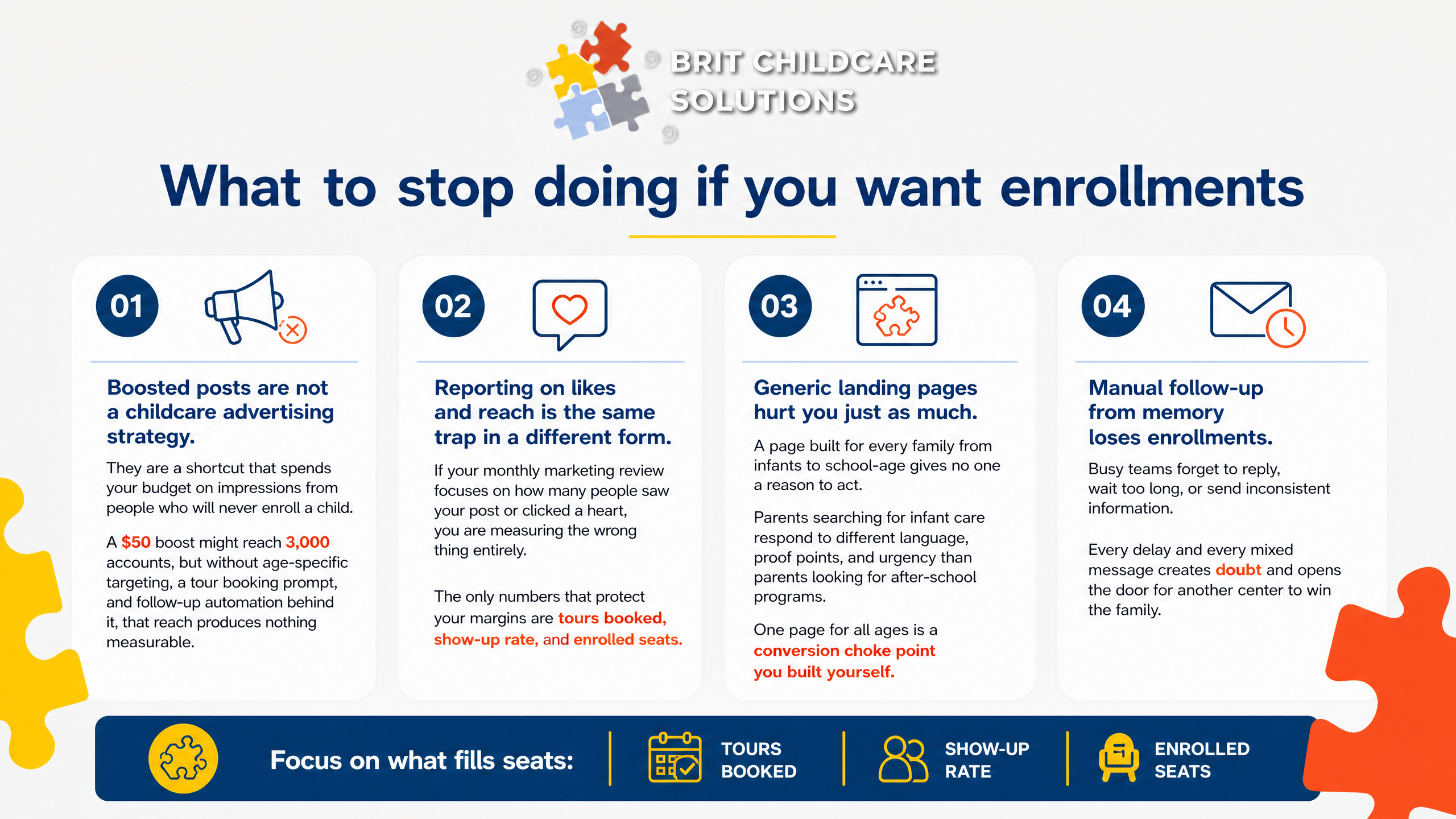
Boosted posts are not a childcare advertising strategy. They are a shortcut that spends your budget on impressions from people who will never enroll a child. A $50 boost might reach 3,000 accounts, but without age-specific targeting, a tour booking prompt, and follow-up automation behind it, that reach produces nothing measurable.
Reporting on likes and reach is the same trap in a different form. If your monthly marketing review focuses on how many people saw your post or clicked a heart, you are measuring the wrong thing entirely. The only numbers that protect your margins are tours booked, show-up rate, and enrolled seats.
Generic landing pages hurt you just as much. A page built for every family from infants to school-age gives no one a reason to act. Parents searching for infant care respond to different language, proof points, and urgency than parents looking for after-school programs.
One page for all ages is a conversion choke point you built yourself.
Manual follow-up from memory is where most inquiries quietly die. A front desk team managing tours, check-ins, and parent questions cannot reliably track which families need a reminder call, which went quiet after a tour, and which stale leads are still worth reactivating. That is not a staffing failure.
It is a systems gap, and it is exactly what a done-for-you enrollment funnel is built to close.
Ready to Fill Your Open Spots With Tour-Ready Families?
You now have the framework: free visibility through your Google Business Profile, geo-targeted ads that attract high-intent local families, and automated follow-up that keeps no-shows from draining your revenue. The question is whether you have the time and systems to execute all of it consistently while running your center.
That is exactly where we come in. At BRIT Childcare, our Done-For-You Enrollment Marketing Service handles lead capture, automated inquiry response, tour booking, reminder sequences, and enrollment tracking across your location or locations. You stay focused on your staff and the children in your care.
We focus on getting families through your door.
Book an enrollment growth strategy call with our team. Come prepared with your current enrollment numbers, licensed capacity, and staffing goals. On the call, ask us to build you a tour-ready family plan that combines geo-targeted ads with an automated follow-up system designed to cut tour no-shows and move families from first inquiry to signed enrollment agreement.
Visit britchildcare.com/work-with-us to schedule your call.
