How Childcare-Exclusive Marketing Drives Tours
A childcare-exclusive marketing agency is one that works only with childcare centers, preschools, and Montessori schools, and measures success in scheduled tours and enrollments, not clicks and leads. That distinction matters more than most owners realize when empty classrooms are the problem.
Here is what separates childcare-exclusive marketing from everything else:
"Exclusive" is a workflow, not a niche label: it means every system is built around tour conversion, not lead count.
A properly run childcare enrollment funnel can produce 10 to 40 scheduled tours per month for centers with the right capacity.
Red flag: any agency whose portfolio spans restaurants, retail, and real estate alongside childcare cannot benchmark your tour show-up rate.
Weekly tour pipeline reviews are the proof standard, not monthly traffic reports.
Before signing with any agency, confirm who owns the CRM, automations, and follow-up sequences, because those determine whether families actually show up.
At BRIT Childcare, we work exclusively with childcare centers, preschools, and Montessori schools across 40+ states. Our Done-For-You Enrollment System handles inquiry capture, automated response sequences, tour booking, reminders, and conversion tracking so you stay focused on your team and the children in your care, not on managing marketing tech.
Understanding what "childcare-exclusive" actually means in practice starts with one question: when tours are the KPI, does your agency's entire workflow point toward that outcome? That is exactly where we start.
What childcare-exclusive means when tours are the KPI
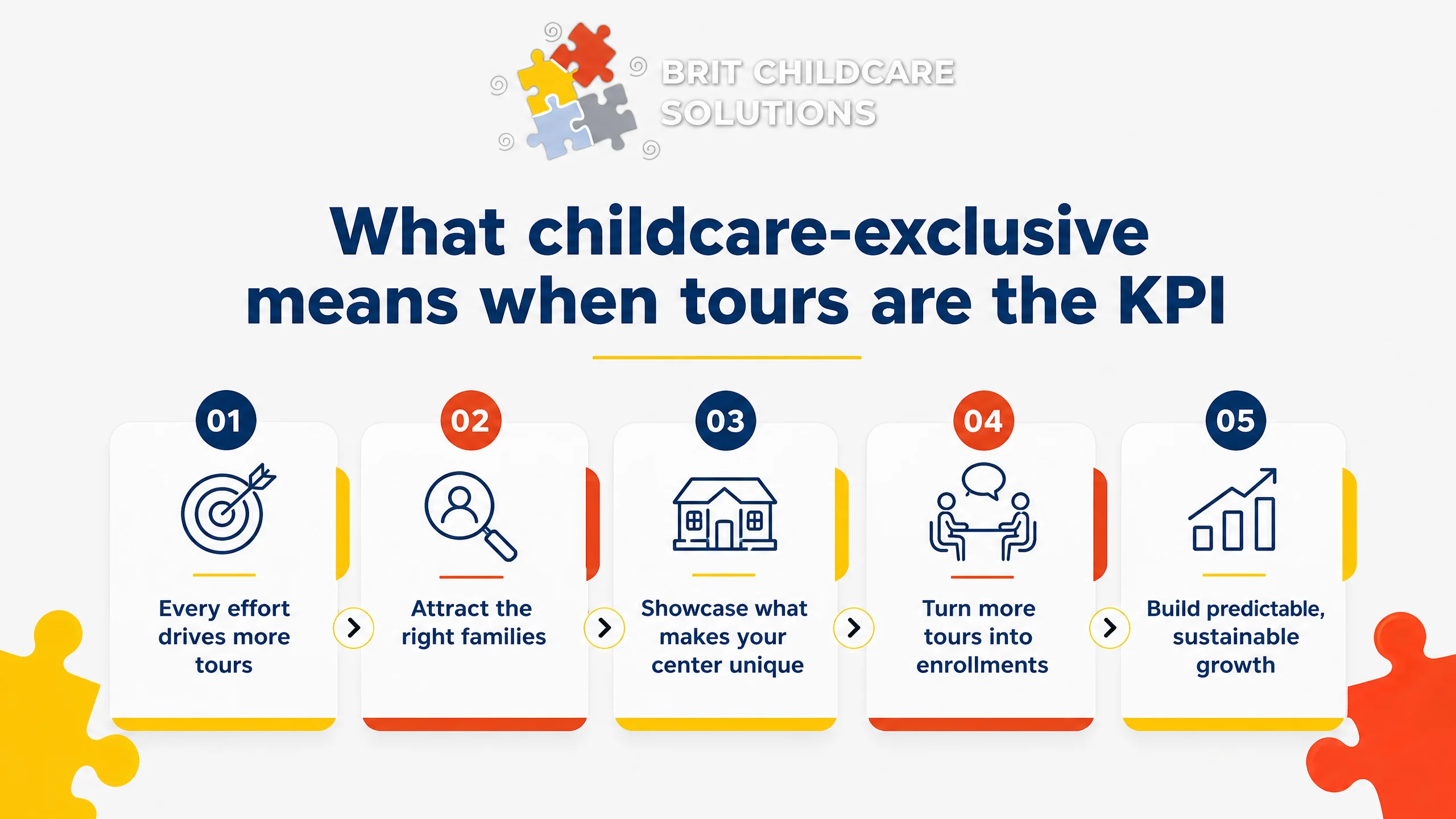
Exclusive is a workflow, not niche
Childcare-exclusive marketing is not a label on an agency's homepage. It shows up in how the system is built before a parent ever fills out a form.
Parents shopping for childcare raise objections that no general marketing agency is trained to handle: infant waitlist availability, part-time schedule options, age-range transitions from infant to toddler rooms. An agency that also runs campaigns for restaurants or law firms has no framework for those conversations.
Exclusive means your inquiry capture uses age-range and schedule filters so leads are pre-qualified before they reach your front desk. It means tour booking is the conversion goal, not a contact form submission. Every automation, every follow-up message, every confirmation text is designed to move one parent toward one outcome: a scheduled, confirmed tour.
The common failure: lead volume
Most generalist agencies optimize for cheap inquiries because that is what they can report easily. Low cost-per-lead looks like progress on a dashboard, but it tells you nothing about whether a single family walked through your door.
The friction that kills enrollment happens after the inquiry arrives. A booking process that requires a phone call, a multi-step form, or a 24-hour wait for confirmation gives parents time to move to the next center on their list. Agencies that do not track tour scheduling friction have no idea this is happening.
Without show-rate accountability, no one owns the gap between leads booked and tours completed. That gap is where most centers quietly lose families they already paid to attract.
The tour metrics that matter
According to 2026 industry benchmarks, the lead-to-tour ratio for childcare providers averages 35%, and tour-to-enrollment conversion sits at 65%. Those numbers only matter if you are actually tracking them per location, per month.
The metrics a childcare-exclusive agency should report on are:
Scheduled tours per month: the volume of confirmed bookings, not raw inquiries
Show rate and reschedules: what percentage of booked tours are completed, and how many are recovered after a no-show
Enrollment yield per tour: how many completed tours convert to a signed enrollment agreement
If an agency cannot give you baseline benchmarks for all three before you sign anything, they are measuring the wrong thing.
How clicks turn into tour-ready families: the childcare-only conversion chain
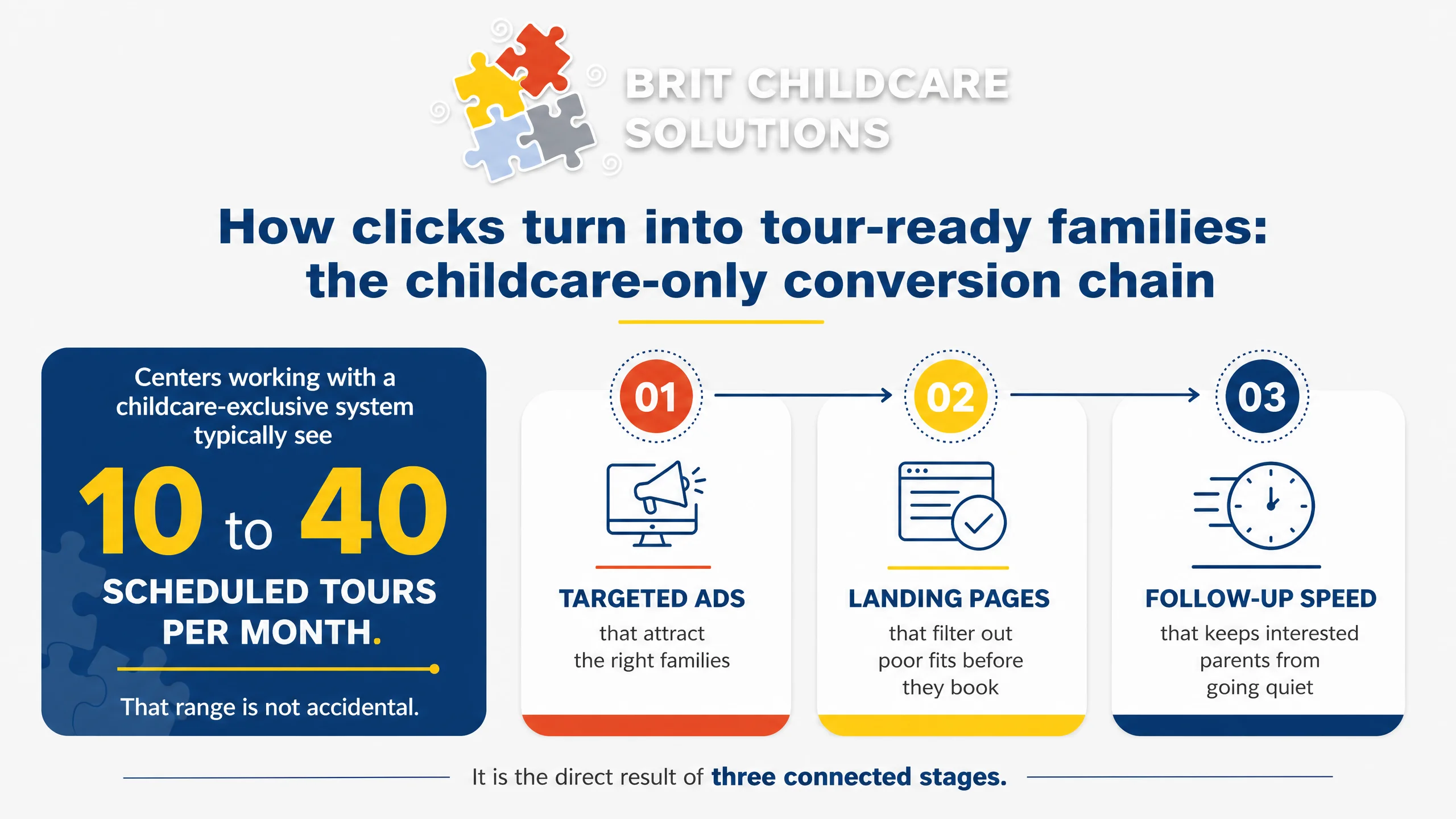
Centers working with a childcare-exclusive system typically see 10 to 40 scheduled tours per month. That range is not accidental. It is the direct result of three connected stages: targeted ads that attract the right families, landing pages that filter out poor fits before they book, and follow-up speed that keeps interested parents from going quiet.
Ad targeting built around childcare fit
Generic agencies target parents. Childcare-specific targeting goes further by filtering for parents who are actually enrollable at your center right now.
That means ads are built around commute radius from your location, not just zip codes. A family 45 minutes away is not a real prospect regardless of how interested they seem. Targeting also accounts for age availability, so a center with infant openings is not spending budget reaching parents of four-year-olds, and waitlist signals can be built in to capture future-need families separately from immediate-need ones.
Program type intent matters too. A parent searching for a Montessori toddler program has different expectations than one searching for before-school care. Ads that match those intent signals produce inquiries that are already pre-sorted by fit before anyone picks up the phone.
Landing pages that pre-qualify
Most childcare landing pages collect a name and email and call it a lead. A pre-qualifying page does more work before the family ever submits a form.
Availability and pricing clarity belong on the page, not hidden behind a call. When a parent can see that infant spots are open and tuition starts at a specific range, the families who submit are already self-selected. Those who cannot afford it or need a different age group exit before wasting your staff's time.
The primary call to action should be a tour request, not a generic contact form. Frictionless mobile scheduling matters here because most parents research childcare on their phones during nap time or a lunch break. A two-click booking flow that works on mobile converts at a meaningfully higher rate than a multi-page form that requires a callback.
Follow-up speed that prevents ghosting
Speed is where most centers lose families they already earned. Harvard Business Review research confirms that responding within five minutes makes a lead 21 times more likely to convert than waiting 30 minutes. Most front desks cannot hit that window manually.
Text-first communication is the standard that works. Parents are not checking email between pickups and dinner. A text response within minutes keeps the conversation open and moves the family toward a confirmed booking before they contact the next center on their list.
Tour confirmation should happen in two steps: an immediate automated confirmation at booking, followed by a reminder text 24 hours and 2 hours before the tour. That sequence alone reduces no-shows significantly. In our Done-For-You Enrollment System, this entire follow-up chain runs automatically so your front desk focuses on the families who actually walk through the door.
Agency checkpoint 1: who they serve and what they refuse
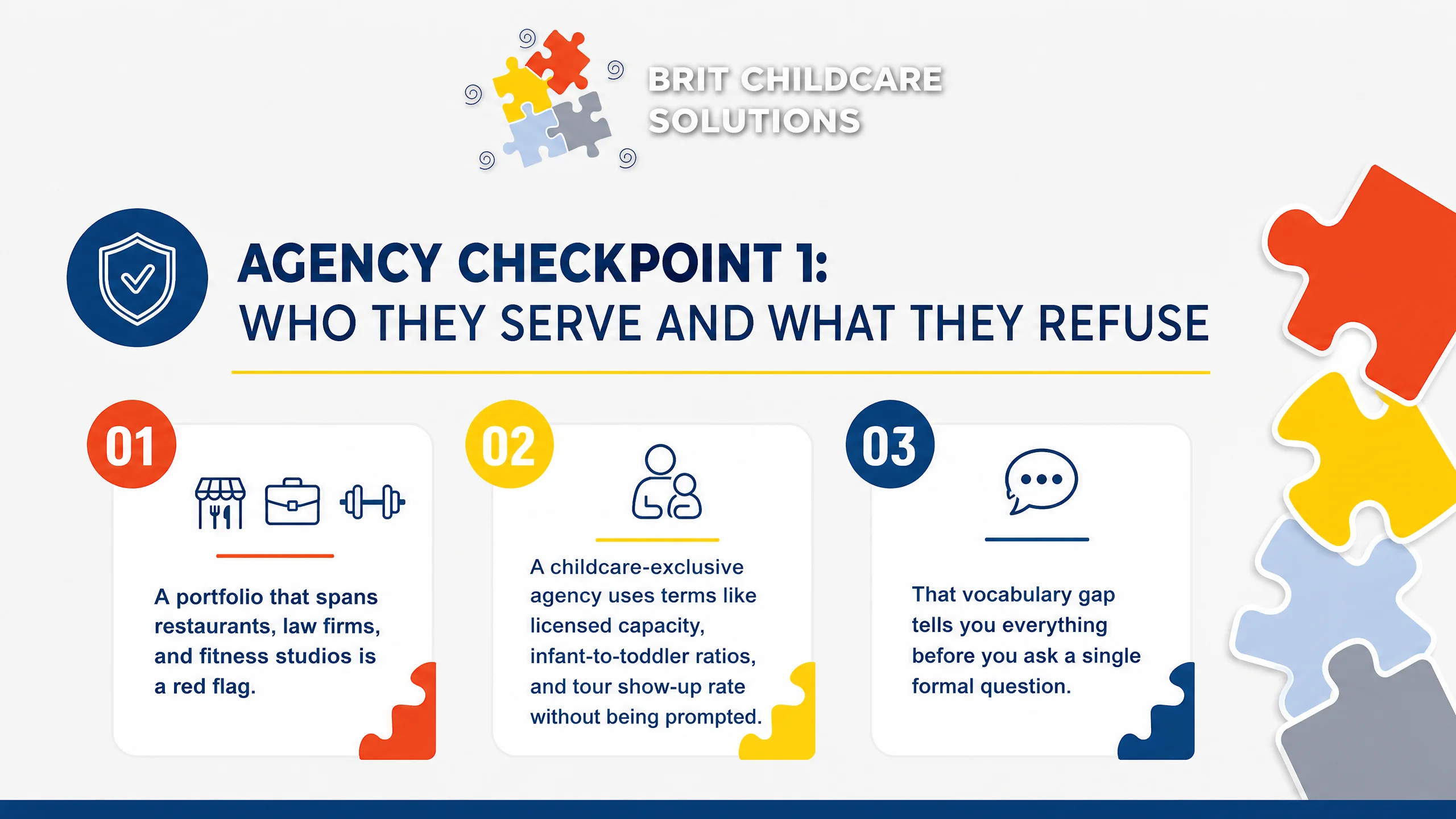
A portfolio that spans restaurants, law firms, and fitness studios is a red flag. A childcare-exclusive agency uses terms like licensed capacity, infant-to-toddler ratios, and tour show-up rate without being prompted. That vocabulary gap tells you everything before you ask a single formal question.
Ask for their client list by industry
Request a client list and look for one thing: every name on it should be a childcare center, preschool, or Montessori school. Mixed-industry case studies featuring retail brands or medical practices signal that childcare is one vertical among many, not their entire focus.
Childcare-only roster with no unrelated industries represented
Case studies citing tours booked and enrollment conversions, not generic lead volume
Active clients across multiple U.S. states, not a single regional market
Geographic breadth matters because enrollment demand, licensing rules, and competitive density vary significantly by state. An agency operating across 30 or more states has seen those differences and built systems around them.
Verify they know your model
Ask how they approach centers with 75 licensed spots versus 150. If they cannot speak to how licensed capacity shapes tour volume targets, they are treating your center like any other service business.
Infant rooms fill differently than preschool classrooms, and a multi-location operator needs inquiry routing by site, not a single shared funnel. An agency that understands these constraints will ask about them first.
Agency checkpoint 2: what they report when they say results
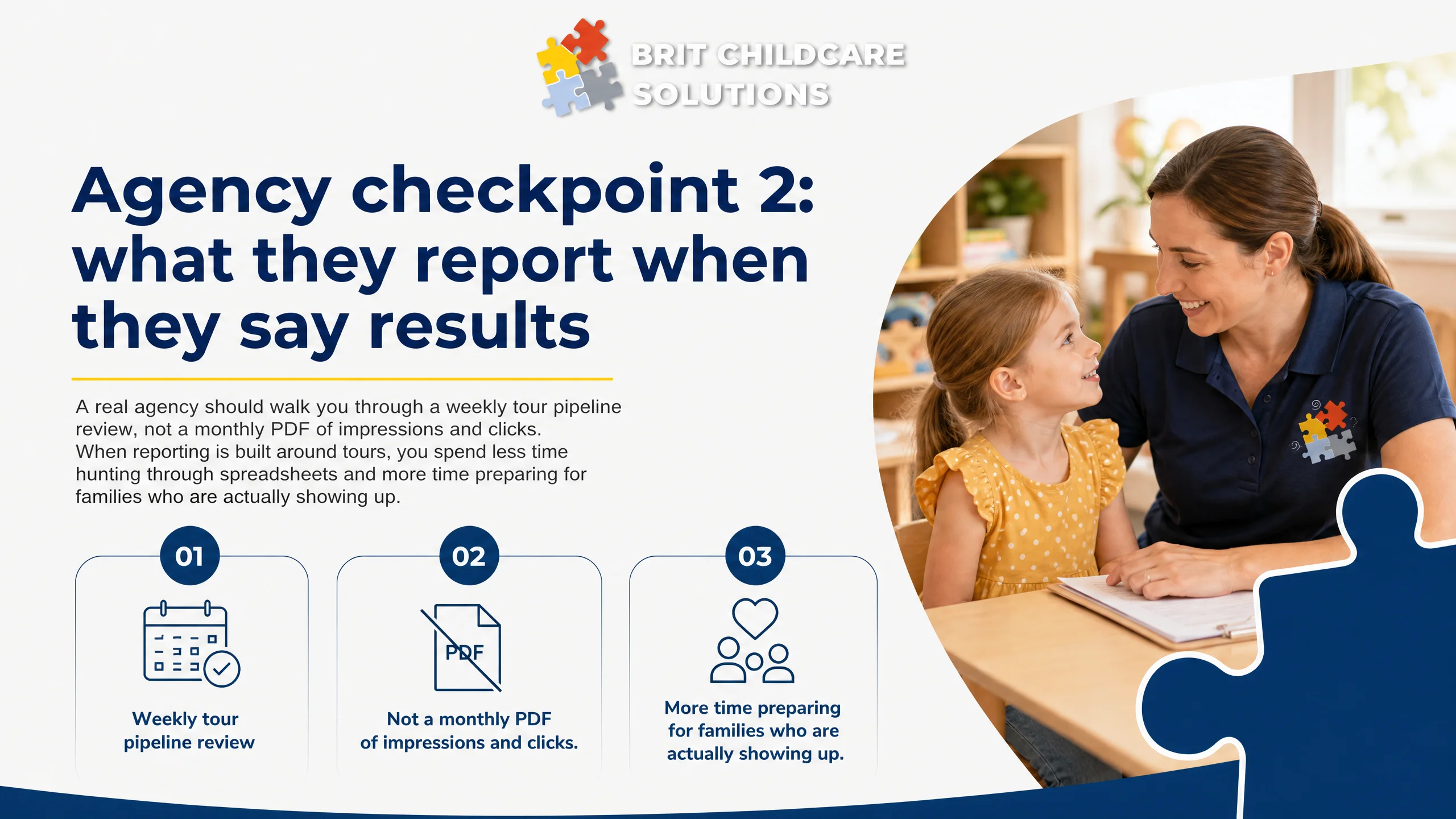
A real agency should walk you through a weekly tour pipeline review, not a monthly PDF of impressions and clicks. When reporting is built around tours, you spend less time hunting through spreadsheets and more time preparing for families who are actually showing up.
Require tour-first reporting dashboards
Ask any agency you are evaluating to show you a live reporting dashboard. If it does not show scheduled tours by source, show rate by time slot, and enrollment yield by age band, it is not built for childcare enrollment.
Scheduled tours per source: which ad channel or inquiry path is actually booking families
Show rate by time slot: which tour windows have the highest attendance so you can prioritize them
Enrollment yield by age band: which age groups are converting from tour to signed agreement
These three data points tell you where your funnel is working and where families are dropping off before they ever sign.
Spot the lead-only reporting trap
An agency celebrating a low cost per lead without connecting that number to tours or enrollments is measuring the wrong thing. According to 2026 industry benchmarks, the lead-to-tour conversion rate for childcare providers should reach 35 percent. If your agency cannot show that ratio, they are optimizing for their metrics, not your classrooms.
Watch for two additional gaps: no attribution connecting ad spend to actual enrollments, and no follow-up SLA showing how quickly leads are contacted after inquiry. Both gaps mean families are slipping out of your funnel untracked.
Agency checkpoint 3: benchmarks they will commit to for your center
Any agency can promise results. Push them for a number. If they respond with 'it depends' and stop there, that is not a benchmark, it is a deflection.
Ask for past-center comparables, even anonymized ones, so you can judge whether their projections are grounded in real performance or optimistic guessing.
Tour benchmarks with clear assumptions
A childcare-exclusive agency should be able to tell you that centers in their program typically see 10 to 40 scheduled tours per month, and explain exactly what drives that range.
The inputs that shift that number include your licensed capacity, local competition density, and whether your center is in a high-traffic urban area or a suburban market with fewer competing providers. A 75-spot center in a competitive metro will ramp differently than a 120-spot center with limited nearby options.
Ask how long before you should expect consistent tour volume. A realistic ramp timeline is 60 to 90 days from launch, not week one.
Show-rate expectations and controls
Booked tours that do not happen are a systems problem, not a parent problem. A committed agency will describe exactly how they protect your show rate.
The controls that matter most:
Text-based confirmations sent immediately after booking, plus reminders at 24 hours and 2 hours before the tour
A reschedule workflow that catches cancellations before they become no-shows and keeps families in the funnel
No-show reason tracking so patterns are visible and the system can be adjusted, not just repeated
If an agency cannot describe all three of these by name, they are not managing your show rate, they are hoping for it.
Agency checkpoint 4: who owns ads, CRM, automations, and follow-up
Before signing anything, confirm two things in writing: the agency's response time commitment for new inquiries, and who makes the first call to a parent. If the answer to either question is unclear, you will become the unpaid tech manager the moment the system goes live.
Define done-for-you ownership lines
Your agency should own the execution. You should own the accounts. Agency onboarding best practices are clear on this: if campaigns run inside an account where the agency is the administrator, your conversion history disappears when the relationship ends.
Your card connects to the ad platform, and the agency gets access, not ownership.
The same logic applies to CRM and automations. A done-for-you partner builds the sequences, maintains contact hygiene, and monitors automation performance. You should never be troubleshooting a broken follow-up workflow at 9 p.m.
Ads: your account, your billing, agency has manager access only
CRM: agency builds and maintains contact records and lead stages
Automations: agency monitors sequences and fixes failures, not you
If any of these three are your responsibility to manage, the system is not done-for-you.
Compliance and platform requirements
Childcare ads on Meta require special ad category selection. If your agency skips this step, your campaigns can be restricted or shut down with no warning. Confirm they check this at setup and at every campaign refresh.
SMS follow-up carries its own requirements. Every text sequence needs documented opt-in consent and a clear opt-out path. Your privacy policy must also reflect how you collect and use inquiry data, including any tracking pixels on your website.
A compliant agency handles all three without asking you to figure out the legal language.
How BRIT Childcare runs the tour system end-to-end
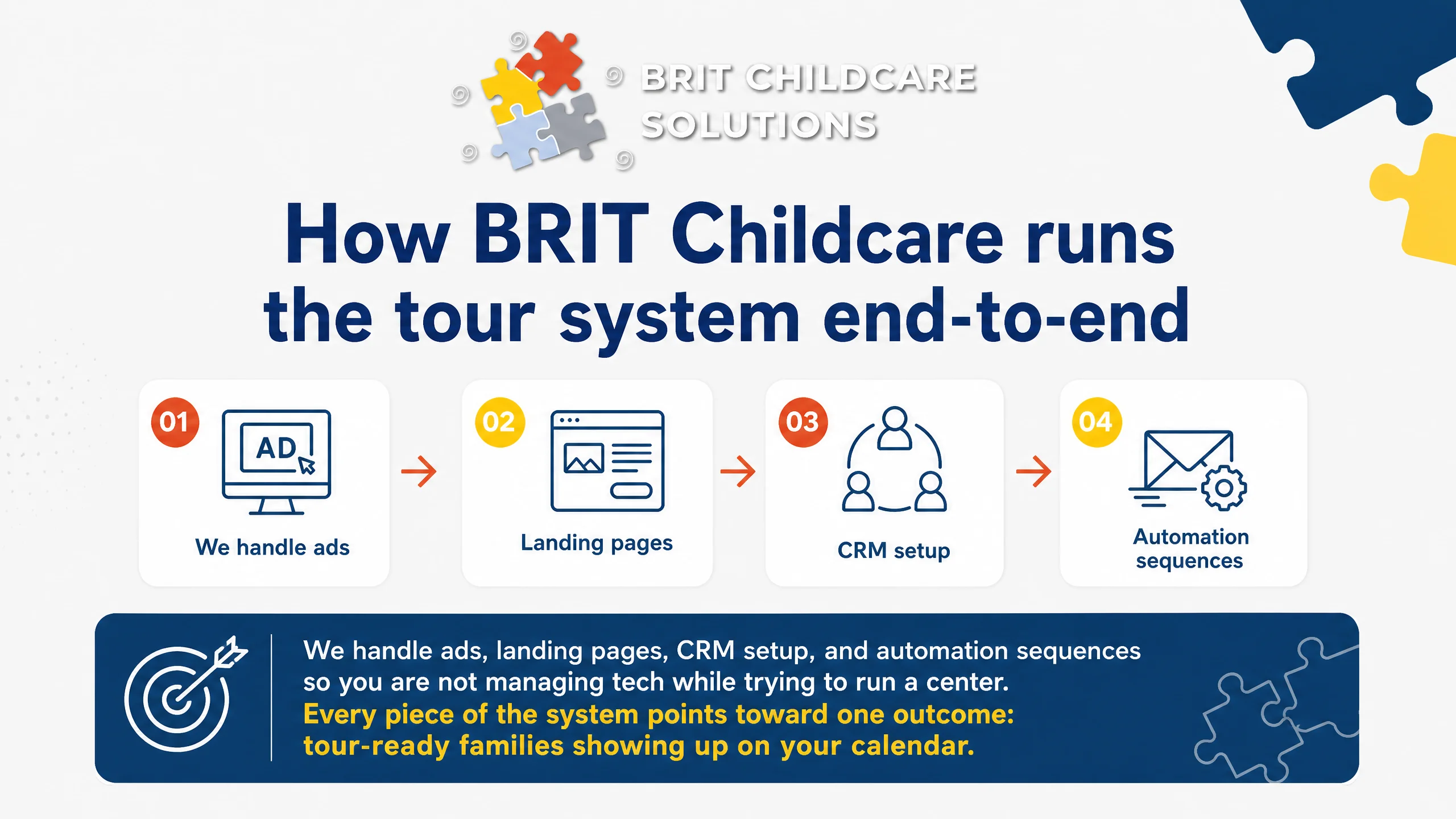
We handle ads, landing pages, CRM setup, and automation sequences so you are not managing tech while trying to run a center. Every piece of the system points toward one outcome: tour-ready families showing up on your calendar.
What the Zoom strategy call covers
The strategy call is a working session, not a sales pitch. We look at your current tour pipeline first: where inquiries come from, how fast they are followed up, and where families drop off before booking.
Tour pipeline diagnosis: identify the exact stage where your funnel loses families
Market and capacity modeling: assess local demand against your licensed capacity and current fill rate
Next 90-day tour plan: a concrete roadmap for inquiry capture, booking automation, and show-up rate targets
You leave the call with a clear picture of what is broken and what fixing it is worth in filled seats.
Minimum fit to work together
We work best with centers that have 50 or more licensed spots, because that capacity level justifies a full enrollment funnel and produces enough tour volume to optimize against real data.
Multi-location operators are a strong fit when they need inquiry routing, per-location tracking, and consistent follow-up across sites. If you are actively opening a second or third location, that is a signal we look for.
Our service is a premium annual partnership. If marketing spend feels like a stretch at this stage, the call is worth postponing until capacity and budget align.
Ready to See What a Childcare-Only System Actually Delivers?
If this article raised questions about your current agency or your enrollment funnel, that is exactly the conversation we want to have. At BRIT Childcare, we work exclusively with childcare centers, preschools, and Montessori schools across the U.S., and every strategy call starts with the same focus: your licensed capacity, your locations, and the tour and enrollment benchmarks we can realistically commit to for your specific situation.
Book a Zoom strategy call with our team and come prepared with your current enrollment goals and how many locations you operate. We will confirm fit on the call and walk you through what inquiry-to-tour conversion and tour show-up rates should look like for a center your size. Ask us directly how we handle CRM and automations, because one of the most common reasons owners stay stuck is that they are left managing the tech and follow-up themselves.
That is not how we operate.
You focus on your team and the children in your care. We handle the system that turns inquiries into tour-ready families. Visit britchildcare.com/work-with-us to book your strategy call.
Frequently Asked Questions
Why do childcare centers focus on lead volume instead of conversion?
Most owners start measuring marketing by how many inquiries come in because that number is easy to see. What it does not tell you is how many of those families actually toured or enrolled. Inquiry-to-tour conversion rate and tour-to-enrollment conversion rate are the metrics that connect your marketing spend to real classroom seats filled.
What's the difference between tours that book and tours that actually happen?
A booked tour and a completed tour are two very different outcomes, and the gap between them is where most centers lose families without realizing it. Reducing booking friction, sending text-based reminders at 24 hours and 2 hours before the tour, and responding to the original inquiry within minutes are the fastest ways to close that gap and raise your show-up rate.
Does more advertising solve enrollment problems?
Not if your funnel is the problem. When inquiry volume is already healthy but seats stay empty, adding ad budget only sends more families into a broken follow-up process. The fix is what happens after the inquiry arrives, specifically how fast you respond, how easy it is to book a tour, and how consistently you follow up before and after that tour.
