How Long Childcare Marketing Automation Takes
The tasks that move families from inquiry to enrolled seat are the ones worth automating first: instant text replies to new inquiries, two-click tour booking, and confirmation reminders that cut no-shows. Most childcare centers that struggle with automation are not missing the right software.
Here is what the timeline and priorities actually look like:
Responding to inquiries within five minutes is the single highest-impact action, and automation makes it consistent without relying on front desk availability.
Tour no-show rates drop significantly when confirmation and reminder messages are sent by text, not email.
Most enrollment loss happens after the inquiry arrives, not during lead generation, so measuring inquiry-to-tour and tour-to-enrollment conversion is what tells you where to fix.
Multi-location operators face a routing problem that generic automation tools do not solve, and inconsistent follow-up across sites is a common reason automation stalls.
Stale inquiry reactivation sequences can recover families who went quiet before ever booking a tour, converting leads most centers have already written off.
At BRIT Childcare, we work exclusively with childcare centers and multi-location operators across the United States. Our Done-For-You Marketing Service installs this exact tour-first automation system, including lead capture, automated response sequences, tour booking automation, and a funnel tracking dashboard that shows you where families drop off at every stage. We handle the technical setup so you stay focused on your team and the children in your care.
Before you estimate how long any of this will take to build or show results, there is one step worth doing right now.
A quick self-audit of your current response time and conversion rates will tell you exactly where your enrollment funnel is leaking, and that number shapes everything that comes next.
Run this 10-minute self-audit before you estimate timing
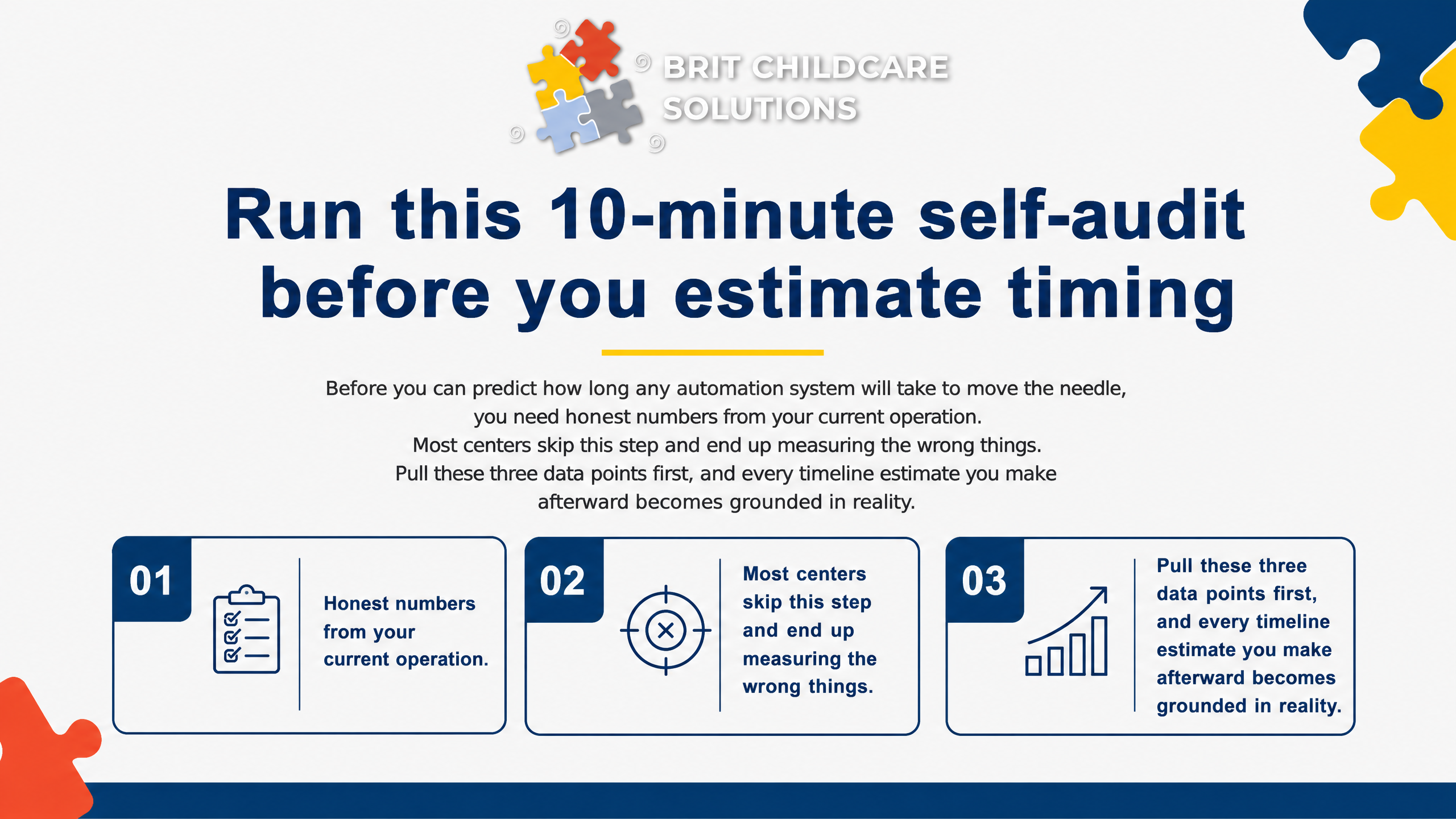
Before you can predict how long any automation system will take to move the needle, you need honest numbers from your current operation. Most centers skip this step and end up measuring the wrong things. Pull these three data points first, and every timeline estimate you make afterward becomes grounded in reality.
Your five-minute response reality
The single most important number in your enrollment funnel is how fast you respond to a new inquiry. Lead response research shows that replying within five minutes increases conversion rates by 100x compared to a 30-minute delay. Most childcare centers are nowhere close to that benchmark.
Start by logging your actual first-reply time for each channel: website contact forms, Facebook messages, Google Business Profile inquiries, and phone calls. Be honest. If your front desk picks up calls but Facebook messages sit until Tuesday morning, that gap is costing you tours.
Text versus email also matters more than most owners expect. Text replies get read within minutes. Email responses often sit for hours.
If your current inquiry workflow routes everything to an email inbox, you are likely losing families to a competitor who texted them back first. After-hours and weekend gaps compound this problem, since many parents research childcare options outside of business hours.
The three drop-offs to map
Most enrollment loss does not happen at the top of the funnel. It happens in the gaps between stages. Map these three conversion rates before you automate anything:
Once you have these numbers, the drop-off that looks worst is where automation delivers the fastest return. In our experience working with childcare centers, the tour show-up rate is almost always the weakest link, not inquiry volume.
Inquiry-to-tour conversion rate: Of every 10 families who contact you, how many actually book a tour? If you do not know this number, you are flying blind on whether your follow-up process is working.
Tour show-up rate: Of families who book, how many walk through your door? A low show-up rate points directly to weak confirmation and reminder systems, not a lead quality problem.
Tour-to-enrollment conversion rate: Of families who tour, how many sign an enrollment agreement?
If this number is low, the issue is usually what happens after the tour, not during it.
Multi-location routing stress test
If you operate more than one site, your audit needs one additional layer. Routing failures are invisible until you look for them, and they quietly drain enrollment across every location.
Run through these three failure points and document what actually happens at your centers today:
Wrong site follow-ups: Does a family who inquired about your north location ever receive a response referencing your south location? Misrouted follow-ups create confusion and signal disorganization to parents who are evaluating you against competitors.
Missed calls and voicemails: How many voicemails from prospective families go unreturned within the same business day? If the answer is unclear, that is the problem.
Handoffs between staff roles: When a director is out and a front desk team member takes an inquiry, does the follow-up still happen on time?
Gaps in handoff protocols are where multi-location centers lose the most families.
These routing gaps are exactly why a single automation system built for multi-location childcare operations outperforms a patchwork of individual staff workflows. Once you document where the breakdowns occur, you have a clear starting point for what to fix first.
The timeline that matters: when you should see booked tours
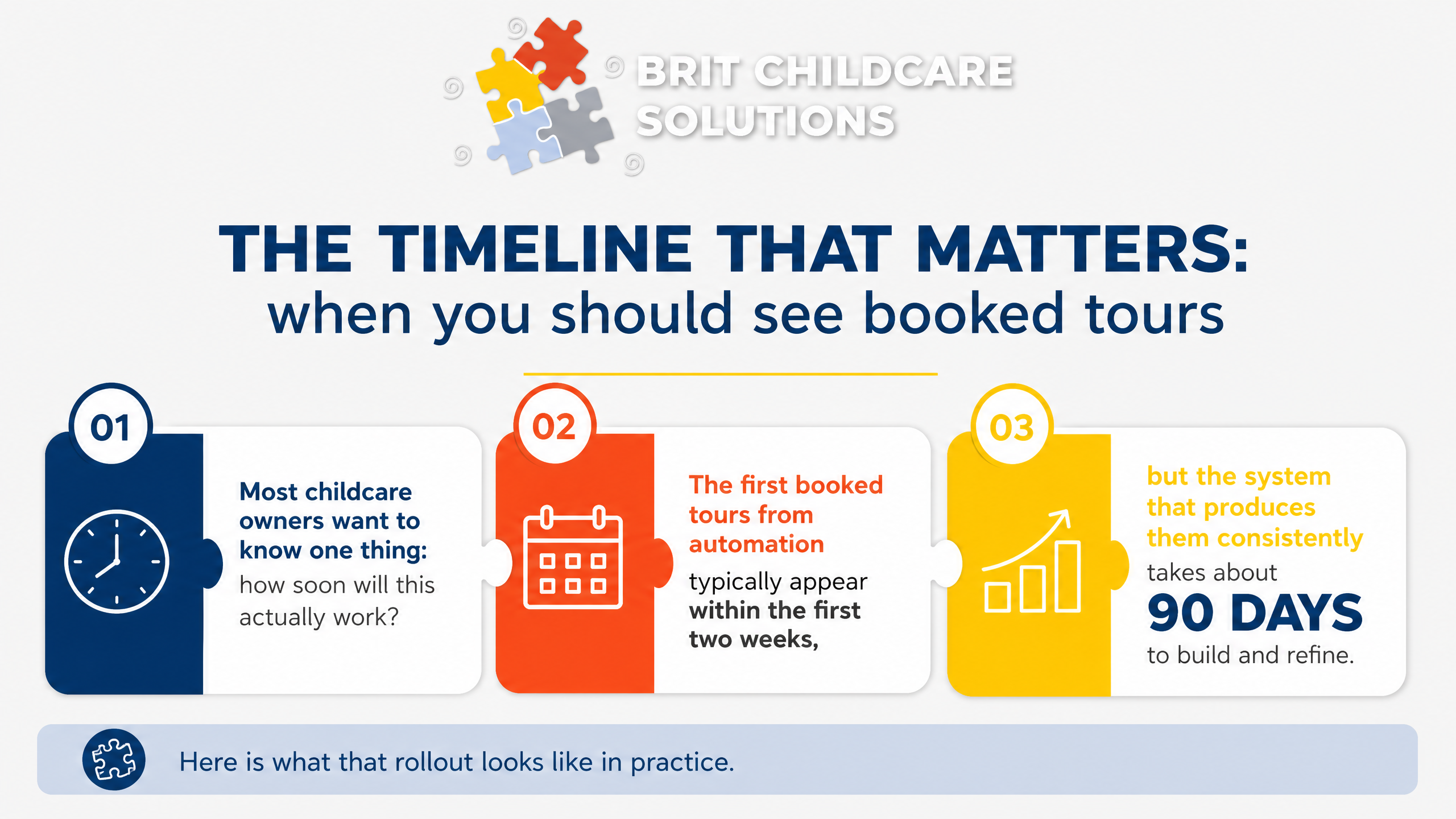
Most childcare owners want to know one thing: how soon will this actually work? The honest answer is that the first booked tours from automation typically appear within the first two weeks, but the system that produces them consistently takes about 90 days to build and refine. Here is what that rollout looks like in practice.
Days 1-7: speed and capture
The first week is entirely about making sure no inquiry slips through. Before any booking automation can work, every inquiry channel needs to feed into one place and trigger an immediate response.
Lead response research shows that responding within 5 minutes increases conversion rates by 100x compared to a 30-minute delay. That gap is where most centers lose families before they ever speak to anyone. The fix in week one is structural: connect your website form, Google Business Profile, Facebook, and any ad campaigns to a single lead capture system, then activate an instant text reply that goes out the moment a parent submits an inquiry.
Unified lead capture: all inquiry sources route to one system, no manual checking of separate inboxes
Instant text reply: automated message goes out within minutes of every new inquiry, regardless of time of day
Basic location tagging: each lead is tagged by the center location they inquired about, which matters immediately for multi-location operators
By the end of day seven, a parent who submits a form at 9 PM on a Sunday should receive a response before they close their browser.
Days 8-30: booking and reminders
Once inquiries are being captured and responded to instantly, the next priority is converting that momentum into scheduled tours. This is where most centers stall without automation: a parent replies to the text, expresses interest, and then waits two days for someone to call them back with available times.
Two-click tour scheduling removes that friction. Parents receive a link in the text thread that lets them pick a date and time without a phone call or back-and-forth. The moment they book, a confirmation text goes out automatically.
From there, a reminder sequence runs in the days leading up to the tour.
No-show reduction is the measurable outcome of this phase. Text reminders significantly outperform email for tour show-up rates, and a simple sequence of a confirmation, a 48-hour reminder, and a same-day reminder can meaningfully shift how many families actually walk through the door.
Days 31-90: tracking and refinement
The first month builds the system. The next two months make it smarter. By day 31, you should have enough data to see where families are dropping off and which inquiry sources are actually producing tours.
Source and location reporting tells you whether your Google ads, your Facebook inquiries, or your organic website traffic is driving the families most likely to book. For multi-location operators, this reporting also shows which sites are converting well and which need attention.
Two additional refinements happen in this phase:
Handoff rules for staff: clear protocols for when automation hands a lead to a human, such as a family who has not booked after three touchpoints or a parent who asks a question the sequence cannot answer
Message testing by conversion stage: adjusting the language in your inquiry response, your booking prompt, and your reminder texts based on which versions produce more confirmed tours
Centers that complete this 90-day build typically have a repeatable system, not just a tool running in the background. The difference shows up in their inquiry-to-tour conversion rate, which is the number that actually predicts enrollment growth.
What you automate first to get faster ROI
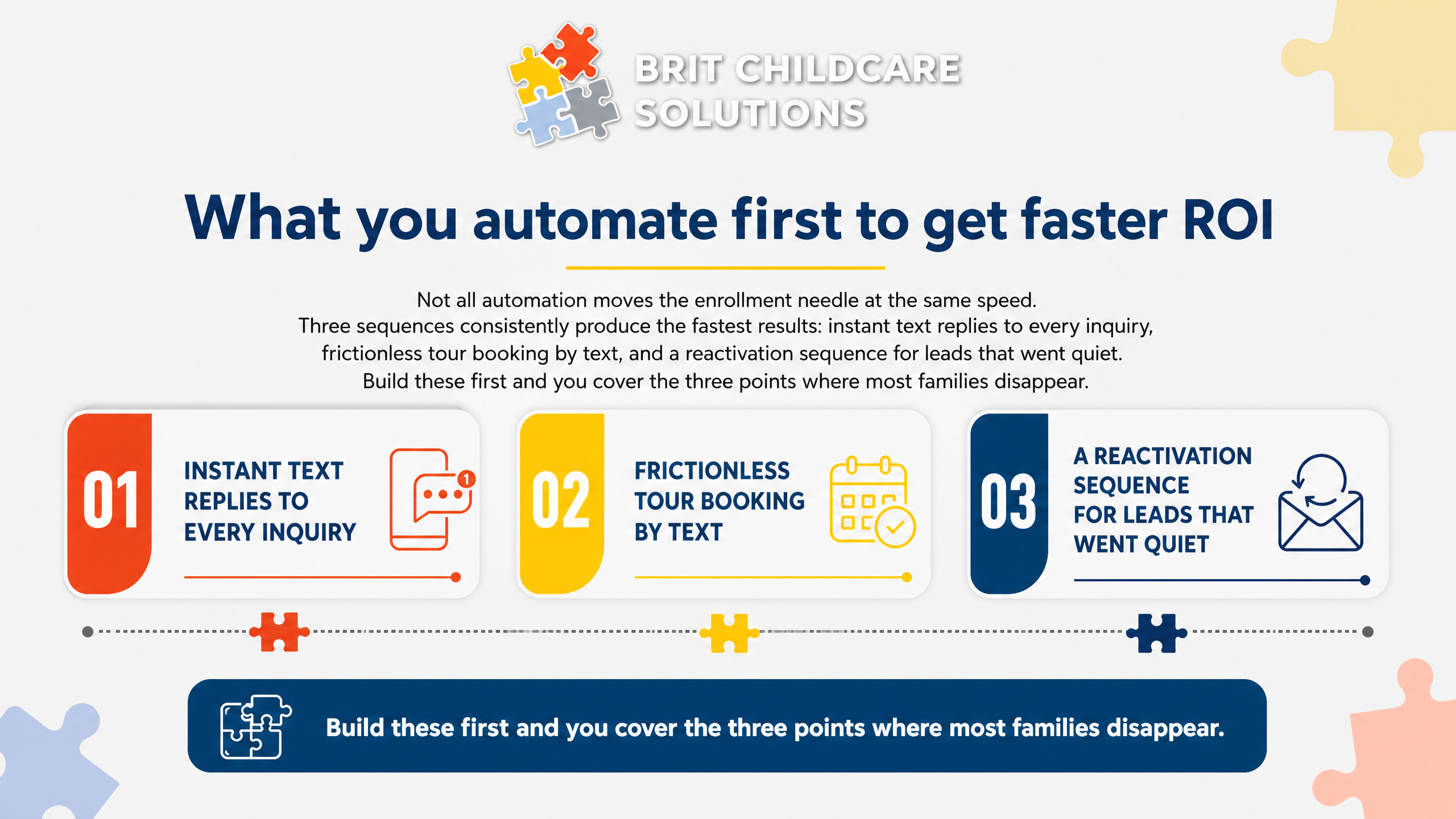
Not all automation moves the enrollment needle at the same speed. Three sequences consistently produce the fastest results: instant text replies to every inquiry, frictionless tour booking by text, and a reactivation sequence for leads that went quiet. Build these first and you cover the three points where most families disappear.
Instant text reply on every inquiry
Speed is the single biggest factor in whether a new inquiry becomes a tour. Lead response research confirms that responding within five minutes increases conversion rates by 100x compared to a 30-minute delay. Families contact multiple centers at once, and the first center to reply with a warm, specific message almost always wins the tour.
Every inquiry source needs this coverage, not just your website contact form. That means:
Website forms and chat: An automated text fires the moment a parent submits a form or starts a chat, acknowledging their inquiry and offering next steps before a staff member even sees the notification.
Google and social lead ads: Leads from Google or Facebook ads often arrive outside business hours. Without automation, those families wait until morning and book elsewhere. An instant reply keeps momentum alive.
Missed call text-back: When a parent calls and no one answers, an automated text goes out within seconds.
It acknowledges the missed call and invites them to book a tour directly.
Together, these three channels represent the full range of how families reach out today. Covering all three closes the gaps that manual follow-up consistently misses.
Two-click tour booking by text
Once a family replies to your initial text, the next job is getting them booked without friction. Requiring a phone call or a lengthy form at this stage causes drop-off. A text-based booking link that shows available slots takes the family from interested to confirmed in under two minutes.
For multi-location operators, the booking link should display slots specific to the location the family inquired about. Routing a family to the wrong campus creates confusion and erodes trust before the tour even happens.
After booking, two things reduce no-shows significantly. First, every reminder message includes a reschedule link so families can adjust without calling, which removes a common reason for silent cancellations. Second, a short tour prep sequence, typically two or three messages sent in the days before the visit, shares what to expect, where to park, and what questions to bring.
Families who arrive prepared are more likely to enroll.
Stale inquiry reactivation sequence
Most centers have a backlog of families who inquired, never booked, and went silent. These are not dead leads. They are families who got busy or distracted, and a short, well-timed message can bring a meaningful number of them back.
The reactivation window that works best is seven to fourteen days after the original inquiry. Earlier than that and you risk interrupting a family still in research mode. Later than two weeks and the emotional urgency that drove the first inquiry has usually faded.
Keep the message short and give them a choice rather than a single call to action. Something like: 'Still looking for care starting in August? We have a few spots open.
Would a Tuesday or Thursday tour work for you?' This format works because it re-qualifies their timeline and start date in the same message, which tells you whether the lead is still worth pursuing. Families who respond with a specific month or age are actively deciding. Families who do not respond after two attempts can be archived without guilt.
Why automation fails in childcare
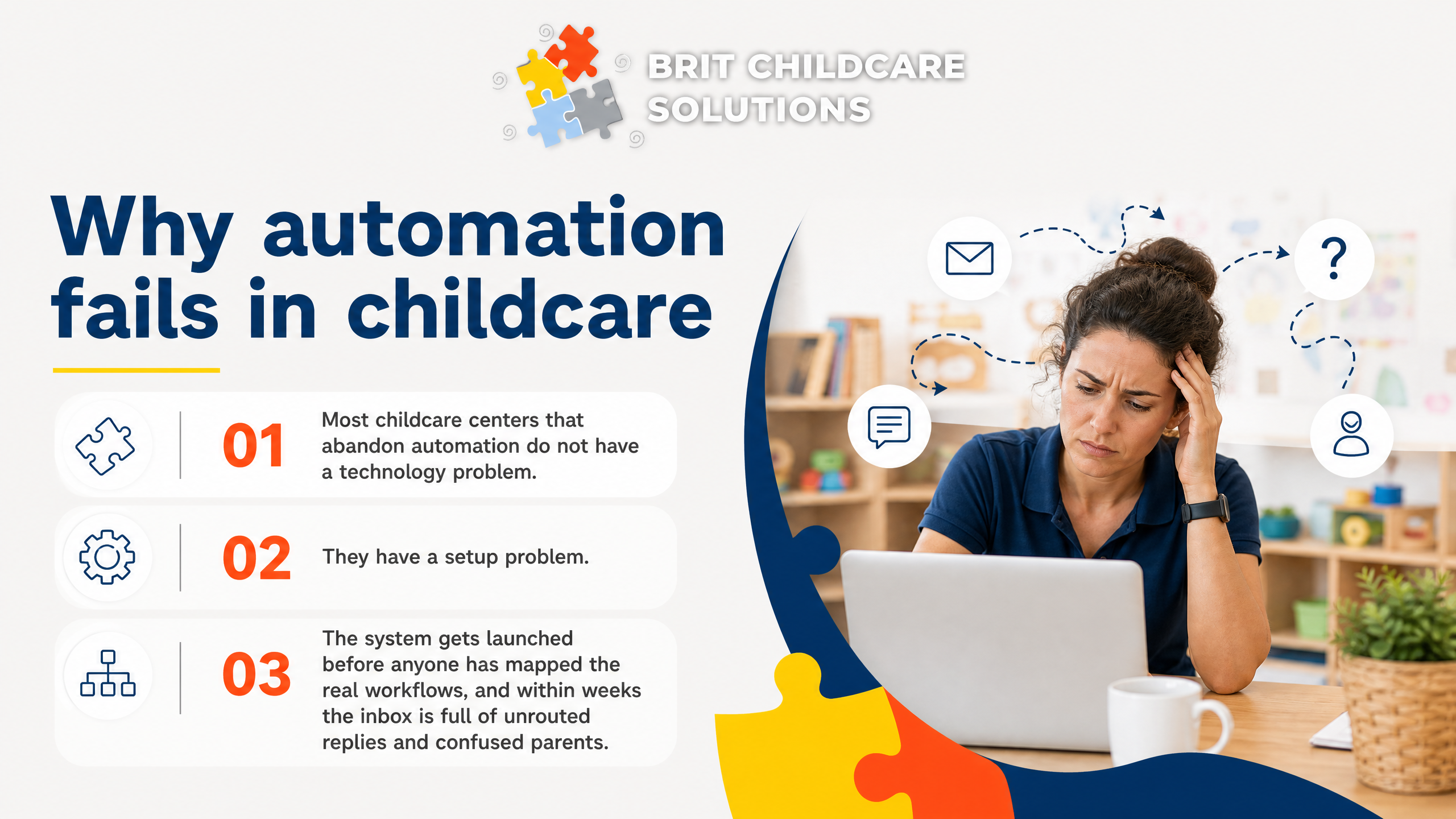
Most childcare centers that abandon automation do not have a technology problem. They have a setup problem. The system gets launched before anyone has mapped the real workflows, and within weeks the inbox is full of unrouted replies and confused parents.
Where complexity sneaks in
Automation breaks down fastest when there are too many message paths with no clear owner. A center might build separate sequences for website inquiries, Facebook leads, and Google ads, then realize no one is monitoring which path a family actually came through.
Follow-up is the other silent failure point. Automation can send the first text, but if a parent replies with a question and no staff member is assigned to respond, the lead goes cold. The system did its job.
The process did not.
Inconsistent data entry compounds both problems. If one front desk staff member enters a child's start date and another leaves it blank, your reminder sequence either fires at the wrong time or not at all. Clean data is not glamorous, but it is the foundation every sequence runs on.
Childcare edge cases to design for
Generic automation assumes one parent, one child, one inquiry. Childcare does not work that way, and the gaps show up quickly.
Families with siblings often need two different program schedules confirmed in a single conversation. If your booking flow only captures one child's information, you will get a tour booked for the wrong age group or a frustrated parent who has to call in to sort out the rest.
Two-guardian households add another layer. Some families require both parents to consent before an enrollment agreement is signed. Your sequences need to account for who receives which message and at what stage, or you risk sending a contract to the wrong contact.
Waitlist timing is equally specific to childcare. A family who joined your waitlist six months ago needs a different message than one who inquired yesterday. When an opening becomes available, the outreach has to be immediate and tied to the right age group and location, not a generic broadcast.
Keeping texts personal at scale
Automated texts do not have to sound automated. The difference is in the details: a first-name greeting, a sign-off from a real staff member's name, and language that reflects your center's actual voice rather than a generic template.
Every sequence should have a staff takeover trigger. When a parent replies with anything beyond a simple confirmation, a real team member needs to pick up the conversation. In our experience, the moment a parent asks a specific question about curriculum or hours is the moment automation should step aside.
Stick to safe personalization fields: first name, child's name, tour date, and location. Pulling in fields that are sometimes blank, like a sibling's name or a preferred start date, creates messages that read as broken rather than personal. Less personalization done consistently beats more personalization done inconsistently.
Use staff first names in sign-offs, not just the center name
Flag any reply that is not a one-word confirmation for human follow-up
Audit your personalization fields monthly to catch blank or outdated data
Parents do not need to know a system sent the first message. They need to feel like your center noticed them.
What to measure weekly so you know it is working
Automation only earns its place in your enrollment process when you can see it moving the numbers. Track these three metric sets at the right intervals and you will know exactly where momentum is building and where families are still slipping away.
Week 1: response time metrics
Your first week of data tells you one thing: how fast your system is actually working. Lead response research confirms that responding within 5 minutes increases conversion rates by 100x compared to a 30-minute delay, so your median first response time is the single most important number to pull in week one.
Beyond speed, check your after-hours coverage rate. What percentage of inquiries that arrive evenings and weekends received an automated reply within five minutes? If that number is below 90%, families are going dark before your team ever sees the message.
Also track reply-to-booking lag time: the minutes or hours between a family's first response and a confirmed tour slot. A fast first reply that leads to a two-day booking conversation still loses families. Your goal is same-session booking.
Week 4: tour pipeline metrics
By week four, you have enough inquiry volume to measure tour pipeline health. Pull three numbers:
If your inquiry-to-tour conversion is below 40%, the bottleneck is usually friction in the booking step, not lead quality. If your show-up rate is below 70%, reminder timing or channel is the problem. Most centers see show-up rates climb significantly when text reminders replace email-only sequences.
Reschedule salvage rate measures how many no-shows your system recovers with an immediate re-booking prompt. A salvage rate above 50% means you are recapturing families who would otherwise disappear.
Inquiry-to-tour conversion: percentage of new leads who book a tour
Show-up rate by reminder: tour attendance broken down by reminder type (text vs. email)
Reschedule salvage rate: no-shows who rebook within 48 hours
Week 8-12: enrollment metrics
Enrollment outcomes take longer to surface because families need time to decide. LineLeader benchmark data shows that 80% of enrollments happen within the same quarter as lead creation, so weeks 8 through 12 are when your funnel math becomes clear.
Track tour-to-enrollment conversion by location. A rate below 60% usually signals a gap in your post-tour follow-up, not a problem with the tour itself. Pair that with time from tour to decision: how many days pass before a family signs an enrollment agreement.
If that window is stretching past two weeks, a structured follow-up sequence can close it faster.
Finally, measure capacity impact by classroom. Which age groups are filling? Which rooms still have open seats?
This tells you where to focus reactivation sequences for stale leads and where your automation is already doing its job.
When done-for-you is faster than DIY
BRIT Childcare's Done-For-You Marketing installs an Enrollment Engine built specifically for childcare workflows, not adapted from a generic CRM. We handle the full lead capture setup, automation sequences, and routing configuration so your team focuses on tours, not technology.
If you have multiple locations
Managing inquiries across two or more sites without routing rules means leads land in the wrong inbox, follow-up is inconsistent, and you have no clear picture of which location is underperforming.
We configure location-based routing so every inquiry is assigned to the correct site automatically. Each location gets its own follow-up standards, so a family contacting your Westside center gets the same response speed and message quality as one contacting your Downtown site.
Routing rules tied to inquiry source and location
Standardized follow-up sequences across all sites
Reporting by location and lead source so you can spot drop-offs fast
If your staff cannot own it
Front desk staff are caregivers first. Asking them to manage lead follow-up, tour confirmations, and reactivation sequences on top of daily operations is where most DIY automation breaks down.
We build the handoff and escalation paths into the system itself, so staff know exactly when to step in and what to say. Tour-specific message templates are pre-written and ready to send. Training is short, focused, and built around the workflows your team actually uses, not a software manual.
If you need proof fast
If your owner or board needs to see results quickly, you need more than a lead count. You need full funnel conversion tracking at every stage: inquiry to tour, tour to enrollment.
Our tour-first automation sequences prioritize booking and show-up rate from day one, which is where most enrollment loss actually happens. When you book a strategy call with our team, you leave with a documented action plan tied to your current conversion rates, not a generic checklist. Lead response research confirms that responding within five minutes increases conversion rates dramatically, and our system is built to hit that window automatically.
Funnel tracking dashboard showing drop-offs at inquiry, tour, and enrollment
Automated sequences designed around tour booking and no-show reduction
Strategy call that maps your action plan to your actual numbers
Centers that track all three conversion points consistently find the enrollment gap faster and close it faster than those measuring leads alone.
You Have the Playbook.
Now Let's Install It.
You now know what to automate, in what order, and what to measure week by week. The harder question is whether your team has the bandwidth to build it, test it, and keep it running while also managing a full center.
That is exactly where we come in. BRIT Childcare's Done-For-You Marketing Service installs your complete enrollment automation system, from lead capture across every inquiry source to automated text responses, two-click tour booking, no-show reminders, and stale inquiry reactivation. We also set up your funnel tracking dashboard so you can see your inquiry-to-tour and tour-to-enrollment conversion rates by location, not just a raw lead count that tells you nothing.
Before you schedule your strategy call, take five minutes to document three numbers: your current average response time to new inquiries, your inquiry-to-tour conversion rate, and your tour-to-enrollment rate. Those three data points will shape everything we build together.
When you are ready, book your strategy call with the BRIT Childcare team at britchildcare.com/work-with-us. We will review your funnel, identify your biggest drop-off point, and map out exactly how your enrollment automation system gets built.
