How to Get Childcare Leads Without Fake Forms
Tour-ready families do not come from more leads. They come from better ones. If you have watched your inquiry count climb while your enrollment numbers stay flat, the problem is not your ad spend or your form placement.
Here is what separates centers that fill seats from those that chase inquiries:
Tour show-up rate, not lead volume, is the metric that tells you whether your marketing is actually working.
Targeting 1 to 2 specific neighborhoods lets you define who you can realistically enroll and stops wasted spend on families outside your reach.
Disabling Google's partner search network is one of the fastest ways to cut fraudulent clicks from your ad budget.
Required form fields and CAPTCHA filter out bots and low-intent submissions before they ever reach your CRM.
Automated text reminders sent before a scheduled tour consistently outperform email for reducing no-shows.
At BRIT Childcare, we work exclusively with childcare centers, preschools, and Montessori schools across 40+ states, and we built our Enrollment Engine around one belief: you do not need more inquiries, you need parents who actually show up. Our done-for-you system handles inquiry capture, automated follow-up, tour booking, and conversion tracking across every location, so you stay focused on your staff and the children in your care.
Before you adjust a single ad or rewrite your contact form, there is one number you need to pull from your data. It will tell you immediately whether you have a lead quality problem, a follow-up problem, or both, and it is the foundation everything else in this playbook is built on.
Start with the metric that exposes fake leads
Most childcare owners measure the wrong thing. They count how many inquiries came in last week, not how many of those families actually showed up for a tour. That single blind spot is where marketing budgets quietly disappear.
Lead volume vs tour-ready rate
Inquiry count tells you how loud your ads are. Tour-ready rate tells you whether those ads are reaching real families. These are two very different numbers, and confusing them is the root cause of empty seats despite a busy inbox.
Three conversion points define your enrollment funnel:
Tours scheduled per lead: how many inquiries actually book a visit. A healthy rate sits above 30%. Below that, your lead quality or follow-up speed needs attention.
Show-up rate baseline: of the tours booked, how many families walk through the door.
Industry experience suggests 60 to 70 percent is a realistic target. Anything lower points to a follow-up or reminder gap.
Enrollment per tour: the share of toured families who sign and pay. Strong centers convert 50 percent or more of attended tours into enrollments.
If any of these three numbers is weak, adding more leads will not fix enrollment. It will only multiply the waste.
The fake lead warning signs
Fake leads do not always arrive as obvious spam. Many look like real inquiries on the surface, which is why lead quality indicators matter more than raw form counts. Knowing the patterns lets you catch the problem before it drains your follow-up time.
Watch for these signals in your incoming inquiries:
Odd emails and phone patterns: addresses with random strings of numbers, mismatched area codes, or disposable email domains like guerrillamail or mailnull are rarely real parents.
Instant form bursts: five or more submissions arriving within minutes of each other, often with similar formatting or identical fields, signal bot activity or click fraud rather than genuine interest.
No response to texts: a real parent searching for childcare responds quickly. If a lead goes silent after two text attempts within 24 hours, treat it as unqualified and stop spending follow-up resources on it.
These patterns are not rare edge cases. Centers running paid ads without form validation regularly see 20 to 40 percent of their inquiries match one or more of these signals.
A simple weekly scorecard
You do not need a complex dashboard to spot a fake lead problem. Three numbers, tracked weekly, give you a clear picture of whether your lead generation is working or bleeding budget.
Build your scorecard around these metrics:
Leads to tours ratio: divide tours scheduled by total inquiries received. Review this weekly by source so you can see which channel delivers tour-ready families and which delivers noise.
Show-ups vs no-shows: record every scheduled tour as either attended or missed. A rising no-show rate is one of the earliest signs that lead quality is slipping, often before enrollment numbers reflect it.
Cost per show-up: take your total ad spend for the week and divide it by the number of families who actually walked in.
This is the number that matters to your budget, not cost per lead.
Tracking lead quality indicators at this level shifts your decision-making from guesswork to a repeatable weekly review that tells you exactly where to act.
Pick 1 to 2 neighborhoods you can actually enroll
Most childcare ad campaigns fail before a single dollar is spent because the targeting is too broad. Narrowing your focus to one or two neighborhoods you can realistically serve is the step that separates budget waste from tours booked.
Define your enrollable family
Before you target anyone, get clear on exactly who you can serve. An enrollable family is not just any parent who fills out a form. They are a family whose child fits your age range, whose schedule matches your hours, and whose budget aligns with your tuition.
Start with your open rooms. If you have infant spots available but your toddler rooms are full, your ads should reflect that. Promoting general enrollment while only having capacity in one age group creates inquiries you cannot convert.
Age groups: List only the specific ages with open seats, not your full program range
Schedule fit: Confirm your hours match common parent work schedules in your area, part-time versus full-time, early drop-off, late pickup
Start-date reality: If your next opening is three months out, say so in your targeting and messaging to filter families who need care now
Tuition range: Know your weekly or monthly rate and target zip codes where median household income supports it without friction
Families who do not fit these criteria will not enroll even if they tour. Filtering them out at the targeting stage protects your follow-up time and your ad budget.
Neighborhood targeting that holds
Set your geographic boundary based on drive time, not radius. A five to seven minute drive is the realistic threshold for most families choosing daily childcare. A one-mile radius in a dense urban area may include hundreds of families; a five-mile radius in a suburban market may include almost none who will actually commit.
Once you have your drive-time boundary, pull the zip codes that fall inside it and exclude the ones that consistently produce low-quality inquiries. If a zip code generates form fills but no tours, it is a signal worth acting on.
Drive-time boundary: Use Google Maps to draw a realistic commute zone around your center, typically five to seven minutes
Zip code exclusions: Remove zip codes with low tour conversion history or household income misaligned with your tuition
Two-area test: Run one campaign per neighborhood for 30 days, compare inquiry-to-tour rates by zone, then shift budget toward the area that converts
Testing two areas before committing your full budget gives you real conversion data instead of assumptions.
If you are waitlisted
A waitlist does not mean you stop all marketing. It means you get selective. Running broad campaigns when you have no open seats generates inquiries you cannot serve, which damages your response reputation and wastes spend.
Pause any campaigns targeting general enrollment and shift to a waitlist-only flow. Only promote tours for rooms where a spot may open within 60 to 90 days. Families who tour a room they can realistically enter are far more likely to hold their place.
Pause low-intent campaigns: Turn off broad awareness ads and any campaigns not tied to a specific open or near-open room
Tour priority rooms only: Invite families to tour only the age group with the most likely near-term opening
Waitlist form with deposit: Require a small, refundable deposit with the waitlist submission to confirm genuine interest and reduce ghost holds
Run Google and Facebook ads that produce tours, not spam
Choosing the right ad channels matters less than setting them up correctly. Most childcare centers bleed budget on broad match keywords, partner network clicks, and instant lead forms that attract parents who never show up. Here is how to run Google and Facebook ads that are built for tour intent from the start.
Google Search for high intent
Limit your Google Search campaigns to exact match and phrase match keywords only. Broad match pulls in searches that have nothing to do with childcare enrollment in your area, inflating your click count while your tour-booked rate stays flat.
A tight negative keyword list is non-negotiable. Before your campaign goes live, add terms like 'free,' 'jobs,' 'curriculum,' 'training,' 'software,' and 'home daycare' to block searches from job seekers, educators, and unqualified browsers who will never book a tour.
Turn on call extensions and location extensions for every campaign. Parents searching for childcare on a phone want to call or get directions immediately. These extensions also signal to Google that your ad is locally relevant, which improves your ad rank without raising your bid.
Turn off Search Partners
Disabling the Search Partners network is one of the first settings we check when auditing a childcare center's Google Ads account. By default, Google opts your campaigns into partner sites, which include hundreds of smaller search engines and directories where click fraud is far more common than on Google.com itself.
Search Partners and the Display Network are separate exclusions. Turning off one does not turn off the other. Go into your campaign settings and uncheck both independently, or your ads can still appear across unrelated websites with low conversion intent.
Once you have run campaigns for 30 days, pull your Search Partners performance data in the campaign segments report. If you see a high click volume with zero or near-zero tour form submissions from that segment, that is the fraud pattern in action. Unprofitable clicks from partner sites can drain your budget quietly while your Google.com placements perform well.
Facebook for local demand capture
Facebook works for childcare enrollment when you treat it as a local awareness channel, not a lead volume machine. Set your geographic radius to one or two neighborhoods you can realistically serve, and write ad copy that names those neighborhoods directly. 'Now enrolling in Riverside and Oak Park' outperforms 'enrolling now' because it filters for parents who already live where you operate.
Send Facebook traffic to a dedicated landing page, not your homepage. The landing page should have one goal: get the parent to schedule a tour. A clear parent promise, a two-click booking option, and a short form with qualifying fields will convert far better than a page that asks visitors to explore your full website.
Avoid Facebook's Instant Lead Forms for childcare enrollment. They feel frictionless, but that is the problem. Parents can submit their contact information in two taps without leaving Facebook, which means they often do so impulsively and without real intent.
The result is a list of names that looks promising and converts poorly. A landing page with a real form creates the small amount of friction that separates curious scrollers from families who are genuinely ready to tour.
Make your form harder to fake and easier to qualify
Your inquiry form is either a filter or a funnel for junk. The fields you require, the validation you add, and the qualifiers you set determine whether your staff spends time on families ready to tour or on submissions that were never real to begin with.
Required fields that filter
Every field you add is a question a bot or a casual browser is less likely to answer. The right required fields do not just collect data, they force the submitter to demonstrate real intent.
Build your form around the details you actually need to decide whether a tour is worth scheduling:
Child age and care start date: confirms the family has a real, near-term need and lets you check against your current openings
Days needed and hours: identifies full-time versus part-time fit before your staff makes a single call
Preferred location and program type: routes the inquiry correctly in multi-location operations and filters families outside your service area
A family who fills out all six fields is far more likely to show up for a tour than one who only left a name and email.
CAPTCHA plus friction choices
Spam submissions waste staff time and pollute your enrollment data. CAPTCHA effectiveness research confirms that reCAPTCHA remains the most reliable tool for blocking automated bot submissions, outperforming most other filtering techniques when paired with complementary checks.
Add these three layers to every inquiry form:
reCAPTCHA on all submissions: the invisible v3 version adds no friction for real parents but stops most automated entries cold
Phone number validation: require a correctly formatted U.S. number and consider a one-time SMS verification step to confirm the number is active
Duplicate and rapid-entry blocking: set your form to reject a second submission from the same IP address or email within a short window, which stops bulk fake submissions without affecting genuine families
Your tour-ready definition
Before your staff contacts a single lead, your team needs a written definition of what a tour-ready family looks like. Without it, every inquiry gets treated the same, and your calendar fills with appointments that do not convert.
Define your qualifiers clearly:
Must-have qualifiers: child age falls within your licensed range, care needed within 90 days, location matches an open program, and days or hours align with available spots
Auto-reject criteria: no start date provided, location outside your service area, or program type you do not offer
Staff time protection rules: only inquiries that meet all must-have qualifiers move to the tour-booking step; all others receive an automated response with next steps or a waitlist option
This definition is what separates a busy schedule from a productive one. In our experience, centers that document these criteria see a measurable improvement in tour show-up rates within the first month of applying them.
Follow-up systems that cut no-shows before they happen
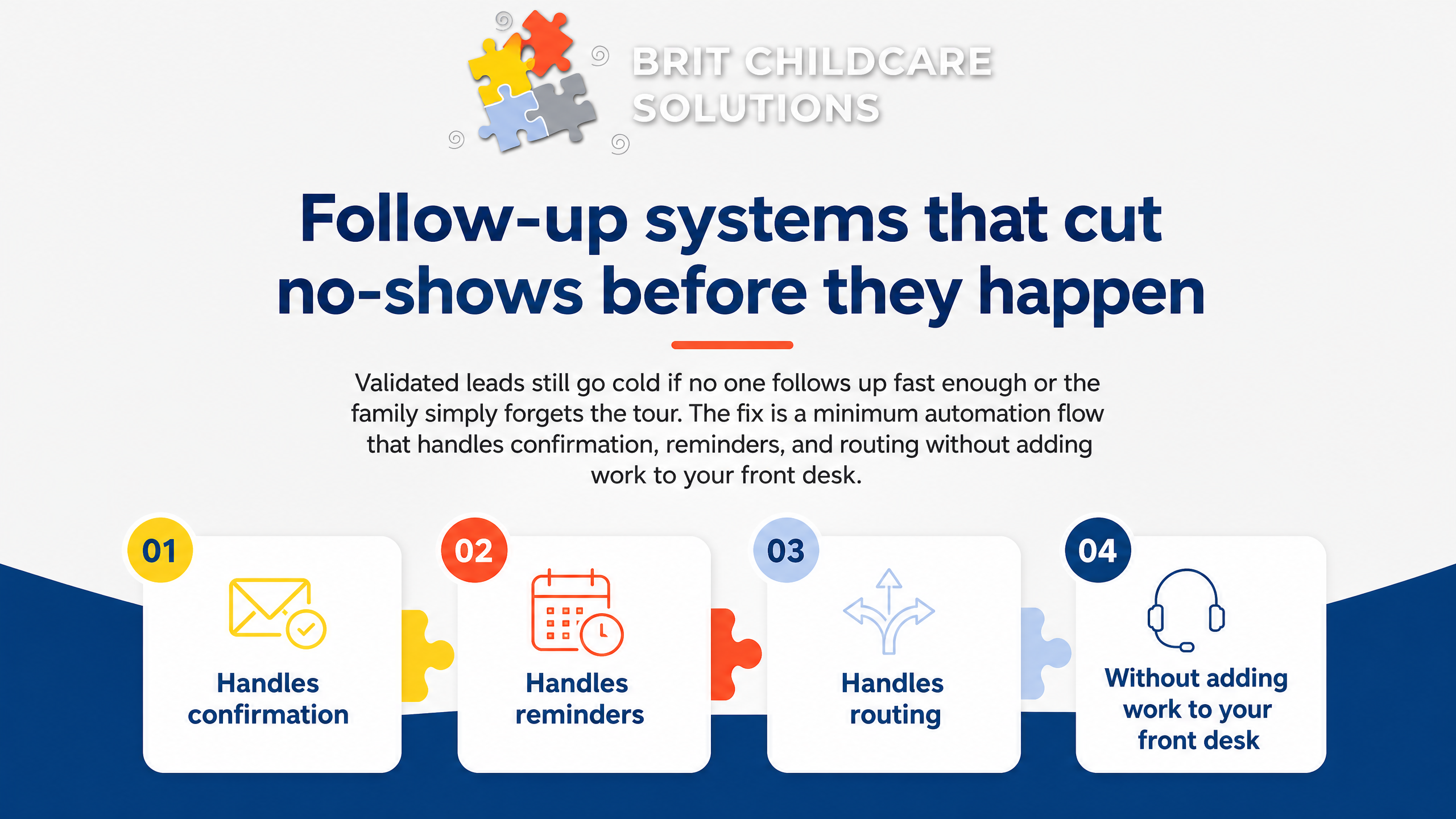
Validated leads still go cold if no one follows up fast enough or the family simply forgets the tour. The fix is a minimum automation flow that handles confirmation, reminders, and routing without adding work to your front desk.
Fast response that feels human
Speed is the single biggest lever in tour conversion. The 5-minute rule is well established in sales research: responding within five minutes can increase your chances of converting a lead by up to 100 times compared to waiting 30 minutes. Parents searching for childcare are comparing three to five centers at once, and the first center to respond sets the standard.
Text before you call. A text feels low-pressure and gets read immediately, while a phone call from an unknown number gets ignored. Send an automated text within five minutes of the inquiry, then follow with a call if there is no reply after 20 minutes.
Route by hours, not just by staff availability. If an inquiry comes in at 7 p.m., your automation should send the text immediately and queue the call for the next morning between 8 and 9 a.m. Calling at 7 p.m. signals poor boundaries; not calling at all loses the lead.
Show-up sequence for tours
Booking a tour is not the same as attending one. A family who schedules on Monday and hears nothing until Friday has already half-forgotten the appointment.
Send a confirmation text the moment the tour is booked. Include the date, time, your center address, and a one-click link to Google Maps. Families should never have to search for directions on the day of the visit.
24-hour reminder: text and email with the tour time, address, and what to bring
2-hour reminder: text only, short and friendly, confirming you are expecting them
Each reminder includes a reschedule link so families can shift the appointment instead of simply not showing up
The reschedule link is the most underused piece of this sequence. A family that reschedules is still a live lead. A family that ghosts costs you a tour slot and a staff member's time.
Compliance and consent basics
Before any text goes out, you need documented consent. The Telephone Consumer Protection Act requires that families opt in to receive automated text messages from your center. A single unchecked checkbox on your inquiry form is not enough.
Add a TCPA-compliant consent checkbox to every lead capture form. The checkbox must be unchecked by default and include clear language stating the family agrees to receive text messages from your center. Link your privacy policy directly next to the checkbox so families can review it before submitting.
Every outbound text must include opt-out language. A simple line such as 'Reply STOP to unsubscribe' at the end of your first message satisfies the requirement and keeps your account in good standing with SMS carriers.
When a done-for-you system beats DIY
Understanding the playbook is one thing. Running it consistently while managing staff, licensing, and daily operations is another. The question is not whether you can learn childcare lead generation - it is whether you have the time and team to execute it every week without it slipping.
What tour-ready lead gen includes
Tour-ready lead generation is not just running ads. It is a connected system where every piece feeds the next.
It starts with geo-targeted ads on Google and Facebook paired with landing pages built specifically to qualify families, not just collect names. From there, validation steps and CRM automations filter out bot submissions and route real inquiries into a follow-up sequence that books tours without manual effort.
The part most centers skip is the weekly review of tour metrics. Tracking inquiry-to-tour conversion rate and tour show-up rate by location tells you exactly where families are dropping off, so you can fix the right problem instead of guessing.
DIY vs generalist vs childcare-only
Childcare search behavior is specific. Parents searching for care are comparing multiple centers at once, often deciding within hours. A generalist agency may understand ad platforms, but they rarely understand that a parent who submits a form on Tuesday morning expects a response before lunch.
Fraud controls matter more in childcare than in most industries. Google Search Partners, for example, can generate clicks from low-quality sites that inflate your spend without producing real families. A childcare-only partner knows to disable that setting by default and to monitor lead quality indicators that signal bot traffic versus genuine interest.
Tour ops integration is where generalists fall short most often. Booking a tour is not the finish line. Confirmation texts, reminder sequences, and no-show follow-up all need to connect to your CRM.
Without that integration, you are left chasing families manually and losing them to centers that respond faster.
What to expect with BRIT
We handle Google and Facebook campaigns done-for-you, including geo-targeting, ad copy, and landing pages built for childcare families. You do not manage the platforms or troubleshoot performance.
CRM setup and automation are included from the start. That means automated responses within minutes, two-click tour booking, and text-based reminder sequences that reduce no-shows without adding work for your front desk.
Our clients typically see 10 to 40 scheduled tours per month depending on location count and market. We work exclusively with centers at 70-plus capacity or multi-location operators, because that is the profile where a full enrollment system produces a measurable return. If you are ready to move from chasing leads to filling seats, a strategy call is the right next step.
Ready to Stop Paying for Leads That Never Show Up?
If this article gave you a clear picture of what's broken, you already know the next step is not more inquiries. It's a system that validates leads before they waste your staff's time, books tours automatically, and keeps families showing up.
That's exactly what we build at BRIT Childcare.
Frequently Asked Questions
What's the difference between an inquiry and an enrollment?
An inquiry is a parent who raised their hand. An enrollment is a parent who signed, paid, and walked through your door. The gap between those two outcomes is where most centers quietly lose families, and it is almost never a marketing volume problem.
It is a conversion system problem.
Why do we have leads but empty seats?
Because lead volume and enrollment growth are not the same metric. Most centers lose families somewhere between the inquiry and the tour, often due to slow follow-up, no-show tours, or unqualified submissions that were never real prospects to begin with. The fix is a system that validates, follows up fast, and keeps families moving toward a scheduled tour.
How fast should we respond to childcare inquiries?
Within five minutes. Parents comparing childcare options are actively reaching out to multiple centers at the same time, and the first center to respond with a clear, helpful message earns the tour more often than the one with the bigger ad budget. Automated response systems make this consistent without adding work for your staff.
