Montessori school marketing inquiry leak checklist
Montessori school marketing fills classrooms when it treats inquiry-to-enrollment as a measurable system, not a branding exercise. If your word-of-mouth has plateaued and you have open seats you cannot fill, the problem is almost never a shortage of leads.
Here is what the data on empty Montessori seats actually shows:
Most centers have a conversion problem, not a lead shortage: inquiries exist but tours are not being booked.
A complete Google Business Profile with 10 or more photos and the correct category is your first local visibility filter.
Every page on your website should funnel to one clear tour request path, not multiple competing options.
Responding to an inquiry within five minutes is the single highest-impact action for turning a lead into a booked tour.
The four metrics that matter for board reporting are inquiry-to-tour rate, tour show-up rate, tour-to-enrollment rate, and cost per enrolled seat.
Done-for-you enrollment automation protects your staff from manual follow-up overload while keeping your mission intact.
At BRIT Childcare, we work exclusively with childcare and Montessori school operators across the U.S., and the pattern we see repeatedly is this: our clients were not losing families because of poor programming or weak reputation. They were losing families in the 24 hours after the first inquiry, when no one responded fast enough and the family booked a tour somewhere else. Our Enrollment Automation System was built specifically to close that window, with automated five-minute responses, two-click tour booking, and a funnel tracking dashboard that gives you the numbers your board actually wants to see.
Before you can fix the leak, you have to locate it.
The first place to look is not your marketing budget or your social media presence. It is your enrollment funnel itself, because most Montessori schools discover they are generating more interest than they realize and losing it long before a tour ever gets scheduled.
Prove you have a leak problem, not a lead problem
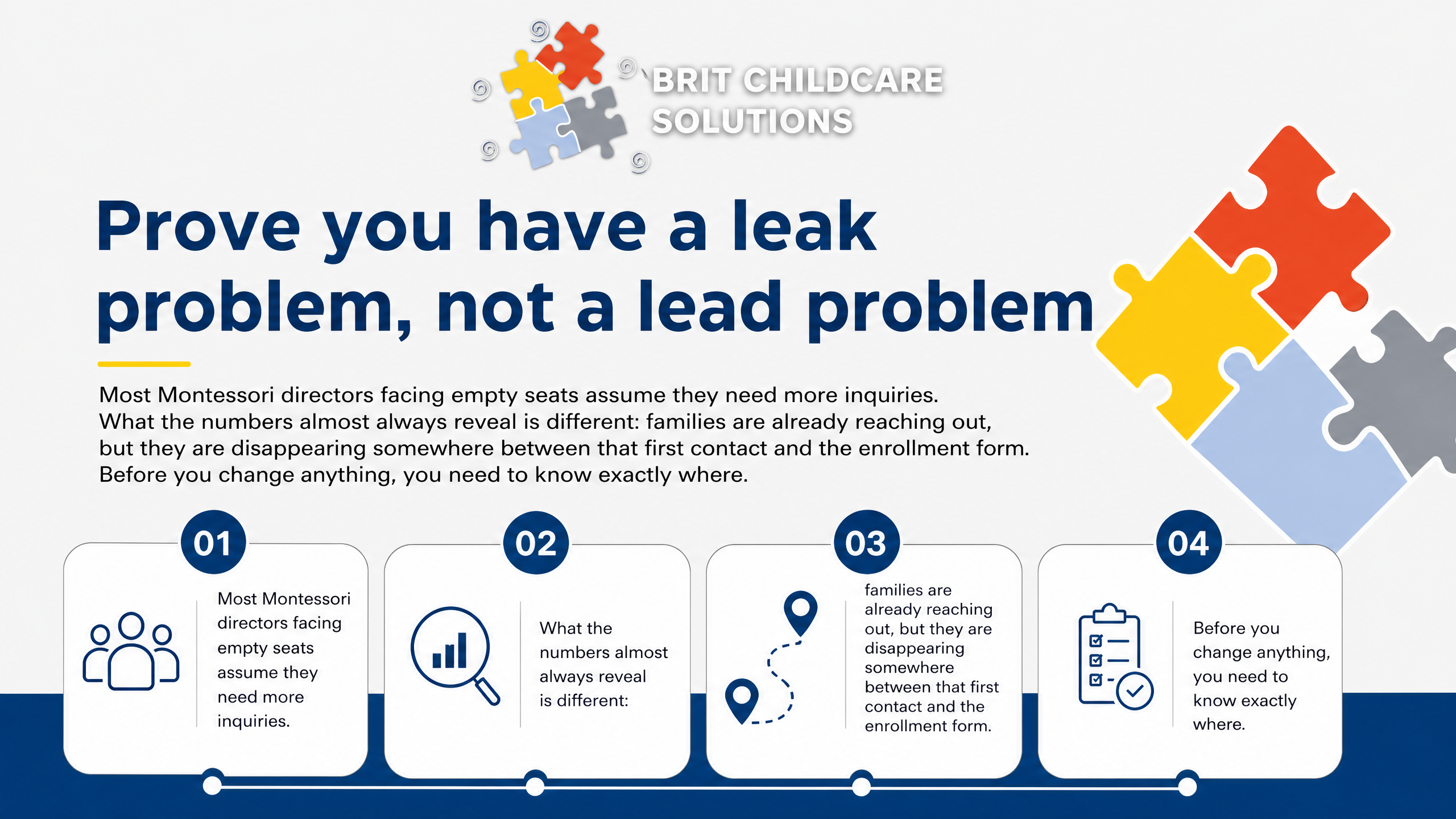
Most Montessori directors facing empty seats assume they need more inquiries. What the numbers almost always reveal is different: families are already reaching out, but they are disappearing somewhere between that first contact and the enrollment form. Before you change anything, you need to know exactly where.
The enrollment funnel you must track
Your enrollment funnel has four measurable stages, and a drop-off at any one of them explains empty seats better than low inquiry volume ever will.
The first conversion is inquiry to tour booking. Of every family who contacts your school, what percentage actually schedules a tour? Centers with manual follow-up processes often see this rate fall below 40%, meaning more than half of interested families never get a foot in the door.
The second is tour booking to show-up. Booking a tour is not the same as attending one. No-show rates of 30 to 50% are common when centers rely on a single confirmation email and no reminder sequence.
The third is tour show-up to enrollment. This is where Montessori-fit messaging matters most. Families who arrive underprepared for what they see often leave without enrolling.
Inquiry to tour booking rate: how many inquiries convert to a scheduled tour
Tour show-up rate: how many scheduled tours actually occur
Tour to enrollment rate: how many tours result in a signed enrollment
Cost per enrolled seat: total marketing and admin spend divided by new enrollments
Cost per enrolled seat is the one number your board can evaluate. It ties every marketing dollar to an actual tuition-paying child, not a click or a form submission.
A simple cost per seat model
You do not need a spreadsheet analyst to build a board-safe enrollment model. Four inputs are enough to show whether your current spend is rational or reckless.
Start with seats to fill per month. A center with 80 capacity running at 65% occupancy needs roughly 5 to 7 new enrollments per month to reach financial stability. Multiply that by your annual tuition value per seat, which for most Montessori programs in the U.S. runs between $12,000 and $20,000 per year.
That single enrolled child represents significant revenue over a typical two to three year enrollment span. Now set your total monthly marketing and admin time cost against that number. If you are spending $2,000 per month on marketing and converting two families, your cost per enrolled seat is $1,000.
Against a $15,000 annual tuition, that math is straightforward to defend.
Seats to fill per month: current capacity minus current enrollment
Tuition value per seat: annual tuition multiplied by average enrollment duration
Marketing plus admin time cost: all spend plus staff hours spent on follow-up
Break-even enrollments needed: monthly cost divided by tuition value per seat
If your break-even calculation requires only one or two enrollments per month, the case for a structured enrollment system becomes very easy to make to any board.
Benchmarks that justify urgency
The data on inquiry response speed is unambiguous. Harvard Business Review research found that responding to a lead within five minutes makes teams 21 times more effective than waiting 30 minutes. For Montessori schools, where a parent is often comparing two or three options simultaneously, a slow response does not just delay a conversation. It ends one.
Tour show-up rates above 80% are achievable when booking is frictionless and reminders are automated. Centers relying on phone-call-only scheduling and a single email confirmation routinely see show-up rates in the 50 to 60% range. Appointment reminder research confirms that automated SMS reminders reduce no-shows by up to 50%, which means the gap between a struggling show-up rate and a strong one is often a text message sequence, not a better pitch.
Follow-up volume also matters more than most directors expect. Families researching Montessori programs typically need seven or more touchpoints before they commit to a tour. A single auto-reply and one follow-up call leaves most of that work undone.
Finally, mobile behavior shapes everything: parents searching for childcare on their phones will abandon a booking process that requires a phone call or a long form. Two-click tour scheduling is not a convenience feature. It is a conversion requirement.
Leak Check Step 1: Fix local intent on Google Business Profile
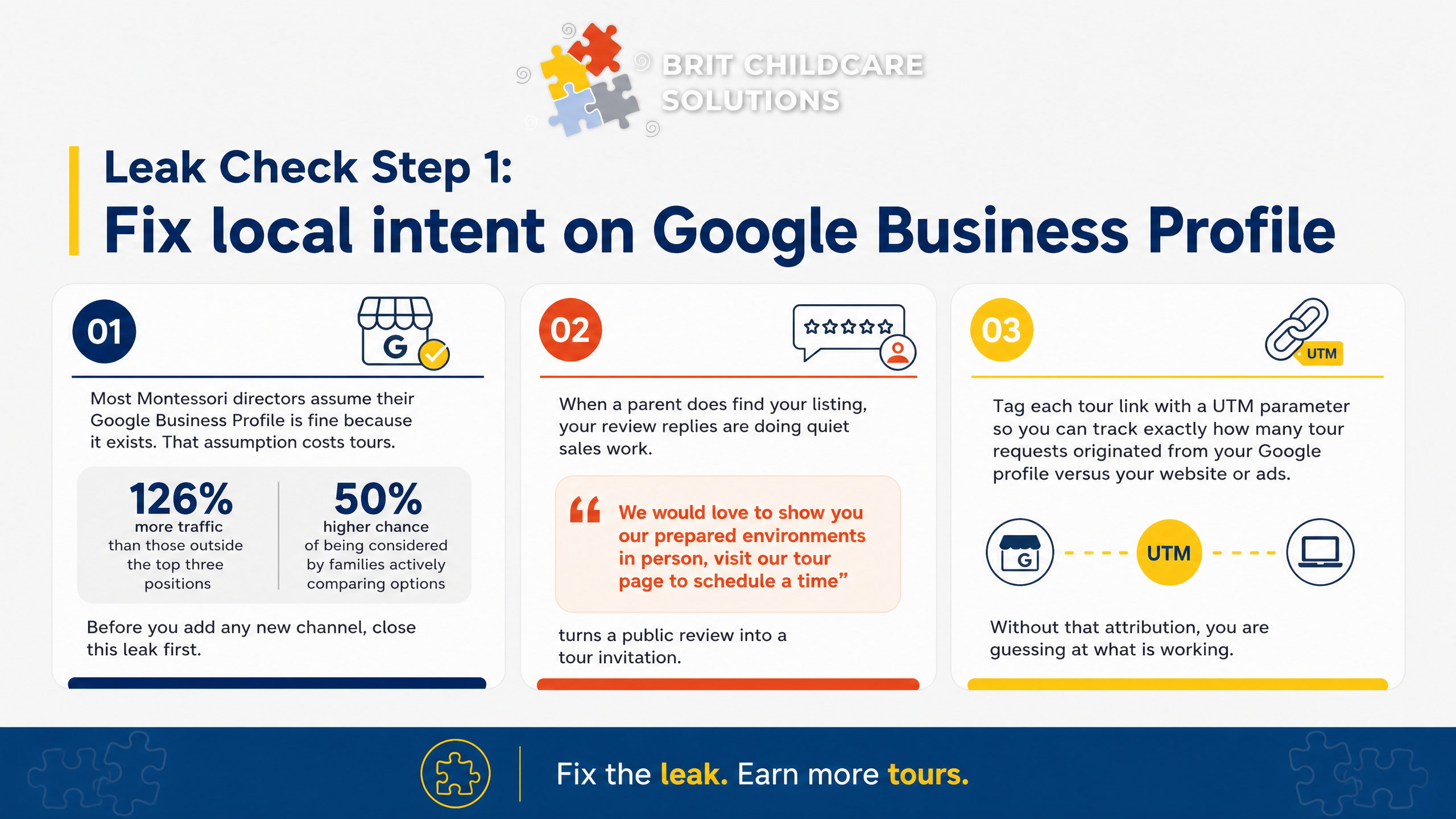
Most Montessori directors assume their Google Business Profile is fine because it exists. That assumption costs tours. Local search conversion data shows businesses in Google's Local Pack earn 126% more traffic than those outside the top three positions, and a complete, photo-rich profile gives you a 50% higher chance of being considered by families actively comparing options.
Before you add any new channel, close this leak first.
When a parent does find your listing, your review replies are doing quiet sales work. A reply that says 'We would love to show you our prepared environments in person, visit our tour page to schedule a time' turns a public review into a tour invitation. Tag each tour link with a UTM parameter so you can track exactly how many tour requests originated from your Google profile versus your website or ads.
Without that attribution, you are guessing at what is working.
Tour-first GBP audit checklist
Your Google Business Profile is the first place a high-intent parent lands, so every field needs to point toward one outcome: a scheduled tour. Run through these four checkpoints before anything else.
Primary category accuracy matters more than most owners realize. If your profile is categorized as 'Private School' instead of 'Montessori School,' you are invisible to the parents searching specifically for Montessori. Verify this under the Info tab in your GBP dashboard and correct it immediately.
Primary category: Set to 'Montessori School' as the primary, with 'Preschool' or 'Private School' as secondary categories only
Hours and phone: Match exactly what appears on your website; inconsistencies suppress local rankings and confuse mobile searchers
Tour link and appointment URL: Add your tour booking page directly to the 'Appointment URL' field so parents can schedule in two clicks from Maps
Messaging and call: Enable both features so families can reach you through whichever channel they prefer without friction
A parent searching on a phone at 9 p.m. will not call back tomorrow. If your profile does not let them act immediately, they move to the next result.
Photos that build trust fast
Google Business Profile impact studies confirm that profiles with photos earn 42% more direction requests and 35% more website clicks. For a Montessori school, photos are not decoration; they are the first proof that your environment matches what a parent is imagining.
Prepared environment images, showing organized shelves, natural light, and Montessori materials in use, communicate your pedagogy before a parent reads a single word. Teacher work shots, a guide kneeling beside a child or facilitating a group activity, build the human connection that drives tour decisions. Critically, no child's face should be identifiable in any public photo.
Shoot from behind, at an angle, or with materials as the foreground subject. This directly addresses the privacy concern many Montessori families hold before they even inquire.
Upload at least five new photos per month. Fresh images signal an active, thriving program to both Google's algorithm and prospective families reviewing your listing.
Leak Check Step 2: Make every page lead to one tour path
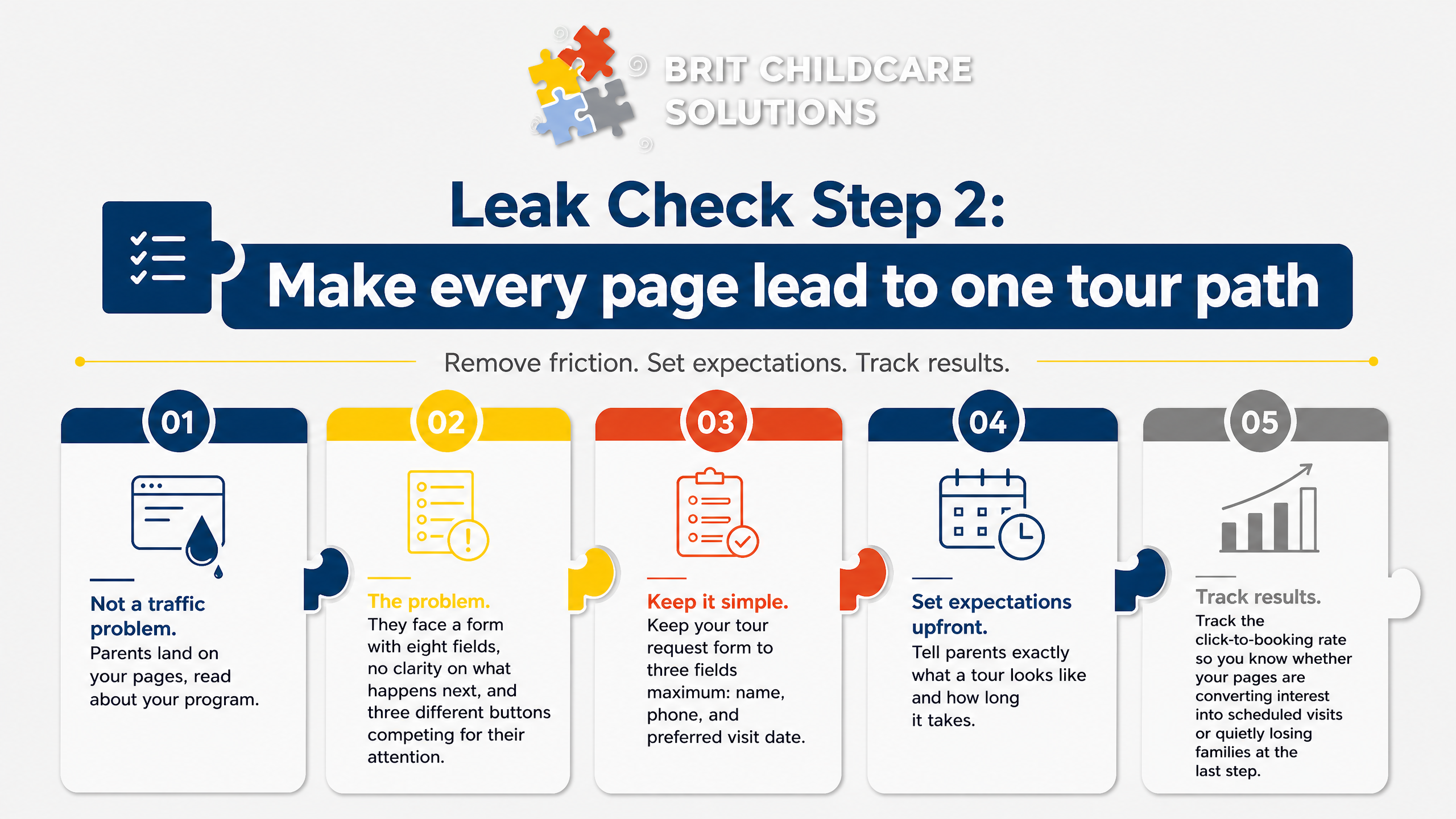
The most common website leak we see is not a traffic problem. Parents land on your pages, read about your program, and then face a form with eight fields, no clarity on what happens next, and three different buttons competing for their attention. Keep your tour request form to three fields maximum: name, phone, and preferred visit date.
Set expectations upfront by telling parents exactly what a tour looks like and how long it takes. Then track the click-to-booking rate so you know whether your pages are converting interest into scheduled visits or quietly losing families at the last step.
One tour CTA, everywhere
Every page on your website should carry one primary button with the same label: 'Schedule a Tour.' Not 'Learn More,' not 'Contact Us,' not 'Request Information' on one page and 'Book a Visit' on another. Inconsistent labels force parents to make a micro-decision at every click, and most will not bother.
Place that button above the fold on every page, including your homepage, tuition page, and program pages. On mobile, position it within thumb reach, meaning in the lower center of the screen where a parent scrolling one-handed can tap it without adjusting their grip. A button buried below three paragraphs of philosophy text will not get clicked.
One button label used site-wide: 'Schedule a Tour'
Above the fold on every page, no exceptions
Mobile placement: lower-center, thumb-accessible
Remove secondary CTAs like newsletter signups or virtual tour links from the same screen
When every page points to the same action, your site functions as an enrollment path rather than a brochure.
Your one-sentence parent promise
Parents do not tour schools that sound like every other school. Your one-sentence parent promise should name a specific benefit, not a philosophy. 'Children ages 18 months to 6 in [your city] build independence and confidence through hands-on Montessori learning' tells a parent exactly who you serve and what their child gains. 'We nurture the whole child' tells them nothing.
Specificity also does the work of fit filtering. A promise that names your age range and location attracts families who are already a match and signals to families who are not that this may not be the right program. That protects your mission and saves your staff from tours that were never going to convert.
Use this sentence on your website header, your Google Business Profile description, your tour confirmation texts, and every first response to an inquiry. In our experience, centers that align their messaging across every touchpoint see stronger show-up rates because parents arrive already connected to what the school stands for.
Leak Check Step 3: Respond in five minutes and prevent no-shows
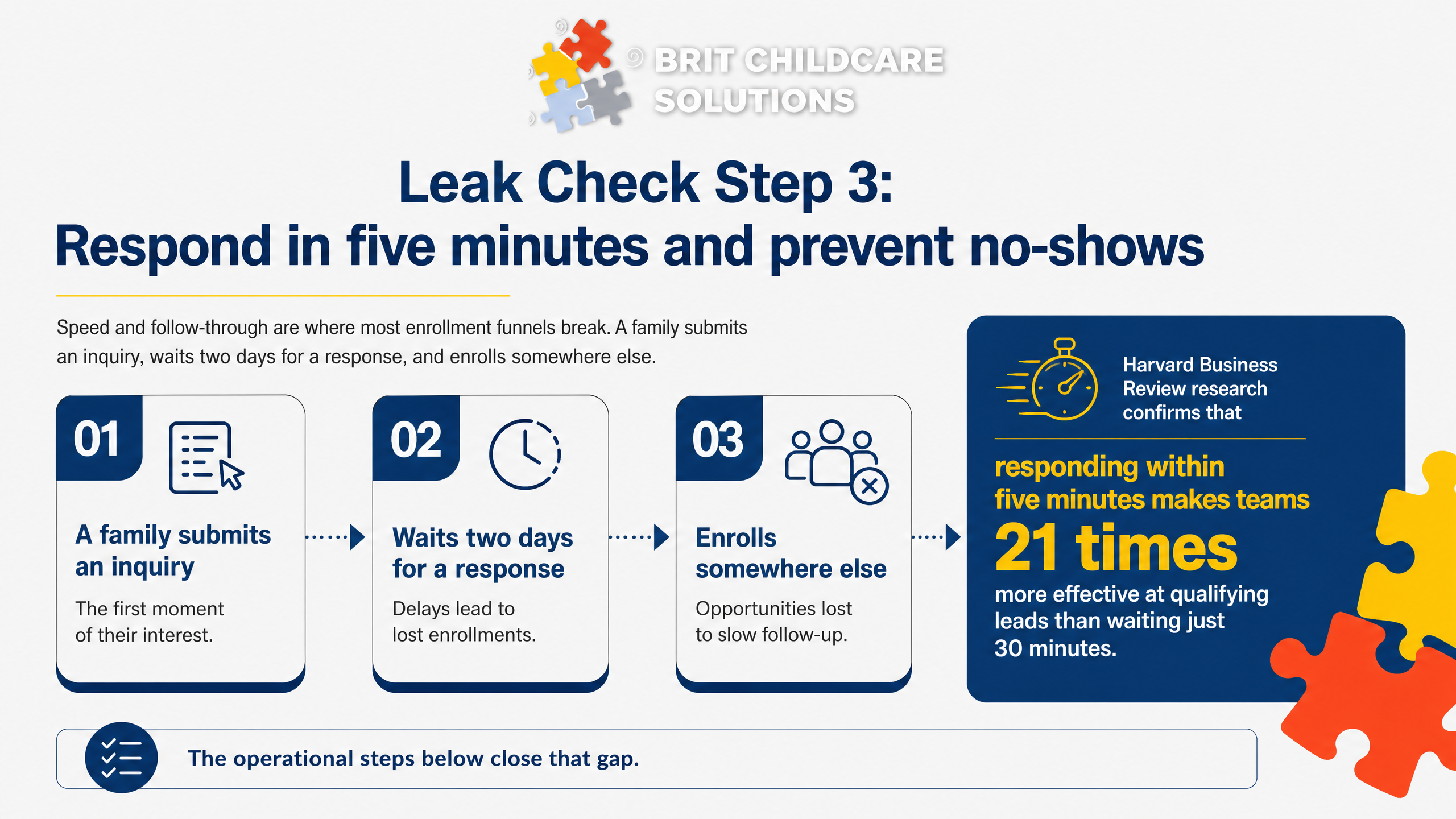
Speed and follow-through are where most enrollment funnels break. A family submits an inquiry, waits two days for a response, and enrolls somewhere else. Harvard Business Review research confirms that responding within five minutes makes teams 21 times more effective at qualifying leads than waiting just 30 minutes.
The operational steps below close that gap.
Five-minute response system
Every new inquiry should trigger an immediate automated text and a follow-up email within the same minute. The text confirms receipt and sets a warm, human tone. The email delivers your parent promise, your hours, and a direct link to book a tour.
Routing matters as much as speed. Inquiries should sort automatically by location and child's age group so the right staff member receives the lead without a manual handoff. For multi-location operators, a missed routing step is a silent enrollment killer.
Set clear handoff rules: automation handles the first response, a staff member follows up by phone within 30 minutes during business hours, and a manager reviews any lead that goes uncontacted for more than two hours. After hours, automation holds the conversation warm with a scheduled morning callback confirmation so no inquiry sits cold overnight.
Two-click tour booking
Phone tag kills tour bookings. Parents searching for childcare are comparing three to five options simultaneously, and the center that lets them book without a phone call wins the appointment.
Your booking system should show real calendar availability by location, not a generic contact form. When a parent sees open slots, they commit. When they see a form, they hesitate.
Send an SMS confirmation immediately after booking with the date, time, and center address
Include timezone labeling for any multi-location center serving families across metro areas
Embed a one-click reschedule link in every confirmation so families can adjust without calling and canceling entirely
A reschedule link is not a concession - it is a retention tool that keeps the family in your funnel instead of losing them to a competitor when life gets complicated.
No-show prevention sequence
Appointment reminder research shows automated SMS reminders reduce no-shows by up to 50%. Two touchpoints do most of the work: a message 24 hours before the tour and a second message two hours before.
The 24-hour message should do more than remind. Include a short 'what to expect' note: where to park, how long the visit takes, and who they will meet. Families who feel prepared show up.
Families who feel uncertain find a reason not to.
Reinforce your parent promise in both messages. A single sentence that connects their child's outcome to your program reactivates the emotional reason they booked in the first place.
When a tour is missed, send a rebook message within two hours. Keep it brief and non-judgmental: acknowledge that schedules shift and offer two specific alternative times. Centers that run a post-missed-tour rebook loop recover a meaningful share of those families before they enroll elsewhere.
Our Enrollment Automation System handles this entire sequence automatically, so your staff focuses on the tour itself, not the follow-up logistics.
Your 30-day scorecard for board updates
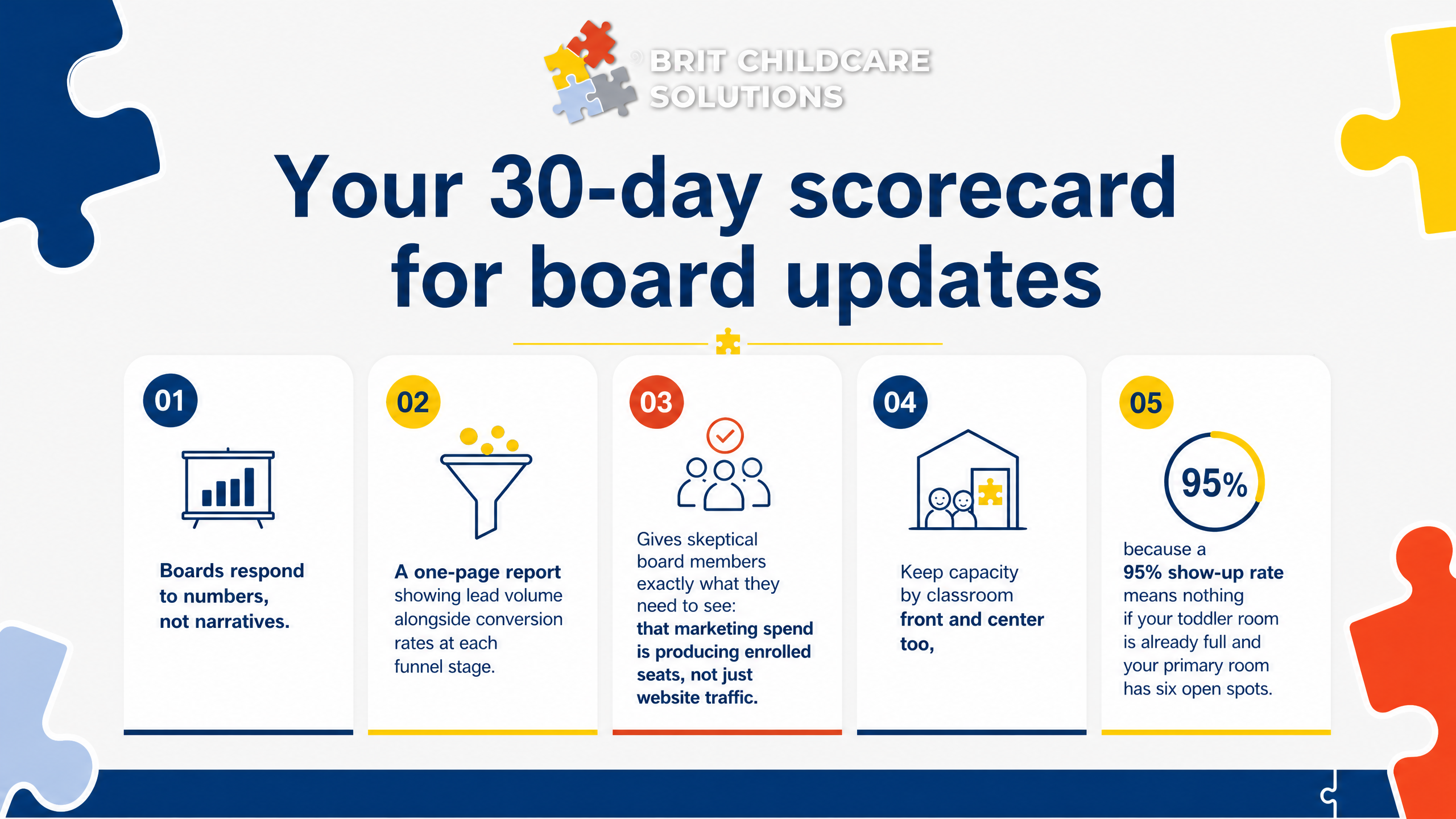
Boards respond to numbers, not narratives. A one-page report showing lead volume alongside conversion rates at each funnel stage gives skeptical board members exactly what they need to see: that marketing spend is producing enrolled seats, not just website traffic. Keep capacity by classroom front and center too, because a 95% show-up rate means nothing if your toddler room is already full and your primary room has six open spots.
Four metrics, one weekly cadence
Track these four numbers every week for 30 days. Weekly cadence matters because monthly reviews hide the week a slow response time tanked your booking rate.
Pull the same four metrics from your funnel tracking dashboard each Friday:
Inquiry-to-tour booking rate: what percentage of new inquiries result in a scheduled tour
Tour show-up rate: what percentage of booked tours actually walk through your door
Tour-to-enrollment rate: what percentage of families who tour sign an enrollment agreement
Cost per enrolled seat: total marketing spend divided by new enrollments in the same period
Cost per enrolled seat is the number that ends the 'marketing versus classroom materials' debate with a board, because it converts a line item into a per-child business outcome.
Where to look when numbers dip
Each metric points to a specific breakdown. When a number drops, you have a diagnostic starting point, not a mystery.
Use this map to isolate the problem quickly:
Response time audit: if inquiry-to-tour booking rate falls, check how long your team takes to reply; Harvard Business Review research shows responding within five minutes makes follow-up 21 times more effective than waiting 30 minutes
Booking friction signals: if booking rate stays low despite fast responses, count the steps a parent takes to schedule a tour; more than two clicks or a required phone call is a conversion barrier
No-show root cause map: if show-up rate drops, check whether text confirmations and reminder sequences fired correctly and whether your parent promise appeared in every first response
Follow-up gap detection: if stale inquiries are accumulating without tours booked, your reactivation sequence may have a timing or messaging gap that needs adjustment
In our experience, most centers leak at one of the first two stages. Fixing response time and booking friction alone often moves the enrollment needle before any other change takes effect.
When done-for-you automation is the mission-protecting choice
Most childcare owners who invest in DIY enrollment software end up with another tool to manage, not a system that runs. Done-for-you automation handles the routing, follow-up, and tracking for you, including multi-location routing controls that assign each inquiry to the correct center automatically. The focus stays on outcomes: tours booked, show-up rates, and enrolled seats, not clicks or impressions.
Signs staff cannot sustain follow-up
If your team is managing ratios, they cannot also monitor an inquiry inbox in real time. The warning signs are consistent and recognizable.
Calls go unanswered during peak classroom hours when staff-to-child ratios demand full attention
Inquiries pile up and get answered in batches at the end of the day, well past the five-minute response window
Tours get booked verbally or by form but never confirmed with a text or reminder sequence
Families who went quiet after an initial inquiry are never recontacted, leaving stale leads unworked
Any one of these patterns means families are choosing another center before your team even responds.
How BRIT fixes leaks end-to-end
Our Enrollment Automation System captures every inquiry across channels and responds within minutes automatically, so no lead waits until a teacher has a free moment.
The Tour Booking and No-Show Prevention System gives families a two-click scheduling path with automated text confirmations and reminder sequences. Harvard Business Review research shows responding within five minutes makes teams 21 times more effective than waiting 30 minutes, and our reminder sequences protect that momentum through show-up day.
Stale lead reactivation sequences follow up with families who went quiet, bringing them back into the funnel without any manual outreach from your staff. A funnel dashboard tracks five key metrics per location so you always know where families are dropping off and what to fix next.
Stop the Leak Before You Spend Another Dollar on Marketing
If you have worked through this checklist, you already know where your inquiry funnel is losing families. The gap is almost never at the top of the funnel. It is in the five minutes after an inquiry arrives, the friction in your booking process, and the silence between a scheduled tour and the day it is supposed to happen.
That is exactly what we built BRIT Childcare's Enrollment Automation System to fix. We handle the rapid response, the two-click tour booking, the reminder sequences, and the full funnel tracking so your team is not manually chasing leads while also running classrooms. It is a done-for-you system, not software you manage yourself.
If you are ready to see where your specific funnel is leaking, start with the five-minute leak check mindset from this article, then book an enrollment automation strategy call with our team. We will walk through your current inquiry-to-tour-to-enrollment path and put together a done-for-you proposal that includes automated follow-up, tour booking, no-show prevention, and funnel tracking built around your center.
Book your strategy call at britchildcare.com/work-with-us.
