How Automated Follow-Up Lifts Tour Conversion
Automated follow-up improves tour conversion by keeping parents engaged between inquiry and enrollment through timed SMS and email sequences that reduce no-shows and move families toward a decision without requiring manual outreach from your staff.
Here is what the data and the system actually show:
Tour show rate, not inquiry volume, is the core metric that determines whether your enrollment funnel is working.
Responding to a new inquiry within 5 minutes makes you 21 times more likely to convert than waiting 30 minutes.
Automated text-based reminders before the tour date reduce no-shows without adding work to your front desk.
Same-day post-tour follow-up with a clear next step moves families from interested to enrolled faster than any nurture sequence alone.
A weekly 20-minute scoreboard review across five funnel metrics shows exactly where families are dropping off so you can fix the right stage.
At BRIT Childcare, we work exclusively with childcare centers and multi-location operators across the United States, and we see the same pattern repeatedly: healthy inquiry volume, low enrollment conversion, and a team spending too much time chasing families manually. Our Enrollment Engine handles inquiry capture, speed-to-lead response, tour booking, confirmation and reminder sequences, and post-tour follow-up automation as a done-for-you system, so your staff focuses on the tour itself, not the logistics around it.
Tour conversion is not a personality trait your best staff member either has or does not. It is a pipeline with defined stages, measurable drop-off points, and specific places where automation does the heavy lifting.
Understanding that pipeline is where everything else in this article begins.
Tour conversion is a pipeline, not a personality trait
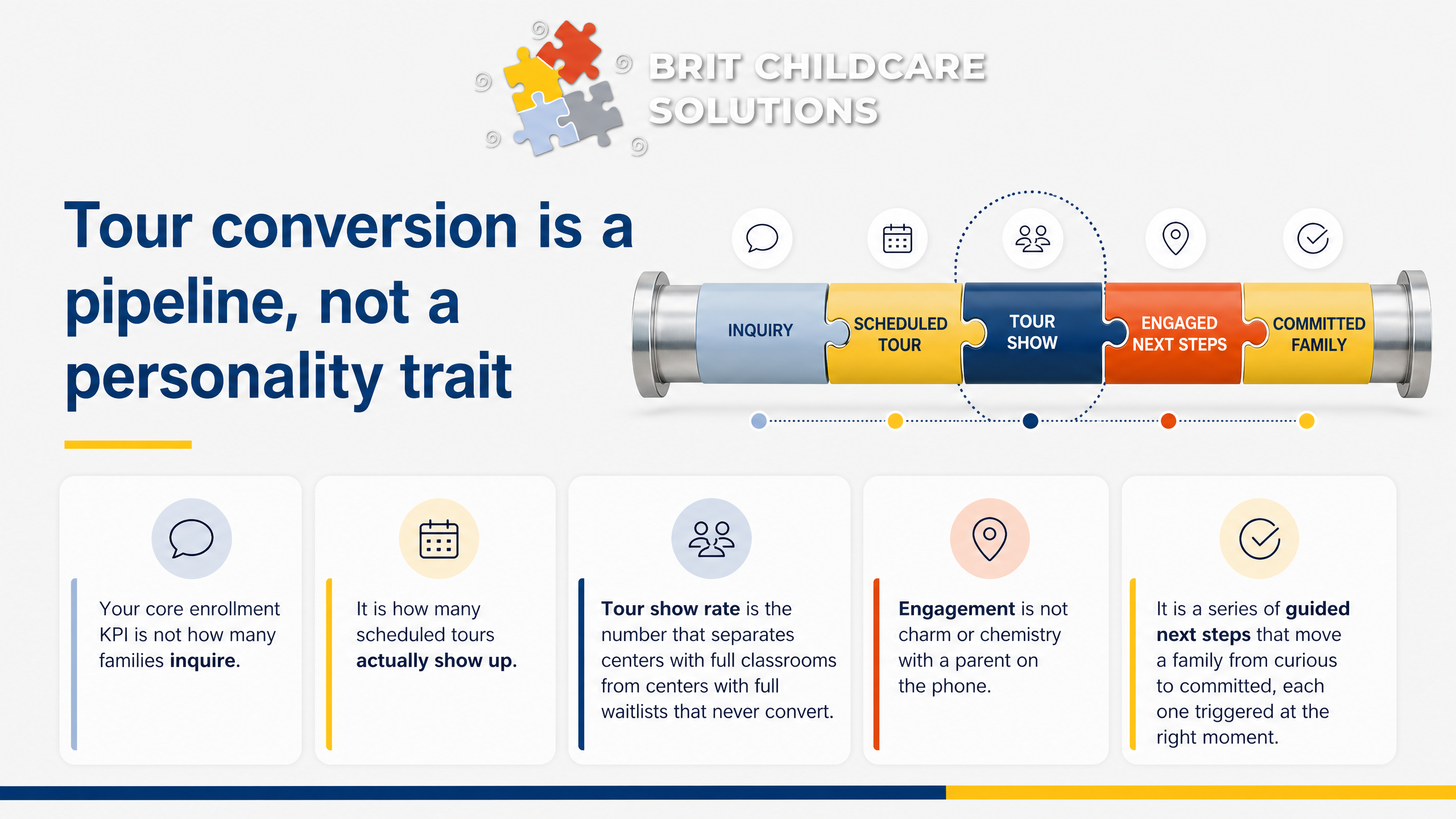
Your core enrollment KPI is not how many families inquire. It is how many scheduled tours actually show up. Tour show rate is the number that separates centers with full classrooms from centers with full waitlists that never convert.
Engagement is not charm or chemistry with a parent on the phone. It is a series of guided next steps that move a family from curious to committed, each one triggered at the right moment.
What tour conversion means
Tour conversion tracks the full path from first inquiry to enrolled child. It breaks into two distinct rates that measure different stages of your funnel.
Your tour show rate measures how many families who booked a tour actually walked through your door. Your close rate measures how many of those who toured went on to pay a deposit and confirm a start date. Both numbers matter, and they fail for different reasons.
Inquiry to tour: family contacts your center and schedules a visit
Tour show rate: attended tours divided by scheduled tours
Close rate: enrollments divided by tours attended
Enrollment is confirmed when a deposit is collected and a start date is set
LineLeader industry benchmarks show call-to-enrollment conversion rates in childcare can be as low as 6%, which means most centers are losing families at one of these two stages, not both equally. Knowing which rate is lower tells you exactly where to intervene.
The common failure pattern
Most centers do not lose families because of a bad tour. They lose them before and after it. The breakdown follows a predictable sequence.
A parent submits an inquiry and waits. If your team does not respond within minutes, that family has already moved on to the next center on their list. Research shows responding within 5 minutes makes you 21 times more likely to convert than a 30-minute delay.
Most front desks cannot hit that window manually.
Even when a tour gets booked, weak confirmation and no reminders leave the appointment feeling optional. A parent who receives one generic confirmation email has little reason to rearrange her schedule if something comes up.
After the tour, decision drift takes over. Parents leave with good feelings but no clear next step. Without a same-day follow-up and a structured sequence over the following 48 to 72 hours, that momentum dissolves into 'we're still thinking about it.'
Before the tour: automate confirmation, reminders, and readiness
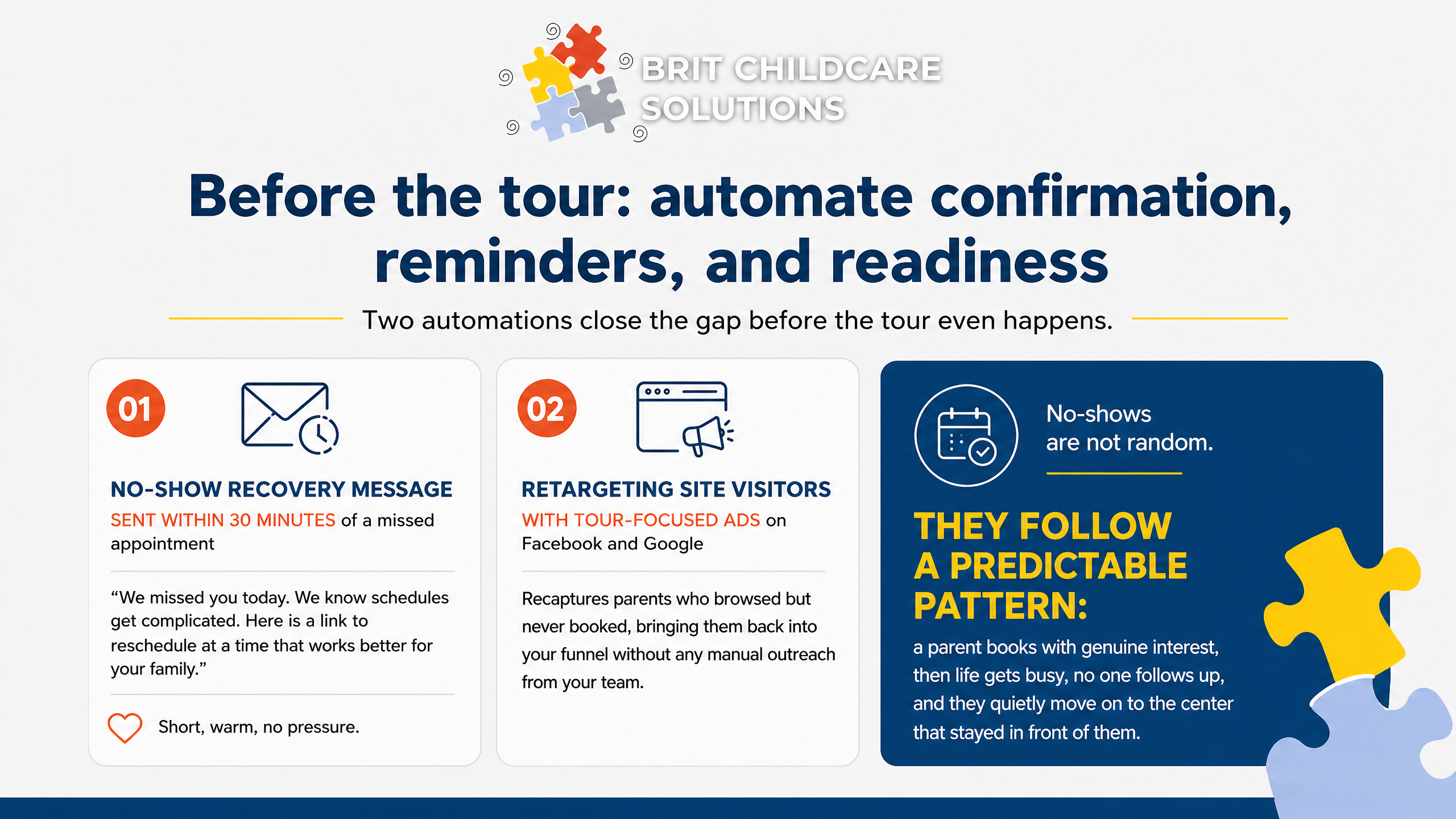
No-shows are not random. They follow a predictable pattern: a parent books with genuine interest, then life gets busy, no one follows up, and they quietly move on to the center that stayed in front of them. Two automations close that gap before the tour even happens.
First, a no-show recovery message sent within 30 minutes of a missed appointment keeps the door open: 'We missed you today. We know schedules get complicated. Here is a link to reschedule at a time that works better for your family.' Short, warm, no pressure.
Second, retargeting site visitors with tour-focused ads on Facebook and Google recaptures parents who browsed but never booked, bringing them back into your funnel without any manual outreach from your team.
Speed to lead and confirmation
The window between a parent submitting an inquiry and choosing a center is shorter than most owners realize. Sales engagement research shows that 78% of customers enroll with the first provider that responds, and a response within the first minute can boost conversions by 391% compared to waiting even a few minutes longer. At the point of inquiry, a parent's intent is at its peak.
Delay erodes it fast.
Your system should trigger an automated SMS response within five minutes of every inquiry, every time, without relying on front desk availability. That first message does two things: it confirms receipt and delivers a two-click tour booking link. Once the parent selects a time, a second SMS confirms the appointment and locks in the commitment.
That confirmation message should include a calendar invite and a direct map link to your location. Both reduce friction on tour day and signal that your center is organized and attentive, which matters to parents who are evaluating trust before they ever walk through your door.
Reminder sequence that reduces no-shows
A single confirmation is not enough to hold a tour appointment across several days. A structured reminder cadence does the heavy lifting without adding anything to your staff's plate.
The sequence that consistently improves show rates runs at three intervals:
72 hours before: SMS reminder with the tour date, time, and a reschedule link
24 hours before: SMS confirmation prompt asking the parent to reply YES to confirm
2 hours before: Final SMS with your address, parking details, and who to ask for at arrival
Pairing the 24-hour SMS with an email that tells parents what to bring (ID, subsidy paperwork, questions for the director) sets expectations and signals a professional, prepared experience. The reschedule link in every message acts as a pressure valve. Parents who cannot make it will use it rather than simply not showing up, which keeps them in your funnel instead of losing them entirely.
Pre-tour questions that qualify
Not every family who books a tour is ready to enroll, and not every tour is worth the same investment of your director's time. Sending three to five qualifying questions after booking filters intent and helps your team prepare for the right conversation.
Ask for the child's age and the parent's preferred schedule, along with their target start date. These answers tell you immediately whether you have an opening that fits. Follow with a question about budget range and whether the family is applying for subsidy assistance, so you can flag families who may need a different conversation about financial options before the tour.
Finally, confirm that the primary decision maker will attend. Tours that end with 'I need to check with my partner' stall more often than those where both decision makers are in the room. A simple line in your pre-tour message, such as 'We encourage both parents or guardians to join us so you can both ask questions and get a feel for the space,' increases the likelihood that the right people show up and a decision can move forward the same day.
During the tour: run a repeatable script that earns the yes
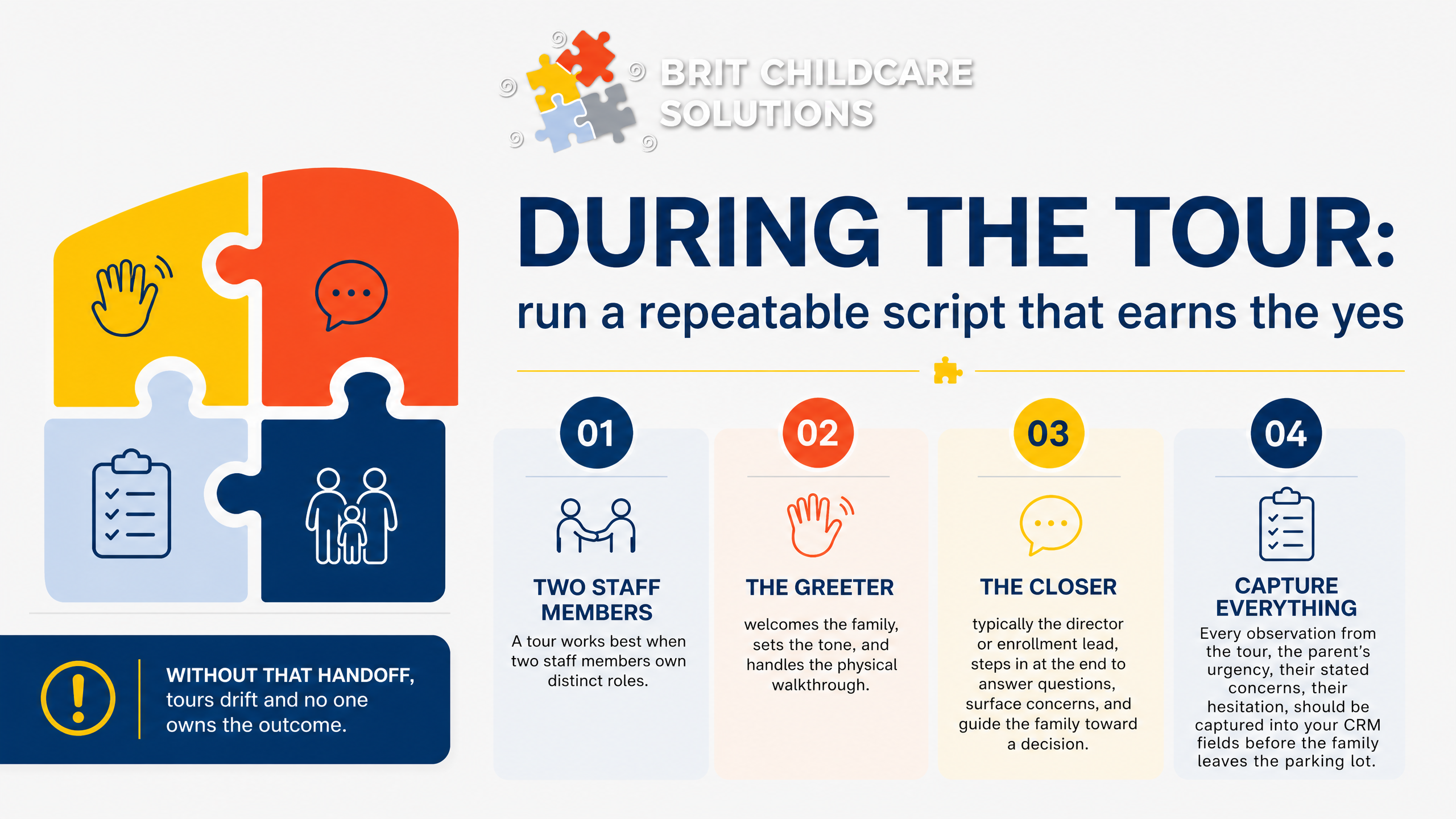
A tour works best when two staff members own distinct roles. The greeter welcomes the family, sets the tone, and handles the physical walkthrough. The closer, typically the director or enrollment lead, steps in at the end to answer questions, surface concerns, and guide the family toward a decision.
Without that handoff, tours drift and no one owns the outcome. Every observation from the tour, the parent's urgency, their stated concerns, their hesitation, should be captured into your CRM fields before the family leaves the parking lot.
The 10 minute tour spine
A structured tour does not feel scripted to the family; it feels reassuring. Open with a warm welcome and a brief agenda: tell the parents what they will see, how long it will take, and that you will pause twice for questions. That framing alone reduces anxiety.
Within those ten minutes, deliver three proof points parents actually need: your safety and supervision approach, a concrete example of daily routine or curriculum, and one piece of social proof such as a parent testimonial or your average enrollment tenure. ChildcareCRM performance data shows top-performing centers average a 76% conversion rate following a completed tour, and consistency in what families hear is a core driver of that result.
Build in two deliberate pauses for questions, one mid-tour near the classrooms and one at the close. Parents rarely volunteer concerns unprompted. The pauses signal that their questions are expected and welcome, which moves you closer to a real conversation rather than a one-sided pitch.
Objection surfacing prompts
Most objections that kill enrollment decisions were never spoken during the tour. The fix is asking directly, before the family walks out.
Use three prompts to surface what is really going on:
Why are you looking to switch now? This reveals urgency and timeline, and tells you whether they are browsing or ready to decide.
What is your biggest concern about changing childcare? This surfaces the fear, whether it is separation anxiety, curriculum fit, or cost, so you can address it directly rather than guess.
Is there anything that would make it hard to move forward?
This uncovers practical blockers like a sibling spot, a start date, or a spouse who has not seen the center yet.
Objections surfaced during the tour are objections you can respond to. Objections discovered after the family leaves become reasons they quietly choose someone else.
Close with a single next step
Families who leave without a defined next step rarely self-convert. Before the tour ends, give them one clear action, not a menu of options.
Offer a hold fee or direct application link on the spot. Tie it to a real availability deadline: if you have two infant spots and one is spoken for, say so. Scarcity tied to truth creates appropriate urgency without pressure tactics.
Set the follow-up time before they leave the building. Ask directly: 'Can I check in with you Thursday morning or would the afternoon work better?' Scheduling it on-site removes the friction of a cold follow-up call and gives your post-tour automation a confirmed touchpoint to build around.
After the tour: same-day follow-up that moves decisions
Most families leave a tour without making a decision on the spot. That is normal. What is not normal is letting days pass without a structured follow-up that keeps your center top of mind.
Your post-tour communication should feel supportive, not like a sales push. Lead with clarity on deposit requirements, what holding a spot looks like, and what happens if they need more time. When families understand the process, they feel guided rather than pressured.
Same-day recap that converts
Send a personalized recap email within two to four hours of the tour. Generic thank-you messages get ignored. Segment your recap by the family's situation: infant care, toddler, preschool, or school-age.
Reference what they told you during the visit so it reads like a conversation, not a template.
Include three things every family needs to move forward:
Tuition and schedule options specific to their child's age group, with no surprises
A direct application link with a clear enrollment deadline or seat availability note
A one-line deposit policy reminder so they know exactly what holding a spot requires
Families who receive a clear, personalized recap within hours of a tour are far more likely to act before comparison shopping stalls their decision.
The 7 day nurture sequence
A single follow-up email is not enough. LineLeader industry benchmarks show families typically need 11 to 14 touchpoints before enrolling, meaning one message rarely closes the loop. A structured seven-day sequence keeps your center present without requiring your staff to chase anyone manually.
Structure the sequence around three moments:
Day 1: Send FAQs addressing the most common post-tour questions, tuition payment schedules, curriculum approach, and what the first week looks like, plus a clear next-step link
Day 3: Share a social proof asset, a parent testimonial, a photo of a classroom activity, or a short video walkthrough that reinforces the environment they saw in person
Day 7: Send a brief SMS check-in asking if they have questions or are ready to hold their spot, keeping it conversational and low-pressure
Each touchpoint builds trust incrementally. By day seven, families who are ready will act, and those who are not will at least stay warm.
When they are not ready
Not every family is ready to enroll after a tour, and that is fine. The mistake is letting those families go cold. A waitlist nurture sequence keeps your center in front of them with a light monthly touchpoint, a classroom update, a staff spotlight, or a community event recap, so when their situation changes, you are the first call they make.
Two automated workflows do the heavy lifting here. A start-date countdown sequence triggers as their target enrollment month approaches, reminding them of availability and next steps without manual outreach. A reactivation trigger fires automatically when a spot opens that matches their child's age group, turning a passive waitlist into an active enrollment opportunity.
In our experience, centers that maintain structured waitlist nurturing fill openings faster and with less ad spend because they are converting families who already trust them.
Prove it works: a weekly scoreboard and the automation triggers
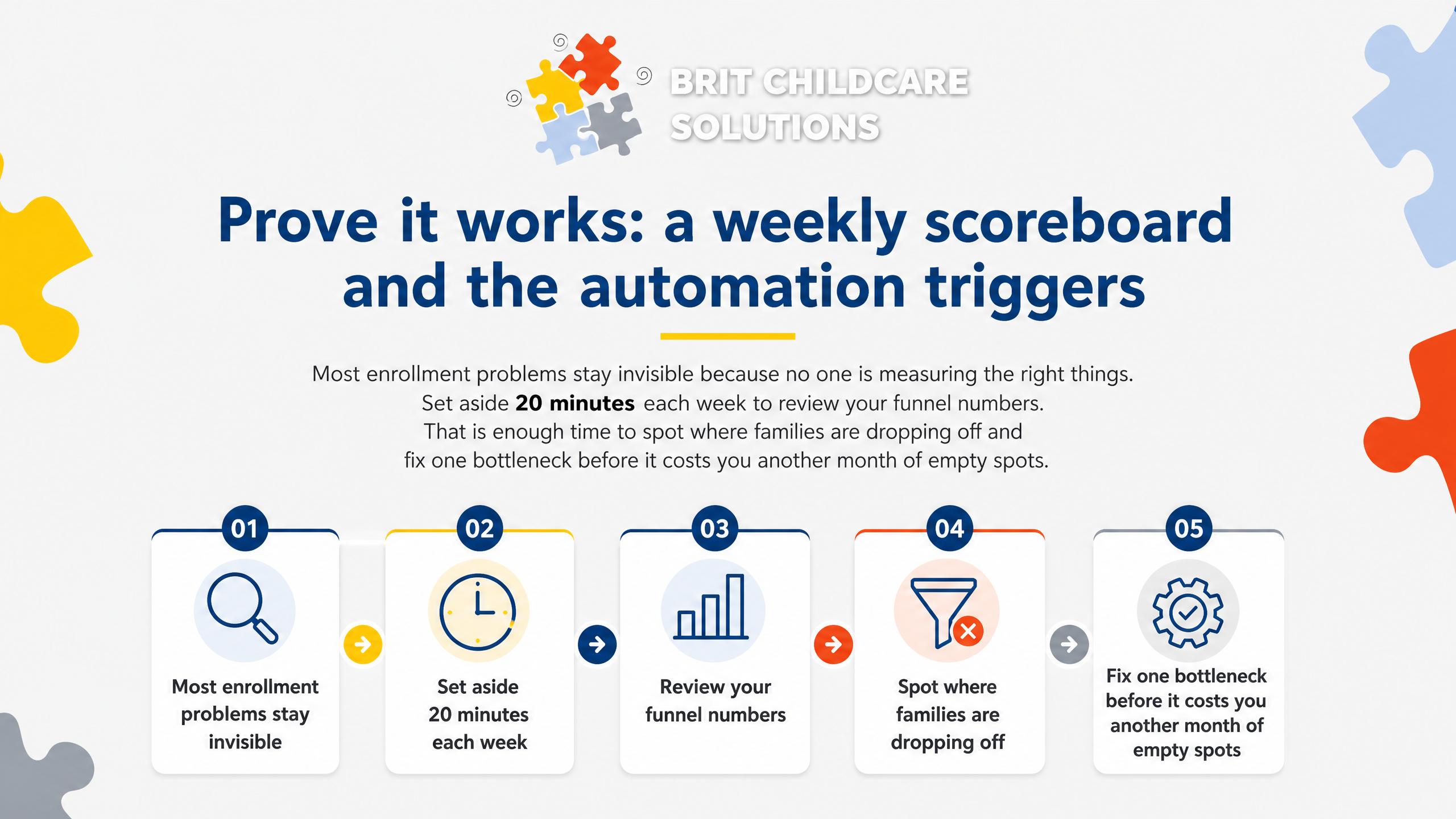
Most enrollment problems stay invisible because no one is measuring the right things. Set aside 20 minutes each week to review your funnel numbers. That is enough time to spot where families are dropping off and fix one bottleneck before it costs you another month of empty spots.
The four numbers to track
Your enrollment funnel has four checkpoints. Each one tells you something specific about where families are falling out of your pipeline.
Inquiries to scheduled tours: What percentage of families who contact you actually book a tour? If this number is below 50%, your booking process or response speed needs attention.
Tour show rate: Of the tours booked, how many families actually walk through your door? Divide attended tours by scheduled tours.
This single number reveals how much revenue is evaporating before a conversation even starts.
Tours to enrollment: Of the families who complete a tour, how many enroll? ChildcareCRM performance data shows top-performing centers average a 76% conversion rate following a completed tour. If yours is significantly lower, post-tour follow-up is the gap.
Days from tour to deposit: How long does it take a family to commit after the tour?
Tracking this tells you whether your follow-up is creating urgency or letting decisions stall.
Together, these four numbers show you exactly which stage of your funnel is leaking revenue so you fix the right problem first.
Where automation should fire
Automation is not about replacing your staff. It is about making sure no family waits, no tour goes unconfirmed, and no post-visit decision gets left to chance.
Three moments in your funnel require an immediate automated trigger:
New lead within 5 minutes: The moment an inquiry comes in, an automated response should go out with your parent promise and a two-click tour booking link. Sales engagement research confirms that responding within the first minute can boost lead conversions by 391% compared to waiting longer. Manual follow-up from a busy front desk cannot compete with that window.
Tour booked confirmation workflow: Once a family schedules, a confirmation message goes out immediately, followed by reminder texts 48 hours and 24 hours before the tour.
This sequence alone is one of the highest-impact ways to lift your show rate.
No-show and post-tour workflows: If a family misses their tour, a reactivation sequence should fire within the hour to reschedule. After a completed tour, a same-day follow-up message should go out, followed by a structured nurture sequence for families who are not ready to commit immediately.
Benchmarks for healthy funnels
Knowing your numbers only helps if you know what good looks like. Here are the targets we use with childcare centers to evaluate funnel health.
A healthy tour show rate falls between 70% and 85%. If you are below 70%, automated reminders and a frictionless booking process are the fastest fixes. A healthy tour-to-enrollment close rate sits between 60% and 80%.
Below 60% typically points to weak post-tour follow-up or an unresolved parent objection that was never surfaced during the visit.
To put this in practical terms: our clients typically see 10 to 40 scheduled tours per month. At 20 tours with a 75% show rate, 15 families complete a tour. At a 65% close rate, that is roughly 10 new enrollments per month from tours alone.
Tighten either metric by 10 points and the enrollment impact compounds quickly. These benchmarks give you a clear baseline to measure against and a realistic picture of what a well-run funnel can produce.
How BRIT Childcare builds the system done-for-you
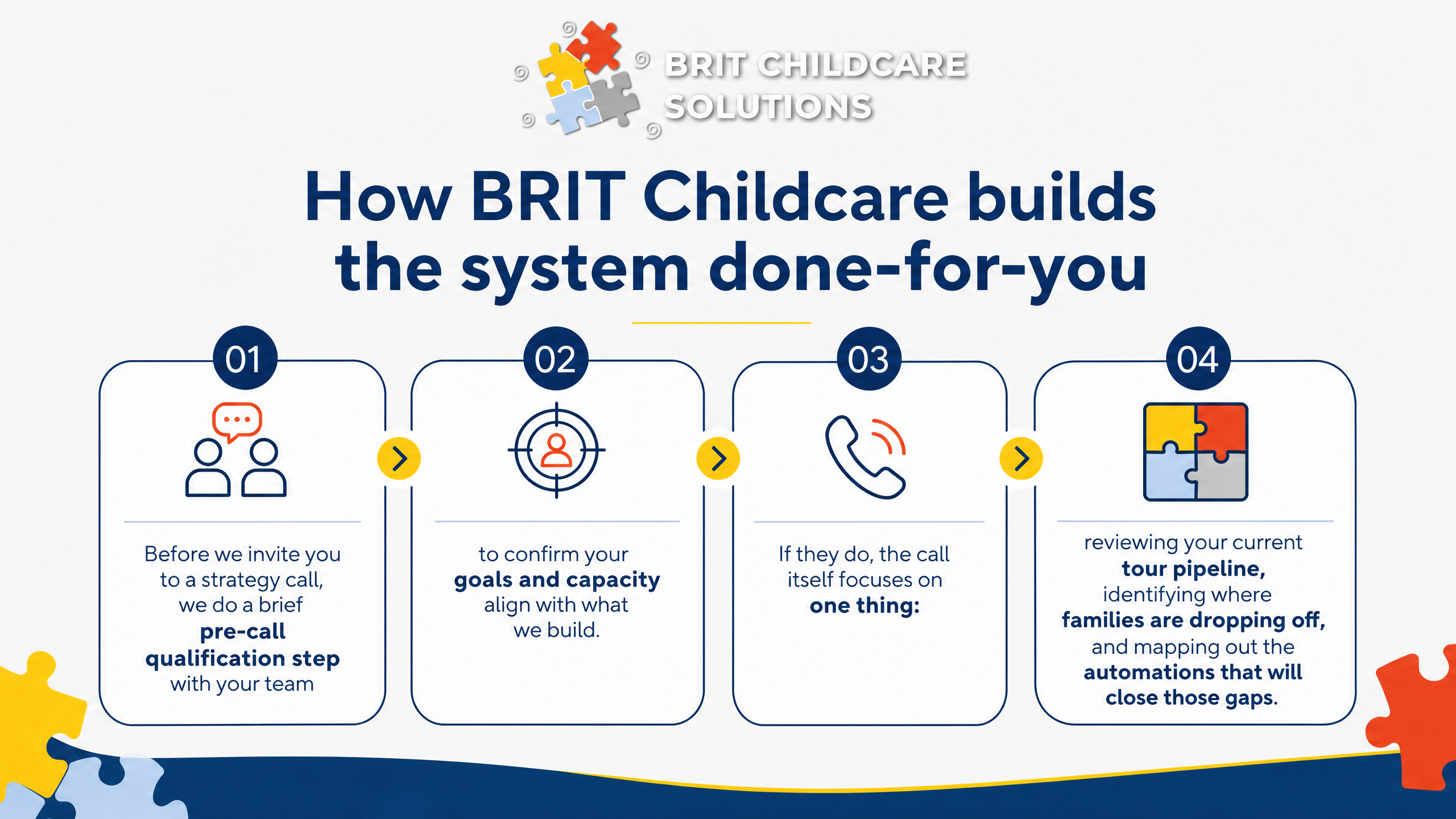
Before we invite you to a strategy call, we do a brief pre-call qualification step with your team to confirm your goals and capacity align with what we build. If they do, the call itself focuses on one thing: reviewing your current tour pipeline, identifying where families are dropping off, and mapping out the automations that will close those gaps.
What we implement end-to-end
We handle every technical layer so you are not managing vendors, platforms, or setup on your own.
On the advertising side, we run Google and Facebook tour ads targeted to parents actively searching for childcare in your area. These campaigns are built to drive tour bookings, not just clicks. On the organic side, we fix the SEO and landing page issues that cause parents to bounce before they ever submit an inquiry.
Then we connect both channels into your CRM, building out the enrollment automation sequences that handle speed-to-lead response, tour confirmation, reminders, and post-tour follow-up automatically.
Google and Facebook ads optimized for tour scheduling, not general awareness
SEO and landing page fixes to improve inquiry capture from organic traffic
CRM setup with automation sequences covering inquiry response through post-tour follow-up
Everything feeds into one funnel so you can track inquiry-to-tour and tour-to-enrollment rates in a single dashboard, by location.
What you handle on-site
Our system drives families to your door and keeps them engaged before and after the visit. What happens during the tour is yours to own.
That means having tour availability that matches when parents are actually looking, typically weekday mornings and early afternoons. It means your staff is briefed and consistent, using the same tour script each time so the experience does not vary by who happens to be available. And it means processing deposits quickly when a family is ready to commit.
A parent who decides on Tuesday and waits a week for paperwork will second-guess the decision.
Who this is a fit for
This is not the right fit for every childcare center, and we are direct about that before the strategy call.
We work with centers at 70 or more licensed capacity. Below that threshold, the volume of inquiries typically does not justify the infrastructure we build. Multi-location operators are a strong fit because our system unifies enrollment tracking and automation across all sites, giving directors visibility into which locations are converting and which are leaking.
Budget is also a qualifying factor. Done-for-you ads, SEO, CRM setup, and ongoing automation management require a premium investment. If you are looking for a low-cost tool to manage yourself, this is not that.
If you operate a center or group of centers at scale, are serious about reaching full capacity, and want a team that handles the marketing system entirely, book a strategy call with BRIT Childcare at britchildcare.com/work-with-us. We will review your pipeline and tell you exactly where the conversion gaps are.
Ready to Stop Chasing Families and Start Enrolling Them?
If your tours are booking but not converting, you do not have a lead problem. You have a follow-up system problem. The good news is that it is fixable, and the results show up in your numbers quickly when the right automations are in place.
At BRIT Childcare, we build the entire enrollment conversion system done-for-you, including speed-to-lead response, tour confirmation and reminder sequences, post-tour follow-up automation, and funnel tracking across your locations. You focus on running your center. We handle the system that moves families from first inquiry to enrolled child.
If you operate a center with 70 or more licensed capacity, or you run multiple locations, book a strategy call with our team. We will review your current tour pipeline, identify where families are dropping off, and show you exactly where enrollment automation can close the gap.
The next step is simple: book your call at britchildcare.com/work-with-us and ask us about our done-for-you ads, SEO, and Enrollment Engine setup. Let us build the system that turns your inquiries into tour-ready families.
