You don't need more leads, parents must tour
Most childcare centers getting inquiries right now do not have a lead problem. They have a show-up problem. Parents fill out your form, you confirm the tour, and then nothing. They ghost. The spot sits empty.
Here is what actually drives tour show rates and fills open seats:
Qualifying families before booking filters out browsers and puts only committed parents on your calendar.
A 72-24-2 hour SMS and email reminder cadence is the single most reliable way to get parents to the door.
Responding to a new inquiry within five minutes dramatically increases the chance that family books a tour at all.
Tracking five pipeline stages in a CRM reveals exactly where families are dropping off between inquiry and enrollment.
A structured no-show recovery sequence brings ghosted families back without pressure or losing the spot.
At BRIT Childcare, we work exclusively with childcare centers, preschools, and Montessori schools across 40+ states, and our clients consistently reach 10 to 40 scheduled tours per month once our enrollment system is live. We built our approach around one outcome: tour-ready families, not just higher inquiry volume.
Before covering the qualifying questions, reminder cadences, and CRM pipeline stages, it helps to understand why the instinct to generate more leads keeps stalling enrollment growth and what the data actually shows about where families disappear.
Why more leads are not fixing your no-show tours
Myth versus reality
More leads do not produce more enrollments if families are dropping off before they ever walk through your door. The real lever is tour show rate, not inquiry volume.
Think about where the conversion leak actually happens. A center receiving 60 monthly inquiries but booking only 20 tours and seeing 10 of those no-show is not a lead problem. It is losing more than half its revenue opportunity after the lead already arrived.
Every no-show tour hits occupancy directly. An empty spot that stays empty for two or three extra weeks because a family ghosted represents real tuition revenue you cannot recover.
Where the drop-off happens
Most centers lose families at four predictable points before the tour ever happens.
The first is response speed. Families inquire at multiple centers simultaneously, and the first center to respond meaningfully wins the tour. A 5-minute response window is the standard that separates centers that book tours from those that get ignored.
The remaining three gaps are just as costly:
Unqualified tour bookings: families who do not match your open age bands or schedule availability waste staff prep time and inflate no-show rates
No commitment before the calendar hold: a tour booked without a confirmation step feels optional to the parent, so canceling feels low-stakes
Weak or missing reminders: Imperial College London research found no-show rates drop 38 percent when text reminders are used, yet most centers rely on a single email
Each gap compounds the one before it, which is why adding more ad spend without fixing these steps produces more no-shows, not more enrollments.
Qualify fast so only tour-ready families get scheduled
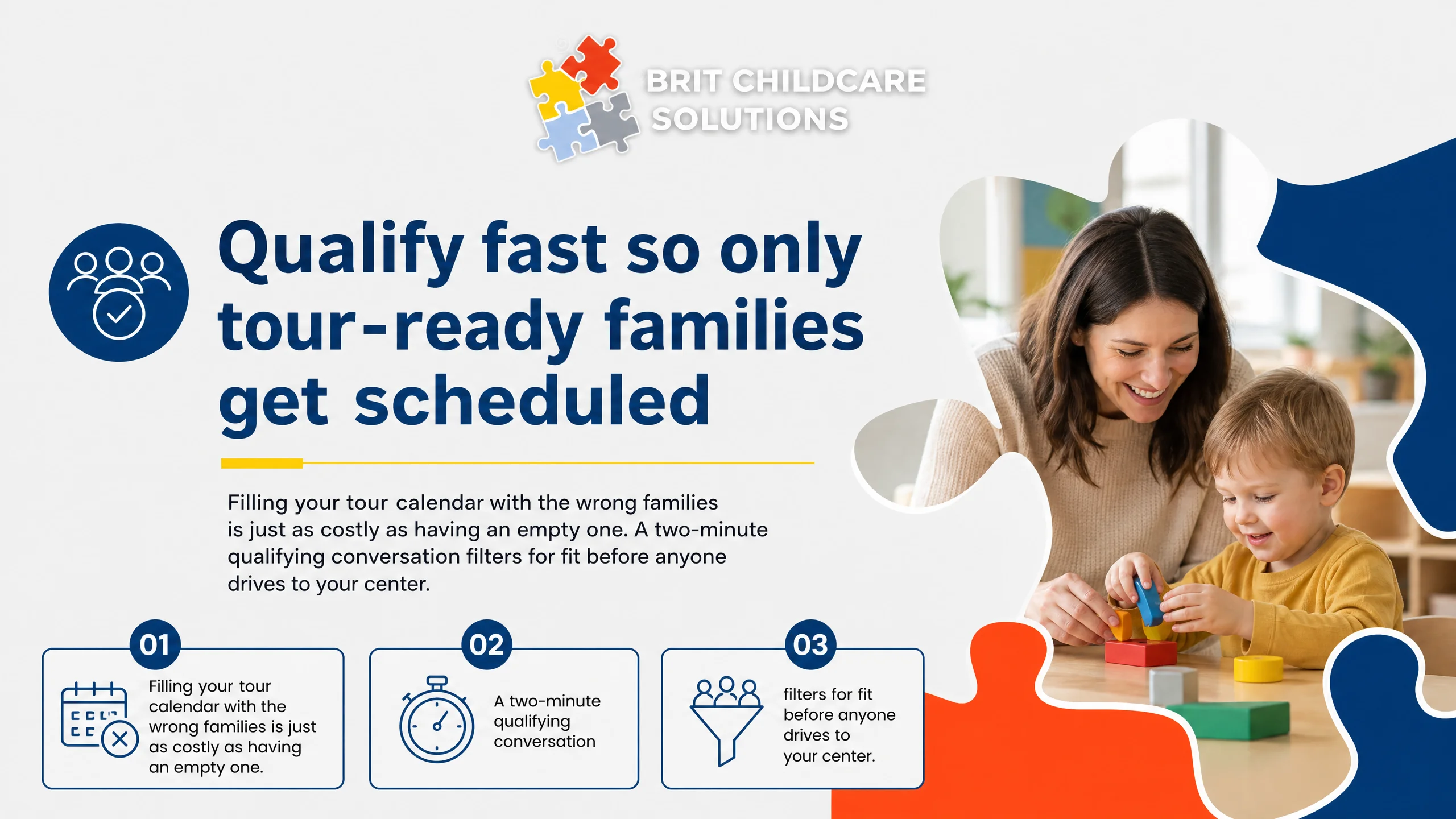
Filling your tour calendar with the wrong families is just as costly as having an empty one. A two-minute qualifying conversation filters for fit before anyone drives to your center.
The three qualifying questions
Four data points tell you almost everything you need to know about whether a family belongs on your tour calendar.
Ask these in your first response or intake call:
Start date: Are they enrolling within 30 days, or just browsing for six months from now? Urgency determines priority.
Schedule and days needed: Full-time, part-time, specific days? A family needing Tuesday and Thursday only cannot fill a Monday through Friday spot.
Child age and classroom fit: Confirm the age band matches an open or upcoming classroom before booking anything.
Budget range and subsidy status: Ask directly whether they are using childcare assistance or paying privately.
Misaligned budget expectations surface early or derail enrollment later.
Families who answer all four clearly are tour-ready. Everyone else needs a different path.
Capacity-first language that converts
Honesty about availability builds trust faster than vague enthusiasm. If a spot is not open today, say so directly and frame what is available instead.
Use language like: 'We have an opening coming up in the two-year-old room in about three weeks. I want to hold a tour now so you are first in line when it clears.' That framing creates urgency without pressure.
Only schedule the tour if the family's needs align with your actual capacity. If there is no realistic fit, offer a waitlist spot or refer them to your next available age band. A declined tour that saves 45 minutes of staff prep time is a win, not a loss.
Book tours with commitment built in
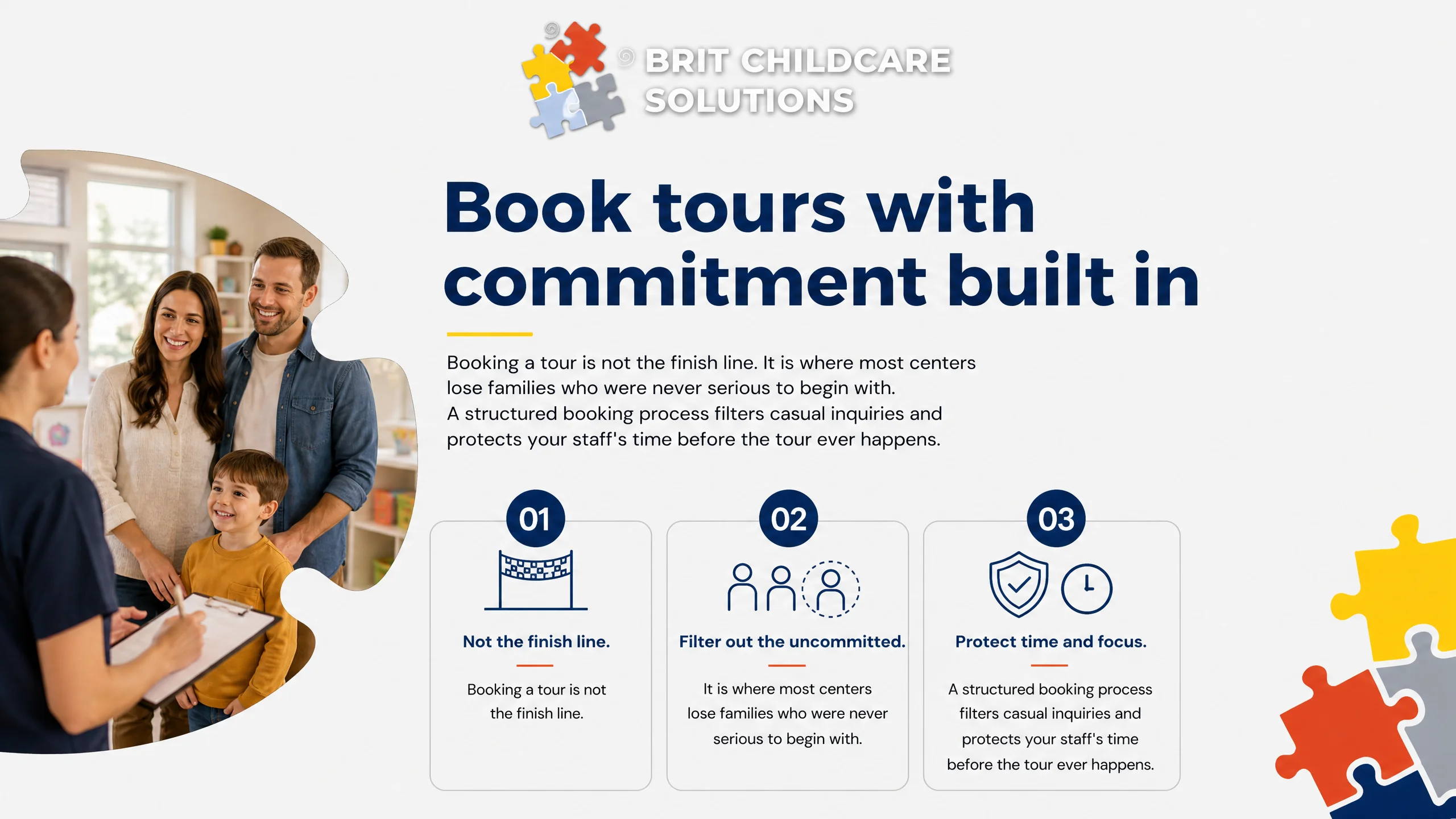
Booking a tour is not the finish line. It is where most centers lose families who were never serious to begin with. A structured booking process filters casual inquiries and protects your staff's time before the tour ever happens.
Your tour booking script
Set expectations at the moment of booking, not the day before. When a parent schedules a tour, your script should cover four things clearly.
What to bring: photo ID, any enrollment paperwork they have started, and a list of questions
Who must attend: both decision-makers, typically both parents or guardians, must be present
Arrival window: arrive within the first five minutes; tours starting more than ten minutes late will be rescheduled
Reschedule rules: cancellations require 24-hour notice; same-day cancellations without notice move the family to a waitlist for the next available slot
Reading these terms aloud or sending them in writing before the tour creates accountability. Families who agree to the terms show up. Families who balk at them were unlikely to enroll anyway.
Confirmation that prevents ghosting
Send a text confirmation the same day the tour is booked, not just the day before. Imperial College London research found no-show rates drop 38 percent when appointment reminders are sent by text, and childcare tours follow the same pattern.
That same-day message should include a calendar invite with your full address, parking instructions, and which entrance to use. Parents who cannot find your building cancel at the last minute.
Require a two-way reply. Ask the parent to confirm with a simple yes or their name. If you do not get a response within 24 hours, follow up once.
No reply after that is a signal to fill the slot.
Use an SMS and email reminder cadence that gets parents to the door
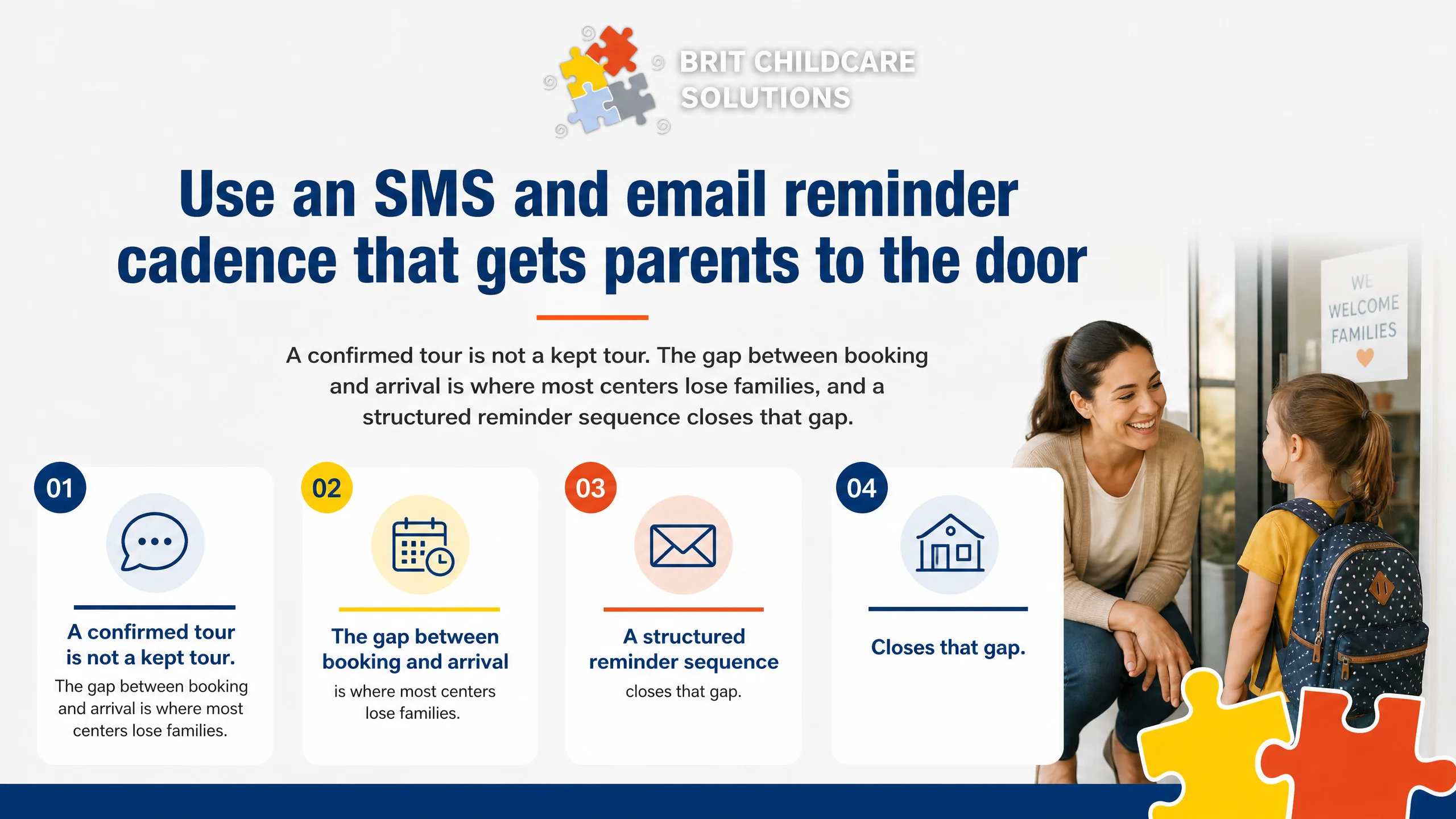
A confirmed tour is not a kept tour. The gap between booking and arrival is where most centers lose families, and a structured reminder sequence closes that gap.
The 72-24-2 hour cadence
Three touchpoints before every tour dramatically improve show rates. Imperial College London research found no-show rates were 38% lower among people who received text message reminders, and the pattern holds for childcare tours.
Each message has a specific job:
72 hours out: Send logistics details, including the address, parking, who to ask for, and how long the tour takes. This gives busy parents time to adjust their schedule.
24 hours out: Request a simple confirmation reply. 'Reply YES to confirm or NO to reschedule.' A response signals real intent.
2 hours out: Send a short on-the-way prompt. 'We are looking forward to seeing you at 2 PM. Reply if anything comes up.'
Every message should include a one-click reschedule link. Parents who cannot make it will rebook instead of disappearing if you make it easy.
Messages parents respond to
Short, plain messages outperform polished ones. A parent reading a text between drop-off and a work meeting needs one clear action, not a paragraph.
What works in childcare-specific reminders:
Two-way texting matters here. When a parent can reply directly to your reminder, they will. That reply is your signal to confirm, adjust, or recover the booking before the no-show happens.
Our Tour Booking Automation includes two-way SMS so no response falls through the cracks.
Use plain language: 'Your tour is tomorrow at 10 AM at Sunshine Academy' beats any formal greeting.
One call to action per message: confirm, reschedule, or reply with a question.
Include a reassurance line: 'The tour takes about 20 minutes and siblings are welcome.'
Track every family in a CRM pipeline from inquiry to enrollment
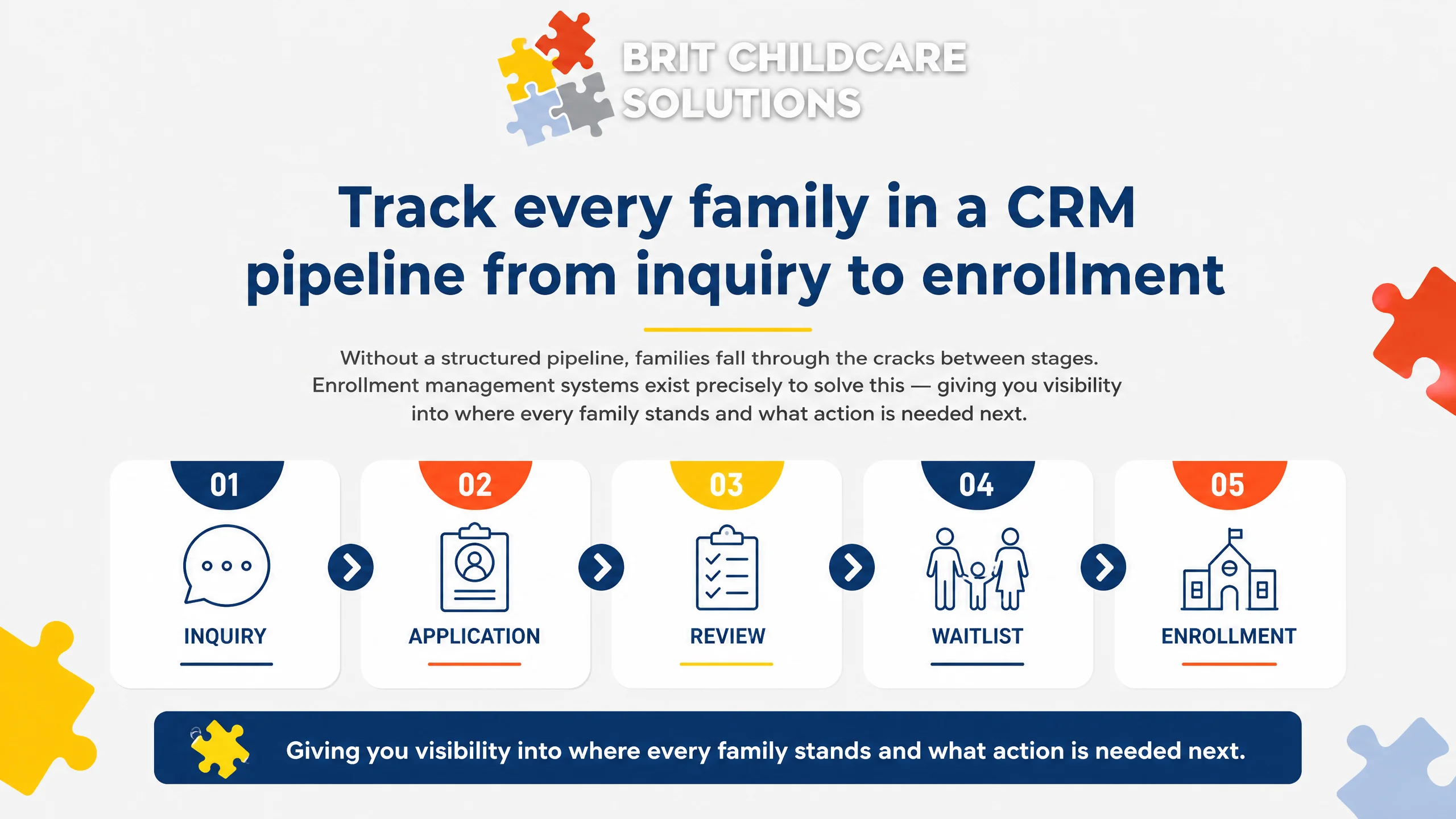
Without a structured pipeline, families fall through the cracks between stages. Enrollment management systems exist precisely to solve this - giving you visibility into where every family stands and what action is needed next.
The five pipeline stages
A simple five-stage pipeline turns a chaotic inbox into a manageable process with clear ownership at every step.
New Inquiry: Respond within five minutes. This is your response SLA. Every minute past that window lowers your chance of booking a tour.
Qualified to Tour: Confirm the family's schedule needs, desired start date, and age group.
Move them forward only when there is a real fit.
Tour Scheduled and Confirmed: Send an SMS confirmation immediately, then a reminder 72 hours out and again 24 hours before the visit.
Toured, Decision Pending: Follow up within 24 hours. Ask one clear question: what would make this the right fit for your family?
Enrolled, Deposit Received: Mark the spot filled and trigger a welcome sequence. This stage closes the loop and feeds your occupancy data.
Each stage should have one assigned owner and one next action. Ambiguity at any stage is where families quietly disappear.
Benchmarks to manage by
Our clients typically reach 10 to 40 scheduled tours per month once their enrollment system is fully running. If you are below that range, the pipeline stages above will show you exactly where families are stalling.
Review these numbers every week, not every quarter. A weekly conversion check takes 15 minutes and catches drop-off before it becomes an occupancy problem.
Track show rate by source. Families from referrals typically show at a higher rate than cold ad traffic. If your paid leads are ghosting at a higher rate, the fix is faster follow-up and stronger confirmation sequences, not more ad spend.
Time-to-first-response target: under five minutes for all new inquiries
Show rate target: 70 percent or higher across all sources combined
Weekly ritual: review inquiry-to-tour rate, tour-to-enrollment rate, and show rate per source every Monday
Recover no-shows without begging or losing the spot
The no-show recovery sequence
A no-show is not a lost family until you treat it like one. Most centers either chase too hard or give up too fast. A clean four-step sequence handles both problems.
15 minutes after the missed tour: Send a brief, warm text. 'Hi [Name], we had you scheduled for a tour today at [time]. Hoping everything is okay. We would love to still connect.' No guilt, no pressure.
Same day: Follow up with a rebook offer.
Give two specific time slots within the next 48 hours. Offering choices reduces friction and signals you are still holding space for them.
48 hours later: One final outreach. Keep it short and genuine.
If they do not respond, this is your last touch before closing the file.
Close-out and nurture tag: Mark the inquiry as closed in your CRM and move them to a long-term nurture sequence. A monthly check-in email costs nothing and occasionally re-activates families whose timing has shifted.
Three touches over 48 hours is enough to recover families with real intent without burning staff time on families who were never serious.
When to stop following up
Chasing the wrong families costs more than losing them. Knowing when to stop is as important as knowing how to follow up.
Stop after three unanswered touches. If a family has not responded to your 15-minute text, same-day rebook, and 48-hour final attempt, continued outreach will not convert them and may damage your center's reputation.
Also stop early when the signals point to a poor fit. A start date six months out, comments about pricing being above their budget, or a pattern of rescheduling two or more times all indicate the family is not ready or not aligned. Tag them appropriately in your CRM and move on.
You Have the Inquiries.
Let Us Help You Fill the Seats.
If you have worked through this playbook and recognized your center in every section, you already know the problem is not your ads or your lead volume. It is what happens after the inquiry lands. The qualifying questions, the booking process, the reminder cadence, the CRM pipeline, the no-show recovery sequence: each one is a system, and building all of them manually while running a center is where most owners stall.
At BRIT Childcare, we work exclusively with childcare centers, preschools, and Montessori schools, and done-for-you CRM setup and SMS and email automations are at the core of what we build for our clients. We handle the follow-up infrastructure so your team is not chasing parents who may never show up.
If your center is at 70 or more capacity, or you operate multiple locations, book a strategy call with us this week. Come ready to talk about your current tour show-up rate and where families are dropping off. We will build the plan around your stage, not a generic template.
Frequently Asked Questions
Do I need more leads or better conversion?
For most centers, the inquiry volume is already there. The gap is in converting those inquiries into booked tours and booked tours into families who actually walk through the door. Shift your focus from lead count to your inquiry-to-tour rate and your tour-to-enrollment rate, and you will see exactly where the real problem lives.
How quickly can I expect results?
Centers that implement a structured enrollment system, including fast response, automated reminders, and CRM tracking, often see meaningful enrollment gains within the first four weeks. Speed-to-response improvements alone can produce emergency fills in the first one to two weeks, with compounding results building over a 30 to 90 day window as the full system runs.
What should I measure instead of cost per click?
The metrics that actually tell you whether your marketing is working are tour show-up rate, inquiry-to-tour rate, tour-to-enrollment rate, and cost per enrolled seat. These numbers show you whether families are moving through your funnel or stalling, and they give you a clear target to improve each week.
